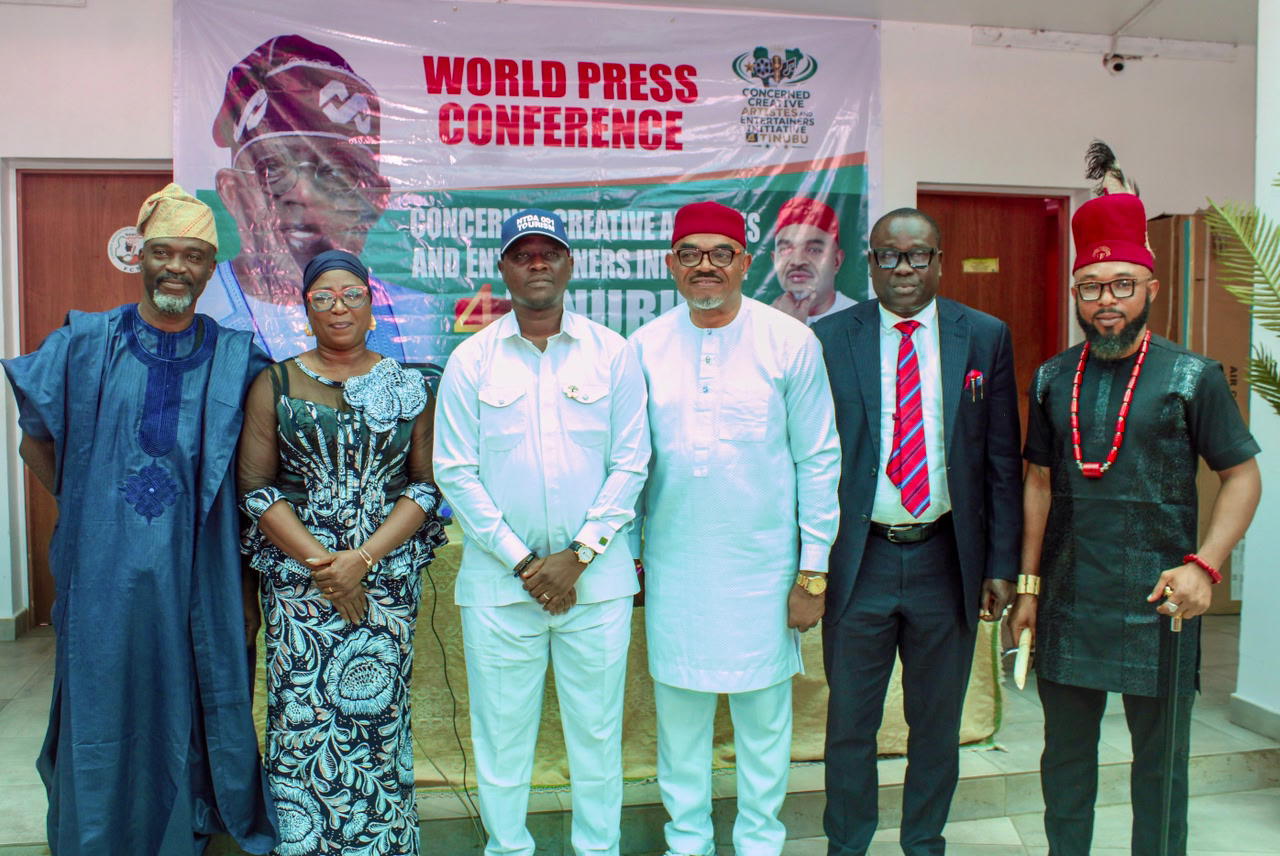
Stakeholders in Nigeria’s creative industry have called for sustained support for the reforms introduced by President Bola Tinubu’s administration, describing the interventions in the creative economy as unprecedented and critical to the sector’s long-term growth.
The call was made on Thursday in Abuja during a press conference organized by the Concerned Creatives, Artistes and Entertainers Initiative for Tinubu.
The stakeholders, drawn from various segments of the creative sector, expressed confidence that the Tinubu-led administration has demonstrated the capacity to transform the creative economy into a viable alternative to oil as Nigeria pursues economic diversification. They urged continued support to ensure the sustainability of ongoing reforms and enable the President to consolidate gains already recorded in the sector.
Speaking at the event, the National President and Convener of the initiative, Emeka Rollas, said the group’s position was based on a careful assessment of measures taken by the administration to make the creative industry a hub for job creation and a key driver of national economic development.
According to Rollas, the government has created an enabling environment for private-sector investment in entertainment, culture, tourism, media and other creative enterprises, while implementing strategic initiatives designed to strengthen the sector’s global influence and create opportunities for creative talents.
The former president of the Actors Guild of Nigeria (AGN) noted that the administration has demonstrated strong commitment to repositioning the creative economy, particularly through the establishment of the Federal Ministry of Arts, Culture, Tourism and Creative Economy, which he said has provided focused leadership and policy direction for the sector.
He also commended the appointment of respected industry practitioners to key positions within agencies under the ministry, including Ali Nuhu, Shaibu Husseini, Obi Asika and Olayiwola Awakan.
Rollas said President Tinubu’s support for the creative industry predates his presidency, recalling that as governor of Lagos State between 1999 and 2007, he laid the foundation for what has become Nigeria’s entertainment capital by fostering an environment that attracted investment in entertainment, culture, tourism and media.
“The transformation of Lagos into the entertainment and creative capital of Nigeria was not accidental. It was the product of visionary leadership that recognized the economic value of creativity long before it became fashionable to do so,” he said.
According to him, the administration has elevated that vision to the national level by positioning the creative economy as a major contributor to GDP growth, employment generation and foreign exchange earnings.
Rollas highlighted the establishment of the $100 million Creative Economy Development Fund, describing it as one of the most significant financial interventions targeted at Nigeria’s creative industry. He said the fund is expected to improve access to financing for filmmakers, musicians, fashion entrepreneurs, designers, digital innovators and other creative professionals.
He also cited the implementation of the $617.7 million Investment in Digital and Creative Enterprises (iDICE) Programme, aimed at empowering young Nigerians in the digital and creative economy.
“These initiatives, reforms and achievements require sustainability and continuity to ensure Nigerians derive their full benefits,” he said.
Emphasizing the sector’s role in national development, Rollas noted that Nigerian artists, filmmakers, musicians, writers, comedians, fashion designers and digital content creators have projected the country positively on the global stage despite operating with limited institutional support and inadequate infrastructure.
He, however, lamented that the industry’s achievements have largely been driven by resilience and innovation in the face of persistent challenges, including piracy, weak distribution networks, inadequate financing and limited policy support.
Despite these obstacles, he said Nigerian creatives have continued to generate employment, attract international audiences and contribute significantly to the nation’s cultural identity.
Rollas called for stronger collaboration between governments at all levels and stakeholders in the creative sector to fully harness the opportunities available within the industry.
“As practitioners, stakeholders and beneficiaries of the creative economy, we must continue to engage constructively with government, support initiatives that advance our industry and work together to build a stronger and more prosperous future for Nigerian creatives,” he said.
He added that Nigeria has the potential to become one of the world’s most influential creative economies through sustained collaboration, deeper investment, stronger institutions and expanded opportunities for creative talents.
On the country’s security challenges, Rollas acknowledged the difficulties facing Nigeria, while urging support for efforts aimed at addressing them.
“While we acknowledge that our nation is currently facing significant security and economic challenges, we also recognize that no administration inherits a perfect society. Every government is judged not only by the challenges it faces but by the courage it demonstrates in confronting them,” he said.
He expressed sympathy to families affected by insecurity and called for a minute of silence in honour of a teacher recently killed in Oyo State and other Nigerians who have lost their lives to violent attacks across the country.
Disclaimer
Comments expressed here do not reflect the opinions of Vanguard newspapers or any employee thereof.