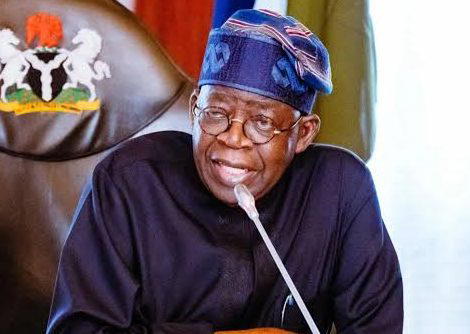
File: President Tinubu
By Victor Ahiuma-Young, Johnbosco Agbakwuru & Omeiza Ajayi
President Bola Tinubu yesterday declared in security and poverty national emergencies, which constitute grave threats to jobs, productivity and national stability. President Tinubu made the declaration on the occasion of the 2026 Workers’ Day celebration where Nigeria’s organised labour warned that the country was drifting towards a dangerous tipping point and collapse of a social contract, a failing economy, and a worsening security crisis that could force workers off their jobs nationwide.
Governors across the states of the federation, in their separate addresses urged workers to remain committed and uphold integrity as well as sustain constructive engagement.
Anambra
Governor Chukwuma Soludo of Anambra state in his speech tasked the organized labour to make a fundamental shift from traditional “protest unionism” to a model focused on national development and wealth creation. Addressing workers during the 2026 workers’ day celebration at Alex Ekwueme Square, Awka, he also called for a more collaborative relationship between the state government and its workforce.
Edo
Edo state governor, Sen. Monday Okpebholo promised to sustain the friendly relationship he has been having with workers in the state even as he expressed appreciation to labour leaders for their support and constructive engagement with his administration, describing the relationship as a model of productive partnership rooted in mutual respect.
Oyo
On his part, Governor Seyi Makinde of Oyo state, said that May Day was not just a celebration, but “a statement that the dignity of labour must be protected, that workers must be respected, and that the government must be held accountable”. While defending his administration’s record on workers’ welfare and security, Governor Makinde said insecurity and poverty had combined to create a hostile environment for workers, drained productivity and destroyed morale.
Delta
In Delta state, Governor Sheriff Oborevwori described workers in the state as the driving force behind government’s progress, urging them “to remain dedicated, uphold excellence in their duties, and continue to work in unity toward the collective progress of Delta State and together, we will build a stronger, more prosperous future for our state”.
Niger
In Niger state, Governor Muhammed Umaru Bago said the welfare of the workers was paramount to the state government and promised not to relent in doing more. Bago then called on all the workers and the residents to join hands with his administration in a bid to provide more dividends of democracy to the people.
Ekiti
Governor Biodun Oyebanji of Ekiti state also reaffirmed his administration’s commitment to workers’ welfare, highlighting sweeping reforms, improved remuneration and sustained industrial harmony. Oyebanji said his administration would continue to invest in workers through infrastructural development, security of the workplace, regular capacity development, merit-based promotions and appointments across the public service.
Enugu
In a similar tone, Governor Peter Mbah of Enugu state assured that “the state government remains committed to workers’ welfare and ongoing reforms”. He noted that the administration had made progress in pension payments, wage implementation, infrastructure development, and security, adding that the government would continue constructive engagement with labour unions.
Benue
Benue State Governor, Rev. Fr. Hyacinth Alia, also reiterated his administration’s commitment to workers’ welfare, economic growth, and infrastructural development. He commended workers in education, healthcare, agriculture, and the civil service for their roles in sustaining development, noting that “each of you plays a critical role in building the Benue of our dreams.”
He commended workers in education, healthcare, agriculture, and the civil service for their roles in sustaining development, noting that “each of you plays a critical role in building the Benue of our dreams.”
We’re confronting both challenges with urgency and deliberate policy action—Tinubu
Meanwhile, President Tinubu, who spoke through Secretary to the Government of the Federation SGF, Senator George Akume, during the national May Day celebrations at Eagle Square in Abuja, told workers, labour leaders and guests that his administration was confronting both challenges with urgency and deliberate policy action.
“There cannot be decent work where workers fear for their lives, where wages cannot feed a family, or where insecurity disrupts farms, factories, markets and other economic activities. These hydra-headed challenges, the government notes, have been treated as a national emergency due to their impact on productivity, livelihoods, and the confidence of both workers and employers,” Tinubu said.
Aligning his message with the global May Day theme on the Decent Work Agenda championed by the International Labour Organization ILO, the president acknowledged that insecurity and poverty remain “significant obstacles” to building a peaceful Nigeria where citizens can “sleep with their eyes closed.”
On security, Tinubu pointed to the launch of the Community Protection Guards Initiative, which he said has recruited 45,000 young Nigerians to secure communities while simultaneously creating jobs.
He commended security forces for their role in protecting economic activities and paid tribute to personnel who had paid the ultimate price in the line of duty.
Reaffirming his administration’s commitment, the President said Nigeria remained on course to defeat insecurity and reduce poverty, promising a future where “decent work is not a privilege for a few, but a reality for all.”
Labour dismisses growth claims
Earlier, Organised Labour had declared that the country was drifting toward a dangerous tipping point, warning of a collapsing social contract, a failing economy, and a worsening security crisis that could force workers off their jobs nationwide.
NLC and TUC Presidents, Joe Ajaero and Festus Osifo, made their feelings known in a joint speech that combined stark economic analysis, political warnings, and an unmistakable threat of mass action if conditions do not improve.
They described Nigeria as a nation where “poverty tightens its grip daily,” institutions are weakening, and citizens are increasingly left to fend for themselves in the face of violence and economic hardship.
Workers create wealth, live in poverty
Setting the tone early, labour leaders reminded the nation of the central role workers play in sustaining the economy, contrasting it sharply with their current condition.
They said: “Workers remain at the very heart of every industry, every economy, and every success story known to humanity. Without workers, no wheel can turn; without workers, no nation can be built.”
Yet, they lamented, those same workers “create immense wealth yet receive only a fraction of it,” enduring exploitation while “poverty tightens its grip around them.”
They described Nigerian workers as people who “rise before dawn and return home at dusk, exhausted yet unbroken,” but increasingly unable to meet basic needs despite their efforts.
Growth without relief, reform without impact
Labour took direct aim at the government’s economic narrative, arguing that macroeconomic indicators have become disconnected from reality.
According to them; “We are told that GDP growth may reach about 3.6%… yet poverty continues to rise. We hear official inflation figures… but these numbers do not reflect the reality experienced daily by workers.”
NLC and TUC argued that Nigeria’s economic model has produced a distorted outcome, saying “Paper growth without jobs, stability without prosperity, and reform without relief.”
They insisted that the benefits of economic policies are being captured by a narrow elite, noting that “An economy that serves only the top 1% while leaving the 99% behind cannot be sustainable. Perhaps, it is working for the ultra-few 1% and not the 99% majority.”
Nation sliding deeper into poverty
Labour painted a bleak picture of living conditions across the country, citing data that shows poverty now affects about 65% of Nigerians — roughly 150 million people.
“Approximately 10,000 people are pushed into poverty every day,” they said, warning that deprivation has reached “alarming levels.”
They described overcrowded cities strained by rural displacement, rising food insecurity, and the re-emergence of diseases linked to extreme poverty in internally displaced persons camps.
“In these camps and communities, diseases such as Kwashiorkor, Craw-craw, and Marasmus are re-emerging,” they noted, calling it “a grim picture of a nation under severe strain.”
Minimum Wage: Labour draws the line
Against this backdrop, labour announced that negotiations for a new national minimum wage will begin in July 2026.
“We will commence the process early to avoid the painful delays of the past,” they said.
But beyond future negotiations, the unions demanded immediate intervention:
“We demand that from July of this year, every worker be paid 100% of his basic salary… to cushion the effects of the renewed crisis of survival. We demand a living wage, not a minimum wage.”
Nigeria is s at War
On insecurity, labour delivered perhaps its most alarming assessment, declaring that Nigeria is effectively in a state of war.
“The scale of violence, the frequency of attacks, and the mounting loss of lives… place Nigeria among the most dangerous places to live on earth,” they said.
Rejecting the characterization of attacks as isolated incidents, they insisted: “It is not. It is a war against our people.”
They cited killings, bombings, and abductions across multiple states, noting that thousands have died and millions displaced.
“People are no longer safe in their homes, on the roads, or even in their workplaces. Daily life has become a gamble with fate”, they lamented.
Workers may stay home
In a major escalation, labour warned that it may take the unprecedented step of directing workers to stay home if insecurity persists.
They said “Nigerian workers may no longer continue going to work with this level of insecurity. We may be forced to advise our members… to stay at home to avoid being kidnapped, abducted or killed.”
They stressed that such a decision would not be taken lightly but could become unavoidable if the situation does not improve.
“The safety of workers is non-negotiable,” they added.
Energy sector under fire
Labour also delivered a scathing critique of Nigeria’s power and oil sectors, describing them as symbols of policy failure and elite capture.
“Over a decade after privatisation, Nigerians have little to show but deepening darkness,” NLC and TUC said of the electricity sector.
They pointed out that despite over N10 trillion in public spending, power supply remains unreliable.
“What was promised as reform has become a burden,” they said, adding that consumers now pay more for less.
On fuel, they highlighted the paradox of an oil-rich nation unable to protect its citizens from price shocks.
“The contradiction is stark and disheartening,” they said.
Governance under scrutiny
Labour raised serious concerns about governance, accusing political leaders of being disconnected from the realities of ordinary Nigerians.
“When leaders seek better education abroad for their children while neglecting domestic schools… it raises fundamental questions about commitment,” they said.
They warned that governance risks becoming “an extractive enterprise” serving narrow interests rather than the public good.
Labour also criticized weakening democratic institutions, warning that the erosion of checks and balances threatens national stability.
A system that bleeds nation
The unions described corruption and illicit financial flows as one of the greatest threats to Nigeria’s future.
“This is not mere corruption; it is a system… one that bleeds the nation continuously,” they said.
They cited trillions lost to subsidy fraud and billions to illicit flows, arguing that such losses directly translate into poor services and low wages.
To confront this, they launched a nationwide campaign: “Stop the Bleeding. Every stolen Naira is a stolen future.”
2027 elections: Labour draws battle lines
Looking ahead, labour signaled a more assertive political role as the 2027 general elections approach.
“2027 will be different. No more will we be voting fodder”, they warned.
NLC and TUC vowed to support only candidates committed to workers’ welfare and national development.
“Those who have undermined workers’ rights cannot expect our support,” they said.
Engines do not beg
Despite the dire warnings, labour ended on a note of defiance and resolve, urging workers to recognize their collective power.
They said : “You are not victims. You are the engine of this nation. And engines do not beg; they move.”
They called for unity, organisation, and sustained action: “The change we seek will not come from elsewhere; it must come from us.”
Among others, NLC and TUC added: “Let this May Day mark the turning point; where Nigerian workers stopped asking and started demanding… Our nation can be saved! But only by us! Only together! Only now!”
Disclaimer
Comments expressed here do not reflect the opinions of Vanguard newspapers or any employee thereof.