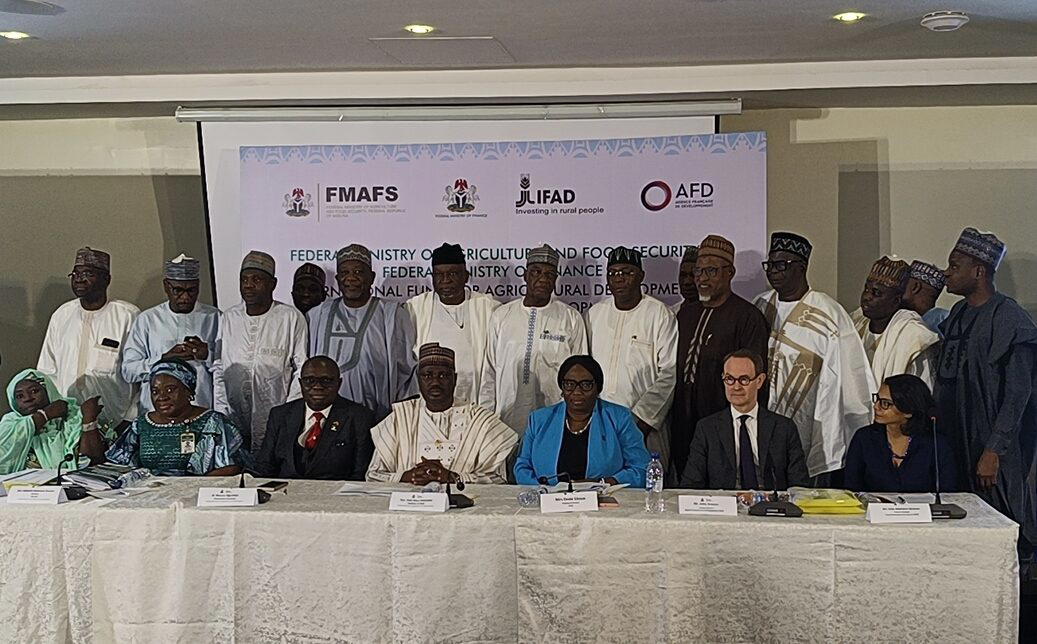
…hold 2-day high-level stakeholders’ engagement workshop
By Gabriel Ewepu
ABUJA – IN a bid to change the narrative in the food systems in northern Nigeria, the Federal Government of Nigeria, International Fund for Agricultural Development, IFAD, French Development Agency, AFD, and nine northern State Governments have synergized to drive the Value Chain Programme in Northern Nigeria to raise youth and women agripreneurs.
The move is on the heels of a two-day ‘High-level Stakeholders’ Engagement Workshop’ held in Abuja, and the participants include; Permanent Secretary Federal Ministry of Agriculture and Food Security Directors of the Ministry; Country Director, International Fund for Agricultural Development; Country Director French Development Agency (AFD); Honourable Commissioners of Agriculture and Finance, from the nine VCN States; and other stakeholders.
Basically, the VCN has been for over two years – consultations, design, negotiations, and approvals since October 2023 in Abuja and in the states, and after government, IFAD, and AFD authorities reviewed and approved every detail, and the participating nine northern states include; Bauchi, Borno, Jigawa, Kano, Katsina, Kebbi, Sokoto, Yobe, and Zamfara.
The Programme according to the Minister of State for Agriculture and Food Security, Dr Aliyu Abdullahi, while delivering his remarks and declaring the workshop open, “is not just another intervention , it is a clear demonstration of the strong political will of the Government of Nigeria to decisively address poverty unemployment, food insecurity, and vulnerability across Northern Nigeria by building strong, inclusive, climate-resilient, and nutrition-sensitive agricultural value chains.”
Abdullahi further stated that, “Under the leadership of His Excellency, President Bola Ahmed Tinubu, GCFR, The Federal Government is fully committed to lifting millions of Nigerians out of poverty, strengthening food security, creating jobs, and building resilient rural economies. Agriculture remains central to achieving these national priorities.
“With the coming of the VCN, we are determined to move beyond primary production to building efficient, competitive, and resilient value chains-where farmers are linked to markets, where value is added locally, where post-harvest losses are minimized, and where rural economies are energized.
“This Programme recognizes that Northern Nigeria holds enormous agricultural potential. However, potential alone is not enough. What is required and what this Programme seeks to provide, is coordination, investment., infrastructure, institutional strengthening, and above all, accountability in implementation.”
Meanwhile, the Minister of State, explained that the selection of priority value chains across the participating States is a deliberate strategy, adding that, “Each State will focus on commodities where it has comparative and competitive advantage, ensuring that interventions are not generic, but targeted, impactful, and economically viable.”
He also appealed to State Governments and development partners to collaborate and ensure “commitment to timelines, adherence to agreed processes, and a shared sense of responsibility” for the success of the Programme.
In her remarks,the Country Director, UN-IFAD, Dede Ekoue, urged participants to make the Programme a topmost priority with patriotism for a successful implementation of the Programme to better the lives of the rural populace, especially youth, women and the vulnerable ones.
“We are at a promising juncture to complete our joint work, to help it translate into concrete support to rural populations and youth and women agripreneurs, for the growth and resilience of agrifood systems in North Nigeria and to enhance food and economic interdependent dynamics in the country.
“We are to use uncommon ways to harness opportunities in this uncommon time. We are not here to do things as we usually do, but to go differently within legal boundries to achieve our agreed prerequisites for start-up and 1st disbursement for the Value Chain Programme in Northern Nigeria (VCN).
“This moment calls for innovation and dedicated focus on approvals, where we replace “business as usual” with creative, out-of-the-box within legal bounds solutions that clear bottlenecks. Through collective problem-solving and solidarity across Federal and State teams, we will achieve our agreed prerequisites for a rapid launch of VCN implementation in support of farmers and rural entrepreneurs.
“That is why this moment is unique. We are no longer designing. We are no longer negotiating. We are now, together, unlocking.”
She also stressed that a value chain teaches us one truth: no node works in isolation.
“For VCN to function – for seeds to reach farms, for water to reach fields, for produce to reach markets – we need each node of our institutional value chain to work well, and to work in complementarity and synergy.
“The Federal Government of Nigeria cannot succeed without the States. The States cannot deliver without the counterpart support from Finance. Agriculture cannot implement without the administrative clearances from Justice and Service. And IFAD cannot disburse without the foundations you, together, put in place. This is why our Joint Roadmap is not a list of demands. It is an invitation to solidarity and joint purpose. Because the truth remains: we win together, or we fail together. Our collective purpose calls for collective solutions”, she stated.
In his remarks, Nigeria Country, Agence Française de Developpement (French Development Agency), Jacky Amprou, said, “This project comes at a time when the need is both urgent and clear. Across nine northern states, rural communities face persistent poverty, food and nutrition insecurity, climate pressures, rapid increasing demography and resource-based conflicts. These challenges are not isolated-they are interconnected, and they demand coordinated and systemic responses.
“Our shared goal through VCN project is to improve food and nutrition security and increase incomes for rural households and building resilience over the next eight years- particularly for women,/youth,/persons with disabilities, and displaced populations.
“The VCN program will support climate-resilient and nutrition-sensitive agriculture, strengthen strategic value chains, and promote the use of innovation and digital solutions to enhance productivity, diversify diets, and reduce pressure on natural resources- thereby contributing to greater social stability.”
Earlier, in an address of welcome, the Permanent Secretary, Federal Ministry of Agriculture and Food Security, Dr Marcus Ogunbiyi, explained that the workshop marks a very important milestone toward effective take-off of the Value Chain Programme in Northern Nigeria.
According to Ogunbiyi, it is an eight-year programme spanning 2026 to 2034, implemented by the Federal Government of Nigeria in partnership with IFAD and AFD, and declared effective on 12th March 2026.
“The VCN is designed to build on the gains of previous interventions such as the Climate Change Adaptation and Agribusiness Support Programme (CASP), while introducing stronger systems for inclusive, climate-resilient, and nutrition-sensitive agricultural development across Northern Nigeria”, he said.
Disclaimer
Comments expressed here do not reflect the opinions of Vanguard newspapers or any employee thereof.