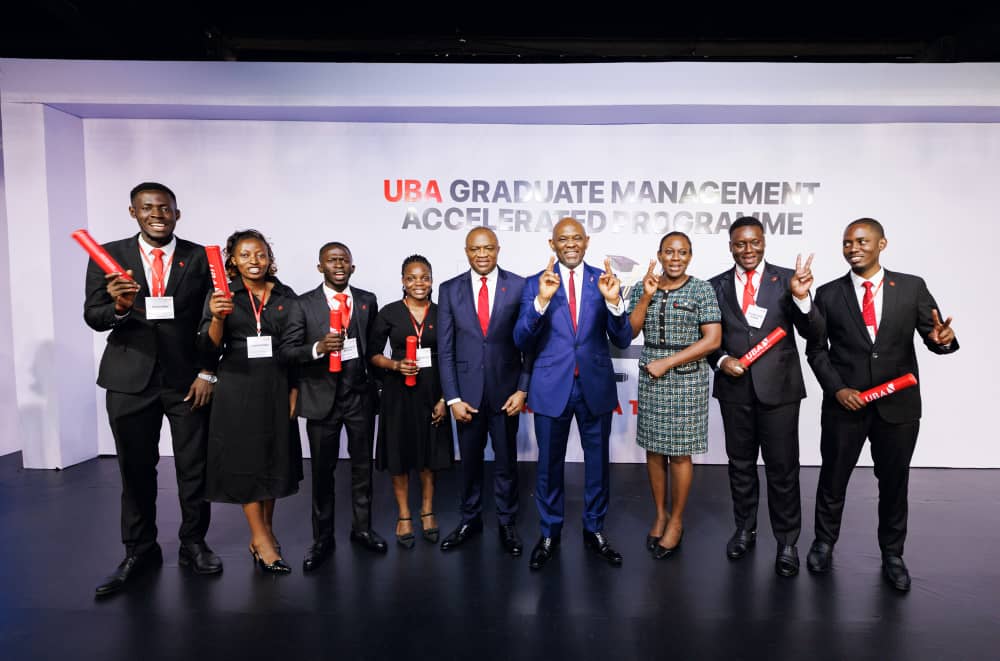
Group Chairman, United Bank for Africa, Tony Elumelu (6th left); Group Managing Director, UBA, Oliver Alawuba, (5th Left) and Group Head, Human Resources, Modupe Akindele, flanked by some of the graduands of the 2026 Graduate Management Accelerated Programme(GMAP) class of UBA Academy, during the graduation ceremony held for over 700 trainees cut across Africa, in Lagos on Thursday.
By Evelyn Usman
In a continent where youth unemployment continues to dominate policy discussions and quietly shape the anxieties of families, United Bank for Africa has intensified efforts to address the challenge with the employment of 720 young Africans under its Graduate Management Acceleration Programme (GMAP), a flagship initiative designed to build a steady pipeline of future leaders.
The induction ceremony, held in Lagos on April 7, 2026, formally integrated the young professionals into the bank’s workforce. The programme has since evolved into a continental talent development platform, producing over 5,000 young professionals across Africa and reinforcing the bank’s commitment to youth empowerment and capacity building
For many observers, the ceremony was less about graduation and more about transition, from uncertainty to employment, from aspiration to structured responsibility, and from Africa’s vast labour pool to a defined corporate future.
Elumelu’s charge
At the heart of the engagement was UBA Chairman, Tony Elumelu, who, in a candid, unscripted session with the graduates, framed employment not as entitlement but as discipline-driven opportunity anchored on sacrifice and performance.
He said, “Discipline, is 100 per cent. You can acquire talent. You can develop it. But discipline is fundamental. It shapes everything,” he said.
Noting that leadership is ultimately measured by output and responsibility, Elumelu added:
“Selecting the right people, training them, developing them, nurturing them, and getting them to align with the vision is not easy. But it is critical for sustained success. What we must do is institutionalise our approach, to build an organisation that can deliver and create systems that endure, so that perpetuity is achieved.”
On customer experience and performance culture within the institution, he was blunt. He said:
“My favourite is when we surpass expectations; my least favourite is when customers complain. That tells you there is work to be done.”
But beyond corporate discipline, Elumelu placed the graduates within a larger African reality,one of possibility, pressure, and responsibility. He said : “I am so happy to see smiling faces, young faces, the future of Africa. When I look at you, I see possibilities. I see what Africa can become.
“We will soon pass on the baton. This is your time. You must develop yourselves. You must take responsibility.”
Then came a more personal reflection, one that neatly wove together employment, sacrifice and economic mobility. To drive home the his message, he recalled :“There was a time I bought second-hand shirts. I washed them, starched them, and wore them. I denied myself for a better tomorrow. Early consumption does not lead to sustained success. In life, you must learn to deny yourself certain things, sacrifice is critical; it is what prepares you for the future.” From that personal history, he shifted seamlessly into a broader charge for the graduates, urging them to see their new opportunity as a platform for impact: “Your future is in your hands, and so is Africa’s. Whatever each of us can do to give people hope, to economically empower others one at a time, we must do it.”
He reinforced the values required to sustain success, insisting that “we must serve enlightened interests. There is value in being dedicated, loyal and committed; excellence is always recognised and rewarded in due course.
You must be disciplined, hardworking, resilient and unrelenting in all you do. There is immense opportunity here to fulfil your aspirations. This is your time,take it.
Deepening inclusion
If Elumelu provided the ideological backbone of UBA’s employment pipeline, the Group Managing Director and Chief Executive Officer, Oliver Alawuba, supplied the scale and architecture that gave it form, anchoring the programme in a deliberate push for inclusivity and gender balance.
Alawuba said the 720 graduates inducted into the bank’s workforce represent a widening continental strategy designed to close Africa’s employability gap, with strong female representation at its core. “Out of the 720, we have about 434 females,” he noted, highlighting what he described as a “very special class” in terms of scale, diversity and gender representation. That figure translates to about 60.3 per cent women in the cohort.
He added that the Graduate Management Acceleration Programme (GMAP) had evolved into a long-term leadership and talent pipeline within the bank’s ecosystem, explaining that when combined with 3,926 graduates from previous cohorts and those currently in training, “we are building a pool of over 5,000 young Africans positioned to drive the future of UBA.”
For Alawuba, however, the programme goes beyond recruitment numbers to structured integration into a performance-driven institution. He said : “These are young Africans who have gone through school, passed through interviews and undergone about six months of intensive training. Today, they are being rewarded for their hard work,” he said.
In his view, the induction marked more than a hiring milestone but “ a clear statement that the future belongs to these young Africans. What we have done is to create an environment for them to flourish.”
Selection process
At the operational level, the Head of Human Resources, Modukwe Akindele, gave a rare glimpse into the scale of demand and the competitiveness of access to opportunity.
She revealed that about 14 million applications were received. Giving insight on how the 720 were selected, she said:
“We shortlist and engage assessment partners. The selection process is deliberately rigorous, designed to filter not just intelligence but workplace readiness.”
“Candidates go through reasoning tests, workplace simulations, and executive interviews. We are testing not just intelligence, but how they behave in real-life work environments.”
Those who eventually made the cut entered a structured training pipeline. They had a six-week academic session, followed by on-the-job training across business areas. Final performance is based on both components, she added.
Akindele further noted that the programme was split into two entry streams, ensuring both fresh graduates and experienced contract staff were integrated appropriately.
According to her, “About 300 of the graduates came through our partner-based programme and join at a supervisory level, while fresh graduates start at entry level. Each pathway has a tailored assessment process.”
Beyond recruitment, she emphasised that GMAP was fundamentally about employment sustainability and leadership succession, adding that:
“This is just the beginning of their journey. In about three years, some of them will emerge as branch managers and heads of departments. They are the future leaders expected to succeed executive management.”
“We believe in the youth and in their potential. They do not need to leave Africa to succeed. We are deliberately nurturing the future leadership of organisations and the economy.”
Deserving honour
The ceremony also recognised the top performers of Cohorts 19 and 20. Anthony Akala emerged as the overall best graduating trainee for Cohort 20, while Ismail Latif clinched the same distinction for Cohort 19. Both were honoured for outstanding performance across multiple components of the programme.
Other awardees included Kavayat Oreloka-Oreloka and Faybo Eder, who emerged best in Sales for Cohorts 19 and 20 respectively. Latif also excelled in Treasury and on-the-job performance for Cohort 19, while Ekene Nna was named best on-the-job performer for Cohort 20. Gift Oko and Nurudin Musa clinched third place overall for Cohorts 19 and 20 respectively, while Gift Michael and Favor Edgar secured second place in their cohorts.
Delivering the valedictory address on behalf of his cohort, Akala described the GMAP journey as transformative. He said:
“Through the structure, discipline, and intensity of the programme, we have been transformed. Today, we are more confident, more capable, and better prepared to contribute meaningfully to the future of UBA.”
He highlighted the breadth of exposure gained through the programme, including finance, credit analysis, treasury operations, trade finance, digital banking, compliance, and customer experience.
He said:
“Beyond technical knowledge, GMAP has taught us that excellence is a habit, discipline is the foundation of success, and grit sustains growth.”
“As we step into the next phase of our careers, we must remain guided by purpose, integrity, and discipline, while upholding UBA’s core values of enterprise, excellence, and execution,” he said.
Akala also urged graduates to adapt to a rapidly evolving banking landscape, especially the shift towards digitalisation, stressing the importance of continuous learning and innovation.
One of the representatives from Uganda, Muuindo Ali Sultan, praised the inclusivity of the GMAP programme and the opportunity it provides to build careers within UBA without leaving the continent.
Disclaimer
Comments expressed here do not reflect the opinions of Vanguard newspapers or any employee thereof.