By Onyeka Ezike
In a bid to reposition Nigeria’s economy through environmental sustainability, transforming waste materials into meaningful creative products, FREEE Recycle Limited, a company that produces reusable, eco-friendly rubber products from recycled end-of-life tyres, has commemorated its fifth anniversary with an art exhibition themed “From Waste to Heritage.” The event was held at Access Bank headquarters in Victoria Island, Lagos.
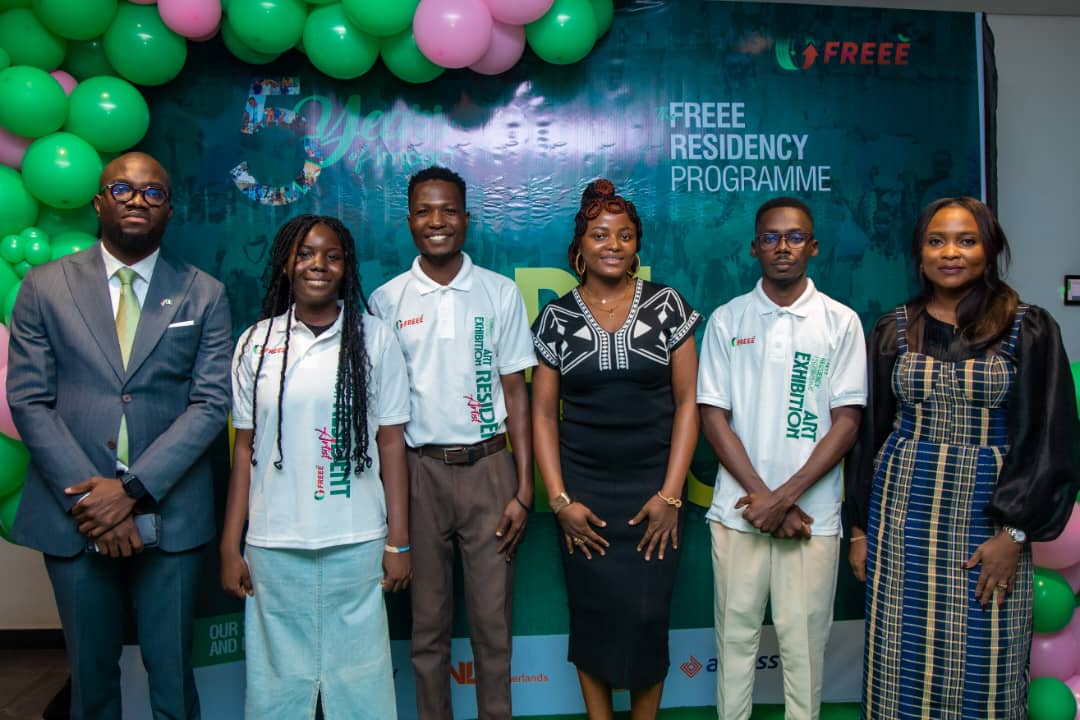
The exhibition unveiled inspiring works created by Artists from the FREEE Art Residency Programme. The residency program gave undergraduates from several Nigerian universities the opportunity to reimagine waste materials and create cultural value from discarded objects, a key step in FREEE Recycle’s mission to transform Nigeria’s waste landscape by merging artistic creativity with sustainable, circular solutions.
The artists were engaged with the historical context of Nigerian art and its relationship to the environment. The programme provided a full residency for talented young artists, led by experienced faculty.
Faculty experts were carefully selected for their expertise and included Prof. Olusegun Jide Ajiboye, professor of Arts at Obafemi Awolowo University; Dotun Popoola, a visionary Nigerian metal sculptor known for his polychromatic scrap-metal art; Oriyomi Pamela Otuka, a distinguished museum curator and cultural advocate and curator at the National Museum of Unity, Ibadan; Jumoke Olowookere, founder of the Waste Museum Africa’s first; and Tunde Odunlade, an internationally acclaimed Nigerian master artist and cultural icon.
The artists included Adesanya Emmanuel, Joseph Ajagbe, Saidu Abdulmumini Degri, Gift Akwajie, and Adenike Adeshina.
Some of the artworks exhibited included “The Ejagham Headdress,” a sculptural casting (1 ft × 4 ft) made from crumb rubber, POP, resin, fiberglass, and rubber roll. The exhibiting artist, Gift Akwajie, is a 19-year-old environmental artist whose work is inspired by the Ejagham headdress and ancient Nsibidi scripts.
Gift also exhibited “The Children Have Gone Mad,” a mixed-media sculpture (3 ft × 4 ft) made from crumb rubber, POP, resin, fiberglass, scrap rubber crumbs, and acrylic paint. “The Children Have Gone Mad” was inspired by Nok, Gelede, and Tiv masks and explores unity and cultural memory. In response to modern tribalism and environmental damage, the artwork asks a crucial question: how can we reconnect with our cultures while restoring balance to our ecosystems.
Her work reflects cultural reclamation and self-discovery. The name Akwajie refers to translating symbols into contemporary forms using recycled tyres and sculptural techniques. Her pieces emphasize resilience and the creative potential of sustainable art, encouraging young people to explore their own heritage.
Reflecting on the residency experience, Gift Akwajie, one of the participating artists, shared: “It was a truly wonderful experience”.
“Sustainability and climate change are causes that are very close to my heart, and being part of this residency allowed me to explore them through art in a meaningful way. I am deeply grateful to the faculty and to Mrs. Ifedolapo for giving us this opportunity, I would genuinely do it all over again.”
Adesanya Emmanuel, a student at Obafemi Awolowo University, presented “Ori Olokun,” a 2-D sculpture measuring 42 × 28, made from tyre crumbs, turtle shell, recycled tyre tiles, resin, and auto base paint. The work represents Olokun (deity of the ocean) and symbolizes life, death, rebirth, and the resilience of Yoruba heritage, echoing the original Ife artefacts.
Emmanuel situates the deity in the modern world by employing discarded materials, exploring the intersection of tradition, innovation, and environmental sustainability, and offering a reflection on the possibilities of renewal.
He also exhibited “The Sacred Vessel,” a 3-D piece (5 ft × 3 ft base) made from tyre crumbs, recycled tyre mat, metal plate, resin, matte black spray, and acrylic paint. Inspired by spiritual conduits in Yoruba culture, the work honours ancestors and sustains indigenous knowledge. Adesanya Emmanuel preserves this sacred essence by crafting a drum from recycled tyres and fiberglass resin, a powerful reminder that the pulse of tradition is kept alive through renewal.
Joseph Ajagbe exhibited “The Connection,” a mixed-media sculpture (4 ft × 4 ft) made from rubber mat, crumb rubber, and resin. The piece reflects the ancient bond between Ife and Benin, two iconic kingdoms whose histories are intertwined through tradition and royal descent. Their centuries-long relationship forged a shared cultural and artistic dialogue, famously exemplified by their mastery of bronze casting. Ajagbe’s work celebrates the common heritage shared by Ife and Benin.
Speaking at the event, the Managing Director of FREEE Recycle Limited, Ifedolapo Runsewe, reflected on the company’s journey and reiterated its long-term vision.
“At FREEE, our journey began five years ago with a simple belief that waste could be transformed into value and creativity that could drive sustainability.
She said, “Recognizing that recycling alone wasn’t enough, we developed our Integrated Recycling and Manufacturing (IRM) model, a zero-waste system that turns every part of a tyre into something useful. Since then, we have recycled over 250,000 tyres, produced 660 metric tonnes of crumb rubber, and cut carbon emissions by more than 8,000 tonnes. Beyond these milestones, we have created jobs, built partnerships, and inspired change extending our impact through initiatives like the FREEE Art Residency, where artists reimagine waste as a tool for expression and social transformation. As we look forward to five years, we remain driven by one commitment to continue transforming waste and inspiring futures. The next phase of FREEE’s journey will deepen our investments in innovation, community impact, and creative engagement building a bridge between sustainability and culture that defines a new legacy for Africa,” Runsewe said.
Beyond industrial transformation, the company’s commitment to social impact is evident through initiatives such as the FREEE Impact Foundation, which has distributed eco-footwear, school uniforms, and learning materials to children across Lagos, Oyo, and Ogun States.
Additionally, the company has partnered with DeSpray Industries to establish an aerosol recycling facility, a landmark project for sustainable packaging solutions.
FREEE has also collaborated with RUWES (Rural Women Empowerment Scheme) to distribute clean cooking fuel derived from recycled aerosol waste to rural and peri-urban communities. This collaboration represents a significant step toward addressing energy poverty while promoting circular-economy principles and gender inclusion.
Over the years, FREEE Recycle has remained steadfast in its mission to promote environmental sustainability through strategic recycling and creative initiatives.
Since commencing operations in Ibadan, Oyo State, the company has recycled more than 250,000 end-of-life tyres, transforming them into products such as interlocking tiles, paving bricks, rubber mats, flip-flops, and school sandals.
Disclaimer
Comments expressed here do not reflect the opinions of Vanguard newspapers or any employee thereof.