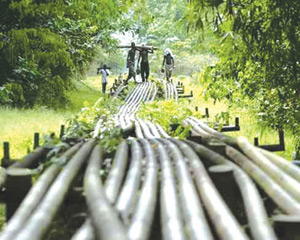
Oil-pipeline
By Obas Esiedesa, Abuja
Operators in Nigeria’s oil and gas sector have identified evacuation bottlenecks as a major obstacle to achieving the Federal Government’s target of three million barrels of crude oil production per day.
Despite possessing over 37 billion barrels in crude oil reserves, Nigeria has struggled to produce more than 1.5 million barrels per day over the past three years. This shortfall is largely attributed to persistent attacks on pipeline infrastructure and widespread oil theft.
Speaking after a tour of the $400 million Otakikpo crude oil terminal developed by Green Energy International Limited (GEIL), industry operators emphasized the urgent need to overhaul the country’s crude evacuation system to meet national production goals.
They pointed out that although Nigeria’s production capacity remains robust, hundreds of oil wells remain shut-in due to evacuation constraints.
Speaking to journalists, the Executive Coordinator at the Independent Petroleum Producers Group (IPPG) Secretariat, Mr. Oyeleke Banmeke observed that there is a huge infrastructure deficit across the petroleum industry.
While expressing excitement over the successful completion of the first indigenous onshore crude export facility in more than five decades, he said the economics of the facility makes it a major boost especially for indigenous oil producers.
“So you would have seen about seven or eight member IPPG companies here today. And the feedback has been very positive. They have been very impressed with what they see. It is shocking that we have a terminal, an onshore terminal, that can take 250,000 barrels of oil a day. And we talk about energy security every time. We talk about production growth. But we have never talked about the infrastructure to manage it.
“And if you look at it, we have an infrastructure deficit across the entire value chain for the oil and gas industry. So now you put this kind of thing in place. What it has done for us is to ensure reliability. It has helped us to ensure availability and, finally, resilience of infrastructure”.
Banmeke who led the IPPG delegation that included officials from Aradel, Heirs, Frontier Oil amongst other indigenous operators congratulated GEIL for achieving the fit, assuring that with the right economics the facility would reduce the cost per barrel for the operators in the area.
Speaking earlier, the Chairman, Green Energy, Prof. Anthony Adegbulugbe disclosed that the 250,000 barrels per day export facility has the potential to unlock production in about 40 oil fields around Otakikpo area.
Prof. Adegbulugbe noted that a lot of investments are needed to improve evacuation facilities in the industry in order to meet the government’s production target.
He said: “To me, to my company, to the community, to our dear country, this terminal represents more than steel and storage tanks, more than pumps and generators, more than marine export infrastructure. It represents hope—the belief that Nigeria’s oil industry can be fully indigenous, execute world class projects and drive industry transformation.
“It represents opportunity—an open door for over 40 stranded fields to finally contribute to our economy. It represents a promise—a promise to the communities that host the Ogoni and Opobo assets that their resources will not be neglected for one more day.
“I hope to make it abundantly clear that it will be difficult for Nigeria to increase daily crude production to above 3 million barrels per day without debottlenecking the Country’s E&P’s upstream & midstream infrastructure. To achieve this goal, the NNPC and indigenous operators must forge an unbreakable alliance to quickly and efficiently unleash the full potential of our country’s resources.
“My company has identified 5 more of these terminals that must be rapidly constructed to support the realization of the renewed hope agenda of Mr. President. In providing these infrastructure, GEIL is desperate to partner with NNPC to seize the moment and redefine what it means to be a global energy leader”, he added.
The newly built terminal, located in Otakikpo, boasts an initial storage capacity of 750,000 barrels, with plans for expansion up to three million barrels. It features a pumping capacity of 360,000 barrels per day for loading export tankers, positioning it as one of the most significant infrastructure projects in Nigeria’s oil and gas sector.
On his part, the Managing Director of the Otakikpo Oil Terminal, Kayode Adegbulugbe said the facility which is currently designed to support up to 250,000 barrels per day of crude injection, currently processes output from the Otakikpo field, which produces about 10,000 barrels per day.
“It also opens strategic opportunities for third-party producers, particularly the more than 40 nearby stranded fields estimated to contain over three billion barrels of oil equivalent (BOE)”, he added.
Disclaimer
Comments expressed here do not reflect the opinions of Vanguard newspapers or any employee thereof.