By Elizabeth Osayande
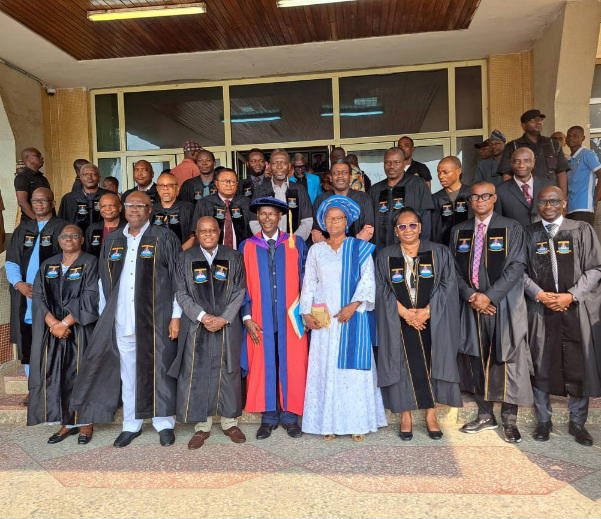
In a landmark event that showcased the importance of technology in education, Prof. Silas Eniola Egbowon delivered the 102nd Inaugural Lecture of Lagos State University, LASU titled “Educational Technology: The Uninformed, The Misinformed And The Informed.”
Professor Egbowon, who has been a pivotal figure in the field of Educational Technology, was born on February 11, 1955, in Orioke Iwamimo, Ondo State. He earned his B.A. in Education from the University of Ife (now Obafemi Awolowo University) in 1981, followed by a Master’s degree in Educational Technology in 1986, and a PhD in the same field in 2006. He joined LASU in 1991 and rose to the rank of Professor in 2017, contributing to over 40 publications and supervising numerous students throughout his career. Apart from his academic accomplishments, he is a pastor and is happily married with four children.
The inaugural lecture drew attention to both common misconceptions about Educational Technology, ET and its transformative potential in learning environments. Standing at the lectern, Prof. Egbowon addressed prevalent misunderstandings, stating, “There is a belief among some that we are utilizing outdated, local materials while the world races towards digital solutions. While it’s essential to keep pace with technology, it’s equally important to recognize the value of culturally relevant materials, especially in rural areas.”
The lecture emphasized the Culturo-Techno-Contextual (CTC) Approach, pioneered by Emeritus Professor Peter Okebukola, which has become integral to the African Centre of Excellence in Instructional Technology and Science Education (ACEITSE). Prof. Egbowon elaborated, “When learners are exposed to materials that resonate with their culture and environment, they engage more deeply and learn better.”
In discussing the taxonomy of instructional materials, he explained, “Educational materials fall into various categories – audio, visual, and audio-visual – to cater to all types of learners, whether they be blind, deaf, or sighted. This ensures that every learner’s needs are considered and addressed.”
Counteracting the notion that technology must be taught separately, Prof. Egbowon asserted, “Technology should seamlessly integrate into teaching and learning. Our goal is to make it a routine part of our educational process so that both educators and students can benefit from its capabilities.”
He framed Educational Technology as a systematic approach designed to enhance instruction, stating, “Educational Technology is not an end, but a means to an end. It is applicable across all disciplines and should be embraced for its role in training and skill development.”
To address the evolving landscape of education, the guest lecturer proposed several recommendations, including the establishment of an Educational Technology Centre. “[This centre] will focus on capacity building, digital literacy, and accessibility for learners with disabilities,” he explained. “It is essential for our university to modernize our approach to educational resources.”
Prof. Egbowon also encouraged the integration of the 4Cs—Creativity, Critical Thinking, Communication, and Collaboration—into teaching practices to nurture a more effective learning environment.
Disclaimer
Comments expressed here do not reflect the opinions of Vanguard newspapers or any employee thereof.