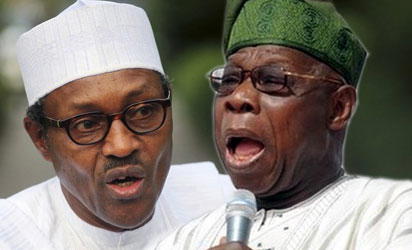
Buhari and Obasanjo
BY OSA AMADI
Since former president of Nigeria, Dr. Olusegun Obasanjo, released his legendary letter to President Buhari, both knocks and praises have been trailing both the letter and the writer.
That was not surprising. Expectedly, the beneficiaries of the rots in Buhari’s government must fight back and defend Buhari and the government down to their graves.

Buhari and Obasanjo
It is also expected that enemies and critics of Buhari and APC will find a credible reference for Buhari’s failure in the Obasanjo’s letter.
Whether Obasanjo said the truth in his letter or not is not the tenor of this piece. As they say, you need no mirror to look at the things you wear on your hands – rings, wrist watches, bangles, etc. Similarly, you don’t need OBJ’s letter to tell whether Buhari is doing well or not. As they say in Latin, res ipsa loquitur – the evidence speaks for itself.
The people I want to engage here are people like the president of League of National Patriot, Abdulkareem Abdullahi Ikharo, who hailed OBJ as a courageous patriot who has the interest of the country at heart, but added: “even though President Obasanjo did not do better when he was in office, his message cannot be ignored.”
How can anyone in his or her right senses compare Obasanjo’s government and Buhari’s government and have the effrontery to submit that Obasanjo did not do better? If our memories are failing us, permit me to remind us of four key achievements of Obasanjo’s government:
Professionalization of Nigeria’s Armed Forces
By throwing 93 senior military officers out of the army, few days after taking power in 1999, Obasanjo laid a stronger foundation for Nigeria’s democracy and brought professionalism into the Nigerian Army. Many of those retired army generals were practically politicians queuing up to plan coups and takeover government. OBJ went from one military barracks to another preaching professionalism to soldiers. Choose between being a professional soldier and leaving the army, he warned the remaining soldiers.
Explaining his action later, OBJ said: “Talking about engineering in politics, when I got into office as elected president, I got 93 officers of the armed forces out of the military because they were used to what is called the chummy chummy life in government house, and if I had left them in the military they would have been the ones that would have created more problems for us and our democratic dispensation would not have lasted as it has.”
No other living Nigerian could have lived after having the courage to throw 93 Generals out of the army!
Strengthening of the banking institutions
Before OBJ’s return to power, banks in Nigeria were collapsing in what was called ‘distress’ as a result of weak financial bases. After depositing your money in a bank that time, you would just wake up the following morning and find a big padlock on the entrance gate of the bank. The bank had been distressed! It does not matter how many billions you have there, what you will get, according to the law, is N50, 000 only!
OBJ could not tolerate that. He took Soludo, and together, they recapitalized every bank to the tune of N25 billion. Those banks which could not raise N25 billion had to merge with other banks for a stronger financial base. That way, till this day, Nigerians could deposit their monies in a Nigerian bank and go to sleep peacefully.
Loosening Nigeria from the Paris Club debt noose
As at the time Obasanjo returned as civilian president, Nigeria was almost strangled with foreign debt burden. The country was so much indebted to the Paris Club that it was almost using her blood to just service the debt, not to pay the principal amount borrowed.
As Oti, Peter. A et al noted in the Journal of Economics and Sustainable Development (2006), “Between 1980 and 1990, Nigeria’s external debt rose from N2.3 billion to N633.1 billion with the increase in external debt/real gross domestic product ratio higher than the sustainability threshold. The ratio of total debt to gross domestic product which captures debt burden rose from 19.9% in 1980 to 108.2% in 1994 but plummeted between 53.5% in 1995 and 32.5% in 1997. The debt burden shows upward movement again from 1998 to 2006. The burden decreased thereafter due to the debt relief granted the country in 2006 amounting to over $18billion.”
When OBJ saw this scenario, he said for Nigeria to make any form of progress economically, this debt noose must be loosened! And that was exactly what he did with the help of Ngozi Okonjo Iweala.
Giving Nigeria the Global System for Mobile Communication (GSM)
Before OBJ returned in 1999, NITEL was making minced meat of Nigerians over telecommunications, just like the electricity companies are doing today. NITEL gave people telephone bills they never used, and if you dare refuse to pay you are disconnected for life! Between 2002 and 2003, whatever needed to be done for Nigerians to join the rest of the world in enjoying the magic and invention of wireless telephony especially the GSM, was done by the Obasanjo regime. Since then, the multiplier effect of GSM revolution in socio-economic life of Nigerians has been so huge, and still counting – the same GSM Nigerians were told was for only the rich!
I can go on, but it is needless. I have made my point with incontrovertible evidences. No one leader can solve all the problems of a country, state, or region. The secret to success is to choose a few aspects out of those numerous problems, and solve them. So please, nobody should compare Obasanjo and Buhari and submit to Nigerians that Obasanjo did not do better. Although he may have his short-comings, if every leader of Nigeria had tried like Obasanjo, the condition of Nigeria and Nigerians would have been better today.
Disclaimer
Comments expressed here do not reflect the opinions of Vanguard newspapers or any employee thereof.