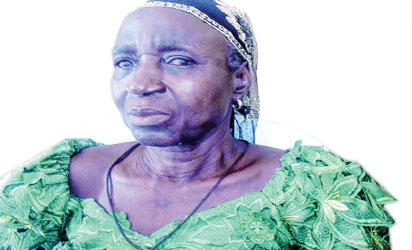
Grace Nwaiboko
…TRAVAILS OF A FISTULA SURVIVOR
By Chioma Obinna
To some people, the situation they find themselves may be worse than death. Some may hang on in the face of challenges but, right inside, they are only alive but not living. This aptly describes the plight of Grace Nwaiboko, a Fistula patient who was sent out of her matrimonial home when she became blind.
Right inside the hall of the National Obstetrics Fistula Hospital, Abakaliki, Ebonyi State, Grace sat on a white plastic chair holding a walking stick. By her side was a young girl of about 14, simply identified as Ogbom, meaning “My namesake” in English.
Sunday Vanguard’s encounter with Grace, an indigene of Abakaliki, revealed a broken person. She dares death because her fear of death is dead. To her, there is nothing to lose again as she has lost virtually everything valuable to her.
She lost her womanhood at a very young age, lost her eyesight, lost her husband and lost her place in society. Although Grace is among the 2,337 success stories at the Centre, she is still not happy. “I am broken. There is nothing more for me to lose. The level of my suffering cannot be put into words. I am really, really suffering,” she lamented
The sexagenarian has lost track of her background. Even her date of birth is a distant memory. Standing little above five feet, Grace, however, recalled that she got married at a very young age, immediately after the Biafra war. She was about 16 then. Her marriage was eventful and she and her husband quickly settled down as a couple. Few months after, luck smiled on her, she became pregnant.

Grace Nwaiboko
Months passed, the happy couple prepared for the coming of the baby. Everything was ready, expectations were high, hopes were bright, but little did they know what fate had in store.
On D –day, Grace fell into labour. It continued for 96 hours (four days); while she was eager to hear the cry of her baby, her husband was calling for help.
Apparently confused at this point, she was rushed to hospital where she was operated on. Unfortunately, the baby died. Few days later, she started leaking urine, a condition, medical experts call Obstetric Fistula. It affects two million women worldwide and 400,000 Nigerian women. It is a hole between the birth canal and rectum or bladder, also known as Vesico-vaginal Fistula (VVF). A major cause is prolonged obstructed labour, leaving a woman incontinent of urine or faeces Recto-vaginal Fistula, RVF, or both.
Obstetric Fistula (VVF) occurs when the tissues between the woman’s vagina and her pubic bone are damaged by continuous pressure from the infant’s neck trapped in the birth canal.
That was the beginning of her woes.
Soon after she woke up, the death of her baby was announced to Grace, and as if that was not enough; she was briefed about her new status due to the prolonged obstructed labour.
Grace almost died, when the news was broken to her. She fainted and was unconscious for hours in the hospital. She was not herself until she was discharged.
If wishes were horses, beggars will ride
Narrating her ordeal to Sunday Vanguard, Grace said: “It was a harrowing experience to me. It was my first child as a newly married bride. I could not believe it the day it started.”
Just like the English proverb, “If wishes were horses, beggars will ride”, she prayed for a positive change for so many years but her situation changed not.
A few years after, Grace was taken to a Fistula centre in Calabar where she was repaired. Unfortunately, it relapsed. For about 47 years, Grace, who was rendered childless by the problem, lived with the shame associated with Fistula in a country like Nigeria where women bear the burden of Fistula alone. Such is the fate of Grace.
“After suffering and leaking urine for so many years, I was taken to Calabar and repaired. After some years it started again. I continued to suffer without a child”.
Still in search of solution, Grace was happy when a group of women came to her home and told her about free Fistula surgeries at the National Obstetric Fistula Hospital, Abakaliki. She was excited. After all arrangement was made, Grace was taken to the centre for treatment. Grace was successfully repaired. She was discharged from the hospital after she recovered. She was full of joy. Unfortunately, Grace never had inkling of what was in store.
Expecting that at last, her shame of over four decades had finally come to an end, another tragedy struck.
A week after she was discharged, Grace became blind. Findings by doctors at the Centre showed that she has glaucoma, a leading cause of irreversible blindness. Glaucoma is a disease that damages the optic nerve. It usually happens when fluid builds up in the front part of the eye.
“It continued until when some women in my village gathered us to this place. After the repair I was okay. But when I got home I started having eye problem that led to blindness.”
Caught between the devil and the deep blue sea, Grace’s husband threw her out of the matrimonial home accusing her of being the architect of her woes.
With tears rolling down her cheeks, Grace said: “My husband started accusing me that I came here and they destroyed my eyes. He then sent me out his house. He accused the doctors of fiddling with my eyes. He said my case was not medical but spiritual. He was angry with me. He is convinced that the blindness was as a result of the Fistula repair. Now that I cannot see because I went to the hospital, he demanded that I should leave his house.”
Today, although, Grace is free from Fistula, she is blind, childless, homeless and seeking assistance from good spirited Nigerians.
In what seems like a rescue mission, Ebonyi State government trained Grace and other Fistula survivors in soap making and other confectionaries as part of efforts to alleviate the plight of survivors. “When they sent for me I was not happy. I asked them why they were disturbing me. I don’t have a child. I asked what I would gain. Am I still living? Why were they troubling me? At last, I decided to answer them. They trained us in skill acquisition. When the Centre heard my story, they took me to an hospital but I don’t know what they are saying concerning my sight. I am appealing to Nigerians to assist me.”
Experts harp on combination of treatment and prevention
Precisely on May 23, 2017, the world celebrated the most serious and birth-related tragic injuries that have stripped Grace and about 200,000 Nigerian women of their self-esteem in the society. It was the International Day to End Obstetric Fistula, held under the theme: “Hope, Healing, and Dignity for All.” The annual event is used to create awareness and intensify actions on the condition which typically leaves its victims incontinent, often stigmatised by the community. These women also suffer depression, social isolation and poverty.
Unfortunately, many of the victims in Nigeria, like Grace, live with it for so many years while some go to their grave with the condition.
These and more were the reasons experts and funding partners like EngenderHealth, Fistula Care Plus and UNFPA in the campaign against Obstetric Fistula maintained that to eradicate the condition in Nigeria, there is need to address issues regarding the underlying causes of the problem.
To them, providing treatment for existing cases and combining it with aggressive prevention strategies remain the panacea to eradicating Fistula.
In Nigeria, despite the debilitating nature of the condition, statistics from a nationwide survey conducted by Fistula Care Plus in 2012 showed that about 200,000 Nigerian women are living with Obstetric Fistula while 12,000 new cases are recorded annually.
Unfortunately, only 5,000 of the 12,000 new cases are repaired, leaving a backlog of 7,000 annually.
The World Health Organisation has described Fistula as the most single dramatic aftermath of neglected childbirth. According to experts, malnutrition, poor health services, early marriage and gender discrimination are interlinked root causes.
According to the Country Programme Manager, USAID, Fistula Care Project, Chief Iyeme Efem, preventing the case before it happens by addressing the three delays in maternal mortality is key to eradicating Fistula.
To address the issue, just like a tap running into a bucket of water and overflowing, Efem said there is need to turn off the tap, saying that by so doing, we would be stopping new 12,000 cases filtering into the backlog and then take time to address the backlog.
He maintained that addressing issues of safe birth practices, and deliveries under a skilled healthcare provider as well as providing adequate facilities would prevent Fistula in women.
“Fistula patients are people who have survived maternal death. When you eliminate the major three delays (decision to seek appropriate medical help for an obstetric emergency; reaching an appropriate obstetric facility; and receiving adequate care when a facility is reached), you can stop new cases”, the Programme Manager said.
Efem, who spoke during an event to mark the International Day to End Obstetric Fistula in Abakaliki, maintained that Fistula has nothing to do with witchcraft but entirely a result of complications in childbirth.
Economically, sufferers of Fistula are at a disadvantage, as they are unable to engage in economic activities because of the stench of urine and or faeces. But Efem said for a condition like Fistula, which is preventable and treatable, in 2012, a total of N100,000 was required to treat a case. Unfortunately, not many Nigerians down with the disorder could afford it.
He explained that Fistula occurs due to an interaction of several factors. It could be culture, illiteracy, poverty and poor antenatal care and bad delivery practices. These factors conspire to produce prolonged obstructed labour and delivery, which is the cause of most cases of VVF and RVF.
Corroborating Efem’s views, the Chief Medical Director, National Obstetrics Fistula Hospital, Abakaliki, Ebonyi State, Prof. Sunday Adeoye, said it is only a combination of Fistula repair and prevention of new cases that could end Fistula in Nigeria.
According to Adeoye, Fistula cases were on the decline in Ebonyi State and as of May 22, 2017, a total of 2,337 surgeries and 640 prolapses have been carried out at the Centre.
He lamented that many of the women affected are not still coming out to access care while suffering in silence, adding that the Centre has the capacity to do more than 2,337 with five functional theatres and complete Fistula team.
“Positively, it appears to be on a decline which is good news. Compared from where we started and where we are now. For the surrounding states of South East and South-South, and South West, they are still there. Some of the patients are not even aware that they can come here for free treatment. Some of them have gone to where they will pay and they emptied them of their finances before they know the existence of the centre.”
Speaking during a walk which began from Ebonyi State Government House, the state Commissioner for Health, Dr Daniel Uwazurike said addressing early marriage in the girl-child would help reduce incidences of Fistula. “When a girl-child is trained educationally, she will know the implications of early marriage. She will stay away from female genital mutilation and when she is pregnant, she will access quality healthcare services that are run by a skilled health worker.” He further disclosed that incidence of Fistula has reduced drastically in Ebonyi as the prevalence in the state has crashed from the initial incidence of about 54 percent to less than 10 percent currently.
Disclaimer
Comments expressed here do not reflect the opinions of Vanguard newspapers or any employee thereof.