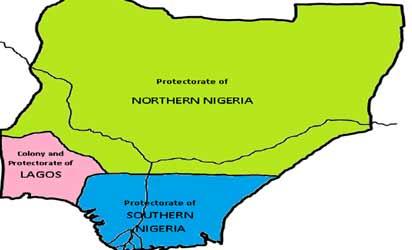
Map of Nigeria
By Eric Teniola
MID-WEST: A Federation of the existing Region, Lagos continuing as Federal Territory or becoming a Region. N.B. The Memorandum considered a redrawing of the constituent units desirable and set out the following criteria: ethnic, linguistic, and cultural affinity or homogeneity, historical association (e.g. Hausa/Fulani, Efik/Ibibio), viability of states both absolutely and relatively, geographical contiguity, comparability in size, reciprocal self-determination (i.e. not only should each minority group be given the opportunity to determine its future but also a majority group must be given the opportunity to determine whether it is willing to associate with a minority seeking such association.
On the basis of these criteria, twelve states might be created (4 in the North, 2 in the West, 4 in the East, the Mid-West, and Lagos). Although desirable, such a rearrangement was considered impracticable in the prevailing circumstances.
NORTH: (i) Original proposal. A Union or Association of the existing Regions, ’and such other States as may be formed subsequently’, with a ‘right to secede completely and unilateral’.
The ‘right of self-determination of all people in the country must be accepted and a referendum or plebiscite shall be the method through which the wishes of the people concerned shall be ascertained. These rights include the right of any State within the country to secede. But the implementation of these principles shall not delay the determination of the future of Nigeria. All necessary guarantees shall, however, be written in the future constitution to establish the right of self-determination by any section.’
(ii) Revised proposal. A Federation with an ‘effective Federal government’. The above-mentioned method of creating new states was to be ‘discussed and formally adopted’.’ Grave doubts about the wisdom of creating states based on “ethnic and linguistic affinities”. In any arrangement based on this principle, there are bound to be large numbers of small pockets of minor ethnic and linguistic groups who will necessarily find themselves grouped uncomfortably with the larger and dominant ethnic groups.
Whilst in the past, such tiny tribes were undisturbed within larger units not based on tongues, they are most likely to develop genuine fears of tribal domination in any political arrangement based on the principle of language. Most of the smaller ethnic and linguistic communities have coexisted peacefully without any ill-feelings towards their bigger neighbour only because they and their neighbours belong to a larger political entity’.
‘In the exercise of ascertaining the wishes of the people for the creation of States as well as the actual creation of States, no Region except the Mid-West should be left out of the operation.’
WEST: (i) Original proposal.
(a) First alternative: A Federation with ‘the immediate creation of more States (including a Lagos State) based on ethnic and linguistic affinities, account being taken also of territorial contiguity and economic viability’. Also ‘clear-cut and less cumbersome provision for the creation of additional states in the future under conditions which should be clearly set out in the Constitution’.
(b) Second alternative: A ‘Commonwealth comprising the existing Regions and such other Regions as may be consequently created, with Lagos forming part of the present Western Nigeria’. Each State should have a right unilaterally to secede… at any time of its own choice.’
(ii) Revised proposal. A Federation; ’the creation of more States (including a Lagos State) based on ethnic and linguistic affinities, account being taken also of territorial contiguity and economic viability’ was’ strongly recommended’. ’In the event of states not being created, Lagos shall form part of the Western Region.’
On November 30, 1966, Lt. Col. Gowon adjourned the conference and disclosed that ’they had run into difficulties which made it impossible for them to meet.’
It was the failure of the conference that led to the Aburi meeting in Ghana.
Dr. Mudiaga Oje told me in 1977 that if the adhoc conference had succeeded, the Civil war could have been avoided. Suffice it to say that the issues raised at that conference are still relevant till today.
Disclaimer
Comments expressed here do not reflect the opinions of Vanguard newspapers or any employee thereof.