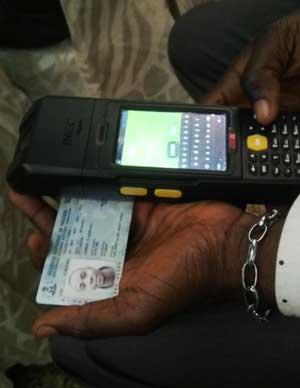
•Card reader
As Nigerians reflect profoundly on more distressing allegations of sordid insinuations of fiscal impropriety in the budget approval process from the National Assembly, one other area of focus that will be on people’s minds this weekend is the repeated inconclusive outcome of recent elections,and recent revelations of corruption on a grand scale in INEC which the current regime continues to probe into, these distressing developments necessitates a call for legislative review of the Independent National Electoral Commission and the problems besetting it.
Failure of Legislative oversight
Observers of the decline of the Independent National Electoral Commission (INEC) seriously question the commitment of the National Assembly to the democratic project in Nigeria, as the legislators have failed to take definitive steps to stem the deteriorating performance of the Commission. It is shocking that members of the legislature are paying scant attention to developments in INEC given how much the survival of their political careers rely upon the configuration and function of the electoral body. As of today structurally, INEC has a deficient National Board with only 7 instead of 13 members as required by Law, and a deficient National leadership structure of only about 16 out of 37 required Resident Electoral Commissioners as the constitutional statute commands.
This comes as a surprise, given the vulnerability of the members of the legislature to weaknesses in the electoral process, especially on the management of pre-election matters by INEC. Some recent analysis by observers of historical trend of re-election to the National House of Assembly shows that most NASS have a turnover (attrition rate of members) of between 60% and 65%. This means that if pre-election and consequently election matters are left the way they are; only about 3 out of 10 Legislators have a chance of returning to the National Assembly.
Given this existential threat of disarray in the electoral process to the future of members of the legislature, it is astonishing that the National Assembly that has oversight responsibility, who make laws to regulate the electoral process are tepid – shockingly so – in responding to decline in the electoral process. It will be recalled for instance, that during the last democratic dispensation, several crises which beset the Commission only received legislative attention when they had deteriorated to become a serious national concern. For instance, when political stakeholders expressed dismay at the lop-sided nature of the Commission’s allocation of Polling Units prior to the General Election, the Legislature remained undecided on what to do, until it eventually came out with a tepid and uncommitted press statement, urging the Commission to rethink the process.
Similarly, when many voters complained of being possibly disenfranchised because of inexplicable delays in the delivery of Permanent Voters Cards, the legislature did not compel the Commission to fully account for the situation, where a significant number of voters were unable to locate their PVCs. More recently there have been repeated observations about constitutional and administrative breaches in the restructuring of the leadership of the Commission; as exemplified by the piecemeal board. The13 members prescribed by the constitution is intended to balance zonal representation, a constitutional prescription that recognizes the need to balance the varying political and socio-cultural diversity of the country in regard to how elections are managed. The Executive arm has since failed to comply with this requirements.
Specifically, Barrister Femi Falana (SAN) drew the attention of the Executive, to an extant Court judgment that it is illegal to conduct elections in Nigeria without a properly constituted INEC. In specific terms what the law directs is 13 from which a quorum of 5 can take legal decisions. The law does not direct that a quorum be appointed, but a board which can form a quorum. For instance a third of a 12 member Board will be a quorum of four, a third of 9 Board Members will be three members, while a third of 7 members as currently exist is 2 and a fraction, by this evaluation, it can be implied that all decisions taken by INEC in conducting elections since the Kogi and Bayelsa elections have questionable legality, and the impending elections in Edo and Ondo states may also be conducted under the same cloud of legal uncertainties.
Still the Board of INEC remains incomplete with only 7 National Commissioners out of the Constitutional 13 members. Similarly, over 20 states remain without resident electoral commissioners appointed. So much so that as at today the entire North West Zone with the highest voting population in th voters register has less number of Resident Electoral Commissioners than any other zone in Nigeria.
Corruption and election racketeering
The restructuring of INEC for better delivery of services has become even more urgent as news filtered into the public sphere recently about the alleged level of corruption on a grand scale within the Commission. This week more allegations of involvements were revealed as a Resident Electoral Commissioner in the South East was roped into the circle. Recent newspaper reports, have continued to regale the public with snippets from the ongoing investigation, in which national and resident electoral Commissioners and possibly a former national Chairman of the Commission were involved in a racketeering plot, in which they collected huge sums of money, allegedly about N23 billion from a former PDP Minister to deliver election in favour of a major political party during the Presidential election.
The allegations have so far named several resident electoral commissioners, and Administrative Secretaries as well as some Electoral officers particularly in the South West and South South. Although it is alleged that the racketeering went widely across all zones, more revelations and possible arraignments are being expected to name and shame all those who were involved in all the zones of the Commission from both South and North but so far not much have been heard about those involved in other geopolitical zones apart from thee ones mentioned. Having put out the name of some of the suspects, the investigating Agency must now go all the way to name everyone involved because a failure to name all those involved will tar the names of those who were not involved with the assumption by the public that they all participated in the fraud. As the nation awaits this roll call of national infamy from INEC, the Commission has continued to perform below par in its core function of conducting free, fair and acceptable elections.
More Inconclusive elections
As a further testament to the failing performance of INEC, Nigerians who were hoping for some redemption of the credibility of the Independent National Electoral Commission (INEC) were thrown into further despair, this week as another inconclusive re-run election was declared in Imo state, this follows the last series of inconclusive Area Council elections in the Federal Capital Territory (FCT), an entirely new nadir for the Commission.
These recent climb down in institutional performance is more unfortunate because, not too long ago many people had begun an advocacy, for INEC to take over the conduct of Local Government Elections across the country,which had become a travesty of democratic conduct in many states. Some of these inconclusive elections have been attributed to total number of cancelled votes cast, being more than the margin between leading political parties. An election where significant number of votes were cancelled ballots, is a sign of gross irregularities, either by way of malpractice or outright fraud.
Cancelled ballot may stem from voters not placing their thumb prints on the box of their preferred candidate properly enough to tell exactly who or what party the voter is voting for, amongst other anomalies. But cancelled votes can also be manipulated in the form of deliberately spoilt ballots. According to Chad Vickery and Erica Shein, Electoral “Fraud is based on wrongful intent, whereas malpractice is a form of negligence”.
A situation where so many votes had to be cancelled indicates a very likely gross negligence on the part of INEC to adequately educate voters prior to elections on the consequences of how they place their thumb prints in a ballot or on the other hand it may be the result of some clandestine issues bordering on election fraud, neither of these indicates that INEC is improving. It has now conducted as many as five inconclusive elections in several jurisdictions in which elections were superintended by the Commission since the beginning of this regime, expectedly, almost all of these elections are in some level of dispute resolution.
Need for individuals of integrity with unblemished records known by Nigerians
The last set of appointments made by the Presidency into the Commission did not elicit public confidence in the Commission, with the exception of Mrs Amina Zakari who had established some national administrative credibility, until her ties to the President poured cold water on her possible choice for the position of Chairperson. The other new appointees have not inspired the type of enthusiasm which attended the appointment of stellar performers who were appointed with the Professor Jega set of National and State Resident Electoral Commissioners. Hopefully the Presidency will take the track record of the next set of appointees more seriously to achieve better electoral results.
Consequences for 2019 General election preparations
The need to infuse more credible and firmer hands in the affairs of INEC draws further inspiration from the reality of the political arena. In the House of Assembly a growing distance between different merger partners in the APC, as evident from the acrimonious execution of the anti-corruption efforts and the recent bad blood being exchanged between political gladiators concerning the national budget are all early indicators of a very likely contested General election in 2019, because the differences between the political merger partners appears to thicken with every passing day, making it possible that there will be changes of seismic proportions in the alignment of political groups by 2019, arising from a feeling of inequity in the post-election power sharing within APC.
Such possibilities mean that the country cannot afford to go into the next general election with an electoral Commission that cannot conduct elections without equivocations in electoral outcome. To leave INEC without legislative oversights despite its recent declining performances, to leave the appointments to its board at the whim of the executive rather than the direction of the Constitution, and to allow the Commission to continue to flounder will be a monumental failure by the legislature. President Muhammadu Buhari cannot afford that, having worked tirelessly to become Commander-in-Chief through the ballot last year – at the fourth attempt.
Disclaimer
Comments expressed here do not reflect the opinions of Vanguard newspapers or any employee thereof.