By Obi Nwakanma
Dr. Goodluck Jonathan, former President of Nigeria is by no means a great communicator. As a matter of fact he is very drab and uninspiring. This self-effacing, terribly inarticulate man is burdened by the need to clearly put his own achievement in context. One of Jonathan’s greatest problems is that his media team has been unable to put across the achievements of his government, and place his work in its proper context.
Dr. Rueben Abati, bright, accomplished wordsmith, his chief spokesman, seems rather tongue-tied these days, and has also not done this past president any real service by keeping quiet and distant from it all as Jonathan’s adversaries traduce him. Doyin Okupe’s “gra-gra advocacy” lacks the sublime texture of reasoned, convincing, and effective dialogue that should highlight some of the poignant accomplishments of President Goodluck Jonathan.
All those who worked in the former president’s media team have left the man to flounder in the scourge of powerful recrimination and deluge of misinformation that have followed his ouster by the APC in the general elections, and that is now shaping the narrative of his presidency. Suddenly Jonathan is the most corrupt and inefficient president ever to come to power in Nigeria, never mind that the facts do not support this. But it is in the interest of the APC’s propaganda machine to bury the Jonathan presidency, if it must grapple with the consequences of its own significant failures to deal with the problem of governance.
Two strategies the current party in power has adopted is to keep repeating the same statements about Jonathan and an empty treasury; about Jonathan and corruption, and about Jonathan and Boko Haram, until it becomes the truth. It is quite Goebelian, and it is effective.
As a matter of fact, straight of Goebel’s method, the current administration quickly took out PDP’s most effective communicators who have taken on the government: Olisa Metuh, the party’s Publicity Secretary, who had a running battle with the APC’s Lai Mohammed through the election. In the aftermath of the election, Mr. Metuh, an Attorney did provide counters to every of the APC’s claims, until he was slapped with a corruption suit. The other, Femi Fani-Kayode, kept the song going, until not long ago, he too became silenced by a writ and the summonses of the courts to answer to corruption charges after an illegal violation of his privacy by an unwarranted search of his home. Of course, the first target of what is looking like APC’s muzzling tactics aimed at silencing the voice of the PDP is the immediate arrest and confinement of President Jonathan’s National Security Adviser, Mr. Sambo Dasuki, whose position in Jonathan’s National Security Administration, clearly marks him as the man who knows, as they say, where all the bodies are buried, and who could quite clearly unearth terrible skeletons, and show most to be grinning skulls. What better than to keep him running and breathless. And so it is that for the Buhari administration to establish itself, it had to resort to the persecution and possible blackmail of its opponents, or so it seems. But, of course, that is the way of power, particularly the Ottoman variety that we have frequently deployed in Nigeria.
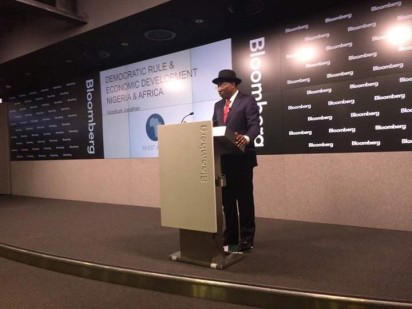
The silence of former President Jonathan’s strategic response team has permitted the current administration to run with all kinds of unverified claims. I am by no means a great fan of the former president, nor do I speak for, or in defence of him, but in the interest of fair journalism, it is important for us in the media to perhaps begin to ask the right sort of questions. Last week, on Bloomberg, Dr. Jonathan slightly broke the silence around his government and challenged one of the central claims of this administration. President Buhari has circulated the view, right from the onset, that he met “a virtually empty treasury.”
Nigerians believed him and sympathized with him. Why would “corrupt Jonathan” leave an empty treasury? He must have looted it with his men. There have been fantastic pictures of financial malfeasance in the former administration which has helped to buffer President Buhari from blame, and provide excuse for his clear helplessness in containing and managing the rather quick slide of the Nigerian economy into triple-digit recession. The health of the economy has posed great difficulty for the president. He does not seem capable of meeting with his very fantastic campaign promises as a result of the quick economic slide. He has tried to explain the downturn in the Nigerian economy by accusing the former administration of “looting” and widespread corruption.
But what has never been transparent is the process that should permit those accused to defend themselves. Nigerians have had a one-sided narrative, and it has been the perspective of the current administration. That is why Jonathan’s statement on Bloomberg is compelling. Dr. Jonathan in his response in the Bloomberg interview for instance said, he did not leave an empty treasury. If he left an empty treasury, he asked, from where did Buhari get the money to bail out the states? Jonathan’s claim that he tackled corruption in the fertilizer distribution cartel is true and verifiable. His claim that his attempts to clean-up the oil industry was frustrated by many of those in the current government who now accuse him of corruption is worth examining. Basically Goodluck Jonathan, though still clearly inarticulate and still unable to very effectively communicate his own defence, however did make a compelling case: he would wait for the present administration to finish their investigation of him, and do what is right for the country.
To be clear, I personally welcome the investigation of former President Jonathan, and the prospect of giving him his day in court, after the Senate would have officially stripped him of any immunity pertaining to any decisions he took in his official capacity as the president of the republic. I think that the former president should offer us in submitting to the courts, the precedent that will open the door into the investigation of every administration from January 15, 1967; and that the National Assembly would hereafter upturn that clause forbidding such investigation. Did Jonathan and his men “loot” the National Treasury? We must know how and when.
Recently, the Buhari administration announced recovery of monies from those who had looted the treasury. The math seemed fuzzy to me, and even more suspicious when the administration went back on its words to publish the names of the looters. This again is an example of the kind of inconsistency that marks this administration, makes every of its effort slip-shod, half-hearted, indecisive, and muddled; and which is increasingly creating trust issues for the administration. Nigerians do not know what to believe of Buhari anymore from his many policy flip-flops. It is vital to transparency that this government publish the names and the faces of those whom it accuses of looting the Nigerian treasury and from whom it has allegedly recovered particular sums.
Nigerians are increasingly growing skeptical about these kinds of political gimmickry. How can the public continue to trust and believe this president if his administration says one thing today, and does its very opposite the next day? This government promised to publish the names of those who looted the treasury of Nigeria, and now it wishes to manage the truth and shield it from the public? Did President Buhari lie to the nation about inheriting an empty treasury? How much exactly did he inherit? This must be made clear. President Buhari himself should also have to answer questions regarding his gross violation of the provisions of the Financial laws of the federation set out in section 80 (1) (2) (3) and (4) and in contravention of the spirit of section 82 and 83 (1) and (2) that sets down the power and control of public fund of the federation under the Constitution of Nigeria. As I have continued to say, Buhari’s unilateral decision to “bail out” the states is an act of illegality because it is not backed by an Act of the National Assembly. This is the precise meaning of corruption.
Disclaimer
Comments expressed here do not reflect the opinions of Vanguard newspapers or any employee thereof.