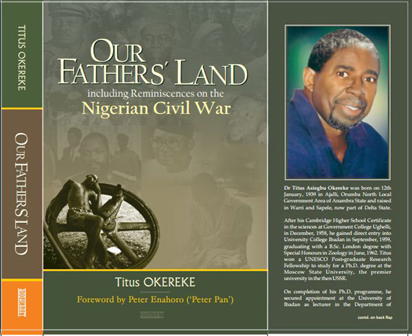
A review of Titus Okereke’s book,”Our Fathers’ Land– Including Reminiscences on the Nigerian Civil War”.
Prof Mark Nwagwu
Titus Okereke treats us to a world worth living in his book, Our Fathers’ Land – Including Reminiscences on the Nigerian Civil War. This is the first book of its class, an autobiographic tale well told, to come out of an alumnus of the old University College, Ibadan, from a graduate of the early sixties, 1960-1964.
I know a number of my contemporaries whose lives are captured in this book. More than this, anyone of my time at UCI, would devour this historical masterpiece. Yes, the details of how one lived may be different from Okereke’s rendition of his own lifestyle, as no two people are alike.

But surely the conditions and circumstances of life at these times would create a character not much different from what Okereke has given us. Here, you meet a man and his times and how he wrestled with the circumstances that presented themselves. He earns high marks for giving us a vivid idea of Nigeria in the colonial days from the forties to the fifties and some of the social transitions in independence. Education was the master of the day and the discipline and character it enshrined in her children created humans of sterling splendour.
‘It was at Sapele Government School that I got to meet quite a few characters who remained my friends for decades later; the likes of Popo Akinyanju, Egerton Uvieghara, Abiodun Craig Adebona, and Ben Atseyinku.’ One may note that none of these was Igbo like your Titus: friendship knows no tribes, knows no barriers, except truth and sincerity. In this regard, we would do well to note this sole yet profound demonstration of friendship and true comradeship. As the author tells us: ‘after about a year at Government School, Sapele, Mr. Owodunni approached my father with a request. ‘T. S.,’ as Owodunni used to call my father, ‘I would like to bring Ademola, my son, over to stay in your house, to stay with your children. Please do me the favour of subjecting Ademola to the same discipline as I know you do to your own sons, Titus and Maurice.’
Mr. Okereke warmly accepted the offer with great pleasure and even when his family was to return to Warri again on transfer, Mr Okereke took Ademola with him. Yes, there was a Nigeria, when an elder, any elder for that matter, could discipline any child he or she found misbehaving. Rules of behavior were strictly followed and everyone was everyone else’s keeper. To help drive home this point of discipline, the author narrates how, on one occasion, the education officer, Mr. Enahoro, whose house was close to the school compound and who had watched his children come late to school, administered punishment on his own two sons, with the permission of the Head Master of the school, for being late to school. Why will there not be high standards of decorum and character when everyone was expected to live a life of merit and purpose. There was a time.
In 1951, the author entered Government College, Ughelli, for his secondary education. His sense of recall is striking: while some of us can hardly remember the name of our dormitory, Okereke readily reels out the names of the students in his dormitory, Forcados House – Popo Akinyanju, from his primary school days in Sapele, Egerton Uvieghara, Jerry Eghagha, Nelo Piserchia, Napoleon Blankson, Godson Keyamo, John Obienu,George Uteh, Mathias Egbuiwe, amongst others. He took the Cambridge School Certificate in 1956 and would continue in 1957 on to the Higher School Certificate choosing to study physics, chemistry, botany and zoology.
But the principal thought differently; having examined Okereke’s performance in the arts subjects, he thought he should have enrolled to read arts subjects. If, therefore, you read this book and ask, how could a zoology graduate have such a good grasp of the English language and write in an impeccable style, you have your answer. Okereke was well grounded in school in the arts subjects. There was a time!
“So, finally, we were at the centre of our dreams – the great University College, Ibadan in September, 1959.” For any young person of these times, nothing was comparable to being described as a student of UCI. You would be regarded as one of the best brains in the country for only the very best could flow through the fine mesh of refined merit, character and scholarship. The author makes it abundantly clear that his undergraduate days at University College were some of the happiest days of his life. Words fly off the page and bathe the reader’s eyes with rays of joy and fulfillment in a life of learning and character. Okereke combined scholarship with a thrilling life in sports: he was the college champion in the 800 meters and mile races and would ordinarily have represented the university at the 1961 biennial sports competition with the University of Legon. However, Okereke was constrained to pay particular attention to his studies for the final London examinations the following June in 1962. His unspeakable jamboree to Legon just to watch the games would be thus understandable. There was a time!
For good cause, lecturers of Igbo extraction, including Okereke, hurriedly left the University of Ibadan and ran to the safety of their homes in Igboland before the outbreak of the Nigerian civil war. They were quickly absorbed into the University of Nigeria, Nsukka, but when the war broke out and Nsukka fell, Okereke had to flee first to Enugu and later to his hometown, AjaIli. His perspectives of the civil war are all personal and bear the badge of sincerity, honesty and joy, even in the face of adversity.
Titus was appointed to the Department of Military Intelligence, DMI headquartered in Umuahia, where he was an assistant director. Titus was later transferred to the foreign service where he would be a member of a delegation to Russia to seek their aid on the side of Biafra. Unfortunately and most painfully, the trip was a thorough waste of time and resources: they never met any Russian official to present their case.
Titus would lament; ‘With Britain already on the side of Nigeria, it would have made sense for Biafra to approach the Soviet Union before Nigeria did, and the person most suited to spearhead such a diplomatic engagement with Russia was Dr. Chukwuemeka Ifeagwu who had served as Nigeria’s former Ambassador to that country. The reluctance or unwillingness on the part of the Biafran leadership to make full use of the assets at its disposal, especially the services of Dr. Ifeagwu, in a timely approach to the Soviet government amounted to failure of Biafran diplomacy. This failure made it easy for Nigeria to become the beneficiary of massive support from both Britain and Russia throughout the civil war.’
Dr. Titus Okereke, a zoologist trained in the finest scientific traditions has given us a book that speaks for scholarship and for his generation of scholars from the mid-sixties, just after Nigeria’s independence, through the 70’s after the war to the eighties when he took off the academic toga and ventured into a life of enterprise in the real world. No other scholar of his time has given us entry into his or her life in a book that celebrates a time in Nigerian life when the virtue of learning and scholarship was the national dream.
I graduated from University College, Ibadan, in 1961, and knew Titus quite well. I appear in the picture of the Zoology Class and lecturers in the second row. Olufemi Boboye is first left, Oyidi is second, Mark Eluwa, third, Anya O. Anya fourth, Mark Nwagwu, fifth, Ralph Odihirin, sixth, S. A. Toye, seventh and E. J. Usua ninth and first from the right. (The name of the eighth student from the left escapes me.) What a time it was. We have biographies and autobiographies by Nigerian notables in administration and commerce, and industry, some of them about a time long since gone. Achebe’s Things Fall Apart captures a pre-colonial Nigeria in its vibrant purpose in Igboland. His latest book, There Was A Countryis compelling reading that anticipates the birth of Okereke’s Our Fathers’ Land now in our hands as an enduring legacy of a Nigeria of virtue, ease, friendship, and fortitude, where the marathon races of life are run high up in the Himalayas.
By Prof. Mark Nwagwu, Paul University, Awkas.
Disclaimer
Comments expressed here do not reflect the opinions of Vanguard newspapers or any employee thereof.