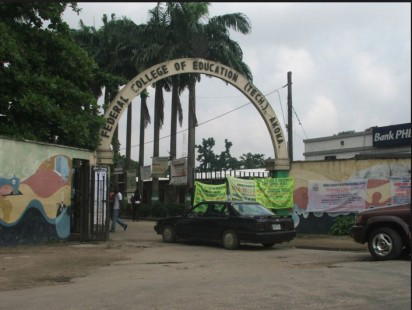
FCE Akoka
Japhet Alakam
After participating in many group exhibitions and many years of working behind the scenes building and nurturing students at the Federal College of Education (Technical ) Akoka, Festus Adeyemi is out with his first solo exhibition titled Between the lines, an exhibition of drawings, paintings, and mixed technique arts.
For Adeyemi, who has been combining academic and administrative work, the exhibition which will also be used to celebrate his 50th birthday will feature about 30 works, covering works from his student days till present. It will open at the Yusuf Grillo gallery, Yaba College of Technology, Yaba, Lagos from 27th November till 11th December, 2015.

FCE Akoka
The presentation encapsulates Festus’ paintings and drawings expressing his contemporary trajectory and fresh artistic conceptions. Essentially, the exhibits portray and depict the challenges of a nation’s over dependence on road transportation and its adverse effect on the citizenry.
Curated by Dotun Alabi, Lagos chapter SNA chair, the exhibition according to him captures the intricacies and the need for diversification of focus, methods, materials, and rendition generally.
Adeyemi who stated that it is not usually easy to hold a solo, as challenges of being faithful to academia has not made it easy, but after his study leave where he visited Coventry University, United Kingdom and saw the efficient transportation system, it spurred him to come up with a solo.
According to him, line is very important to life. Line is one of the most important element in art, we have various types of lines, it expresses ideas, stability, action etc. So he is using lines as an expression of the different challenges that face the transportation system in Lagos like bad roads, bad vehicles, dangerous driving etc.
Adopting the technique of mixed media, canvass well prepared, combined with various elements to make his design, the works portray the various systems of transport, the dangers and others.
As a form of retrosgressive show, it covers works from his student days till present, but majority of the works focus on the transportation.
Some of the works include, Rush Hour, which depicts the typical rush hour situation in Lagos in the evening when almost all passengers are heading home, the bumper to bumper traffic and some passengers hanging on the bumper of a moving bus. Here he points out that the risk involved is great, in as much as the desire to reach home is concerned, safety matters.
Another series, Marwa series 1-2, shows the complementary colours of yellow and purple. Though used in third world countries all over the world, nevertheless cause a lot of danger as most of the drivers are ex- okada riders, not trained and drive reclessly. It also pose great danger.
Also in BRT series 1-4, which the artist see as a welcome idea, it has helped to solve some of the problems like one chance, excess number of vehicles on the roads, and with good drivers. He says such should be encouraged to ease the traffic situation.
According the curator, “Like a cubist, Festus fragments his surface into various segments. Further, he engages impasto or thick relief lines to enrich the overall textual appeal. His bold palette’s application synergises needed visual declaration and delight. His matured colour schemes, mostly complimentary and triad with garnished monochromatic colours exemplifies his deep understanding of painting synthesis and pedagogy.”
In his artistic statement, Festus said that the desire to be part of the solution to the prevalent transport situation in Lagos state informed his present body of works.
“Though, Lagos state government has attempted to inject some measures to correct the situation, however, the efforts have not yielded the desired result. Between the lines, is geared towards lending my voice to showcase the stress being encountered daily by Lagos residents. The goal of the show is not only to draw the world’s attention to the heavy toll that traffic challenges are posing to Lagos residents, but to inspire steps to galvanize positive change in the state believed to be the commercial nerve center of Nigeria’s economy.”
Disclaimer
Comments expressed here do not reflect the opinions of Vanguard newspapers or any employee thereof.