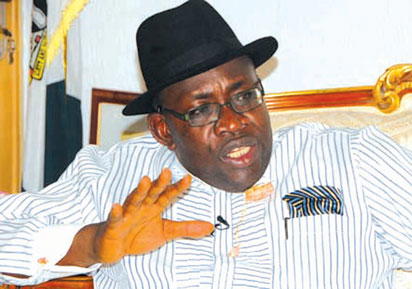
Seriake
•Explains how he relates with First Lady Patience
READ THE FIRST PART HERE
Governor Seriake Dickson of Bayelsa State, in this interview, opens up on the meeting in Government House, Yenagoa, which has triggered controversy that some former Niger Delta militant leaders, including Alhaji Dokubo-Asari are spoiling for war in the event that President Goodluck Jonathan loses the forthcoming presidential poll.
What is the roadmap? The scenarios you are painting in 2011 are radically different from those of 2015. You referred to Buhari’s military past. Obasanjo was also a military ruler. The same issues could be raised about him. In 2011, states where PDP had massive support are in the opposition camp.
(…..Cuts in) Where are those states?
Rivers, Kano, even Lagos
Can I analyse further for you?
You will do it. That’s the first question. Secondly, what happened at that meeting in Government House where you were present with Asari Dokubo, Government Ekpomupolo and a couple of others. Out of that meeting, the message that resonated was that if Jonathan doesn’t win, we are going to war. What actually happened at that meeting because people wondered why that kind of message would be coming from the Government House, where you also sat in at that meeting? What actually happened?
First, you need to know certain things about Bayelsa State and the Ijaw people, the Ijaw nation, whose elected leader I am. Bayelsa is the Jerusalem of Ijaw nation, that is what we say. Governor of Bayelsa has a duty to our country, a duty to Nigeria, a duty to Ijaw nation and a duty to Bayelsa people. Remember two things informed that interaction.
First, it is my duty to interact with my citizens, whether you call them former militant leaders or not. In fact, those people, we call them freedom fighters, you need to interact with them as often as you can as part of the peace building initiative. But something happened. There was a report about Buhari’s endorsement by MEND and the opposition media propaganda system played it up. That created a major problem for us in the Niger Delta. And when you talk of the Niger Delta, Bayelsa is the epicenter, it is the centre of gravity around which these issues revolve. Once Bayelsa is safe, secure and stable, it permeates around others.
Insecurity or instability in Bayelsa will inexorably affect the security situation in other Niger Delta states.

FILE PHOTO: President Goodluck Jonathan (middle); Governor Emmanuel Uduaghan of Delta State (left) and Governor Seriake Dickson of Bayelsa State . Photo: Henry Unini.
I have always been conscious of that, particularly with my background as a product of Ijaw movement myself. So, when the issue of MEND’s endorsement of Buhari, came or let us say a section of the militant group endorsing Buhari, it created division. It raised tension and there was almost a crisis in my hand. Also, when the president went around campaigning, and some people were hostile and attacked him, particularly in the northern states, and it was continuing, it inflamed passion in the Niger Delta.
As a governor, when you have the reports and you read the security barometer, then there was need to step in, interact with the stakeholders, get their views and assure them; if there are messages, pass on and if there are steps to be taken, do so. But at all times, you must engage. Lack of engagement is not an option. So, part of the duty the governor of Bayelsa owes our country is to use his leverage, his good office from time to time to ensure that the security situation in the Niger Delta does not get out of control.
If Bayelsa boils, the whole Niger Delta region and therefore our country will be in crisis. That is what I did. They came and we interacted. It was unfortunate that the media, particularly the opposition propaganda, took up, instead of taking the conclusions of the meeting, which were an affirmation of the peace process and the need to maintain law and order. they now took individual contributions of the people in attendance.
Moving forward, let me assure you all that we, our people, believe in a strong, democratic, united Nigeria. But the Nigeria we believe in is also the Nigeria of equal citizenship, a Nigeria that will be democratic, a Nigeria that will be peaceful, secure and prosperous. All of us have a duty to bring that about. We have to create and rediscover that Nigeria. It is my duty to continue to work with agencies, stakeholders and players, whatever their descriptions are, whatever their past may be, to interact and network to ensure that the fundamental objectives of law and order and preservation of security are maintained.
Then the second aspect to your question, that the PDP is not as strong as in 2011. That is why I said I wanted to do that analysis with you. A lot of people are carried away by huge rallies in the opposition stronghold and so on. We, sometimes, don’t remember that PDP has never won, for example, in Kano, from 1999 till date. We have never won the presidential poll, not even when Yar’Adua, from a neighbouring state, was the flag bearer in 2007.
Therefore, would we have wanted a situation where a sitting governor, liked and respected, my elder brother, Kwakwanso, that’s not an ideal situation but it has happened. But don’t forget that in most of these states, our supporters are many, stakeholders, Shekarau for example, all of them. 25 percent, that is what the Constitution says we should have or more. So, we are not in these states struggling to win 90 per cent for you to use that to determine the outcome of the presidential poll. No.
Yar’Adua, who got elected as our president in 2007, from the neighbouring state of Katsina, did not win Kano. And yet he became president. The PDP is safe and secure in our strongholds. We are safe and secure in the South-south. We are safe and secure in the South-east. We are safe and secure largely in the North-central. We are safe and secure also in a number of states in the North-east and also in a number of states in the North-west. Yes, are we as strong as we were in 2011?
Clearly, we are the first to concede that it is not so. But don’t forget, as I said that we elected a president from the South-west, who didn’t have the South-west. Now, our candidate will even win more in the South-west. Yes, or already we have two governors in the South-west and we have a good candidate in Lagos and the leadership, the voters in Lagos, we have our ways of also monitoring how they are receiving our message.
Between President Jonathan and General Buhari in Lagos, our expectation is that majority of Lagos voters will vote Jonathan. They will vote for continuity; they won’t vote for uncertainty. They won’t vote for a continuation of the system they know in Lagos that has not served their best interest maximally. We will win. After all, the constitutional formula is to win majority of votes, one quarter of votes in two thirds of states.
Still on PDP, the very simple question is, didn’t you see this coming? You were in charge of the reconciliation committee. People were wondering how governors walked out and the body language suggested, ‘ let them go’. The leadership of your party and the president, as the leader of the party, has not shown sufficient leadership to put the party together. Should Rivers be a problem to Mr President at this time?
I have earlier said that Rivers is not a problem, as far as the election of the president is concerned. We expect an overwhelming victory in Rivers State, just as we do in most states ultimately.
The question is not about Rivers but winning the presidential poll. You did not sustain your party. You know if PDP goes down now, for you to get up will be difficult.
PDP will not go down. We are the party that is for all Nigerians. We are the party for the small, as well as for the big. We are the party for the rich, as well as for the poor. We are the party of the minority, as well as of the majority. We are the only party since politics started in Nigeria till date that has given some thoughts, apart from the actuality of doing it, that has given some thoughts to the idea for someone from my place, our side of the country, being a presidential candidate.
And not just that, producing the person as a winning candidate, which the party did in 2011. We didn’t do it alone. All Nigerians did it and we are eternally grateful to them. But that tells you about the nature and character of our party. What we did in 2011 is akin, as I always say, to what the Democratic Party in the US did with the election of Barack Obama as the first black president of the United States.
That’s exactly the same thing the PDP did with the election of Dr Jonathan as the first South-south minority president of our country, democratically elected, not emerging through a military dictatorship or a coup. Now, that gave this country the opportunity to renew and reinvent itself and, for us, it is only the PDP that can continue with that vision of an inclusive Nigeria, that vision of a Nigeria where, as we move forward as a leading nation, it doesn’t matter which state you come from. It doesn’t matter what ethnic group you belong to. It doesn’t even matter the God you choose to worship and how you do it.
Let us talk about development so that we don’t…
That’s actually what I want to talk about.
Three years in the saddle, what can you say are your greatest achievements?
As I said, going round Bayelsa and, even at my quiet time, thinking about some of the things we were able to put in place, I feel very fulfilled. Now, we are not where we want the state to be but there is, no doubt, if you go to Bayelsa, there is no doubt at all that we have made a lot of achievements, achievements in the area of infrastructure, which you see. There are some investments in government that are intangible. Nobody sees what you do. But if you go to Bayelsa and you see the roads and bridges that have come up, it is not story. In fact, the story is that we are over working. ‘This governor self, na roads and bridges we go chop?’ But that is good.
That is complement for a politician, who is attacking frontally the issues of development because for you to move the state to where I want it to be, that is the Dubai of Africa, you have got to think of world class iinfrastructure. You have got to think of security. You have got to think of health care. You have got to think of investment in education as we are doing. Now, we have delivered on that. Roads and bridges connecting communities that nobody thought would be possible or people to be connected.
A lot of you who live in the urban area take a lot of things for granted. But you go to the heart of the Niger Delta, particularly Bayelsa, which was the least developed part of old Rivers State that was carved out, with the most difficult terrain, the least developed, no educational facilities, people are poor and the whole place is rural. They don’t feel government presence; there is no electricity. Now, I am addressing those basic problems of connecting roads to all these communities and the cost of construction is 20 times what you have here.
It is like building the Third Mainland Bridge. That’s what I am doing. What you call roads there are actually bridges. And yet, those are the things that we must do. Otherwise, we can’t have development. So, we have done a number of them, completed so many. A number are ongoing. With the shortfall in oil prices and so on, it is having a direct hit because we don’t have industries that are paying internally generated revenue. For example, in Lagos, you don’t care because of the investments here.
The private sector is strong. The tax can run the state. But do you know that when I took over as governor, the IGR of my state was N50 million. We don’t have industries, so only the civil servants will pay tax. And even they were paying 10 per cent of it. In fact, they said it was part of my sin because I said no, pay as the law has provided. I am not introducing anything new. The PAYE that you all pay is uniform, isn’t it? So, if you go to health care, hospitals built, modern diagnostic centres built, so much is being done.
What is your IGR now?
The IGR now is between N700 and N800m.
What was the magic you used?
Discipline, focus and an insistence that the right thing must be done. We spend political capital but that is what leadership is all about. You don’t shy away from doing what is right because it may sound unpopular. So, when I told civil servants, ‘sorry, no governor has the right to waive paying tax; that’s a federal legislation’. There is this culture of free, free, free.
The government must do everything free. People don’t pay electricity bill. Government pays. Now, that is primitive. It is not sustainable. You cannot allow civil servants to be corrupt. I tightened up all of that and insisted that people must go to work, because, prior to when I came, the wage bill was inflated. One person will have three, four, five names collecting salaries and so on. If anything, that is the sin I have committed.
Disclaimer
Comments expressed here do not reflect the opinions of Vanguard newspapers or any employee thereof.