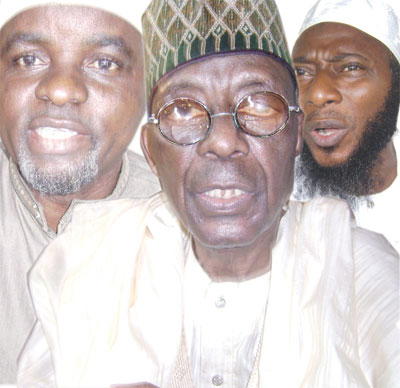
Alhaji M Garuba Akinola Ibrahim, OON, Chief Imam of Lagos State (Centre) and other Imans
By Haroon Balogun

The Prophet Muhammad (peace be upon him) once said, “Who from my Ummah (universal nation) would learn five qualities to act upon or teach to those who would (in turn) act upon them?” Abu Hurairah said, “I, O Messenger of God.” The Prophet (peace be upon him) took Abu Hurairah’s hand and counted the five qualities on it, saying:
- Guard yourself against things forbidden, you will be the most worshipful (devout) of people.
- Be content with what God has allotted you, you will be the richest of people.
- Be good to your neighbor, you will be a believer.
- Love for people what you love for yourself, you will be a Muslim.
- And do not laugh much; much laughing deadens the heart. (At-Tirmidhi, 2305)
He (peace be upon him) drew a square on the ground, then a line in the middle of it that extended beyond it, and a number of small lines around that middle line. He told his Companions that the line in the middle represented man.
Extended ambitions
The square represented his inescapable lifetime. And the small lines around it represented the afflictions that would happen to him (sickness, pain, bereavement, infirmity, and so on). He explained: “If this one misses him, that one gets him, and if that one misses him, this one gets him.” As for the line that extended outside the square, it represented man’s extended ambitions in this worldly life (ambitions that he believed he would attain before his death, but he would not). (Al-Bukhari, 6417)
There was not, and there cannot ever be, a better teacher. The wisest is the best of people. That was Prophet Muhammad (peace be upon him). His goodness of mind was only excelled by his goodness of character, whose ampleness and magnanimity was not narrowed or ruffled by anything. He was always overflowing with knowledge and benefit, always easy with people, approachable, informative, supportive, kind, generous, friendly, and cheerful; teaching people through his noble manners and actions as much as through his noble words.
Prophet Muhammad’s doors were not shut, nor did they have guards. He was within people’s reach. Anyone who wished to meet him could easily do so. His accessibility did not in the least detract from his majesty and honor. At first sight, awe was the primary emotion, which would soon, after a little association with him, dissolve into amiability. “Calm yourself,” the Prophet (peace be upon him) said soothingly to a man who came to talk to him and started trembling: “I am not a king. I am only the son of a woman who used to eat jerked meat (dried meat).”(1)
He smiled without laughing, was sad without frowning, strong without violence, modest without servility, and generous without extravagance. He shook hands with the rich and the poor, the young and the old, and was the first to greet whoever met him, whether young or old, black or red, free or a slave. If a man met and shook hands with him, he (peace be upon him) never withdrew his hand first; he waited for the other man to withdraw his hand. He was never the first to turn away his face; he waited until the other man had turned away his face.
He never said no to anything for which he was asked. And whenever given the choice between two matters, he chose the easier option, unless it involved a sin, in which case he would be the furthest from it. Prophet Muhammad (peace be upon him) was constantly mindful of God, wasted no time in useless talk, prolonged his prayers, shortened his sermons, and was never too proud to walk with the widows and the poor to fulfill their needs. His pattern of life was much like that of the common people.
Good manners and Courtesy
The Prophet (pbuh) was a living example for all humans to follow. His wife A’ishah was asked about his manners, and she said, “His manners were the Qur’an.” In this statement, A’ishah meant that the Prophet (pbuh) abided by its laws and commands and abstained from its prohibitions, and observed the virtuous deeds mentioned in it. The Prophet (pbuh) said: “God has sent me to perfect good manners and to do good deeds.” (Bukhari & Ahmed) Allah, the Exalted, described the Prophet (pbuh) saying:
“And indeed, you are of a great moral character” [68:4] Anas b. Malik served the Prophet (pbuh) for ten years; He was with him day in and day out, both when the Prophet (pbuh) traveled and when he was a resident in Madeenah. He was knowledgeable of the Prophet’s manners. He said: “The Prophet (pbuh) did not swear at anyone, nor was he rude, nor did he curse anyone. If he desired to reprimand someone, he would say: ‘What is wrong with him, may dust be cast in his face!” (Bukhari #5684)
Feelings of the child
The Prophet (pbuh) showed good manners and was courteous to all, even to children. Once when the Prophet was in a gathering, a drink was brought to the Prophet (pbuh) and he drank from it. On his right side there was a young boy and on his left side were elderly men. Feeling obliged by the respect of elders, and not wanting to hurt the feelings of the child, he asked the young boy:
“Do you mind if I give the drink to them?’ The young boy said: ‘O Prophet of God! By God! I would not prefer anyone to drink from the place you drank. This is my fair share18.’ The Messenger of God (pbuh) handed the boy the drink.” (Bukhari #2319) The Messenger of God (pbuh) was the most humble person. He was so humble that if a stranger were to enter the mosque and approach the Prophet’s sitting place while he was sitting with his Companions, one would not be able to distinguish him from his Companions. Anas bin Malik said:
“Once, while we were sitting with the Messenger of God (pbuh) in the Masjid, a man on his camel approached. After he tied it with a rope, he asked: ‘Who amongst you is Muhammad?’ The Messenger of God (pbuh) was sitting on the ground while he was leaning, with his Companions. We directed the Bedouin, saying: ‘This white man leaning on the ground.’ The Prophet (pbuh) did not differ nor distinguish himself from his Companions.”
The Prophet (pbuh) would not hesitate to help the poor, needy and widows in their needs. Anas b. Malik said: “A woman from the people of Madinah who was partially insane said to the Prophet (pbuh): ‘I have to ask you [your help] about something.’ He helped her and took care of her needs.” (Bukhari #670)
Mercy and Compassion
“A man came to the Prophet (pbuh) and said: ‘O Messenger of God! By God! I do not pray Fajr prayer because so and so lengthens the prayer.’ He said: ‘I have never seen the Messenger of God (pbuh) deliver a speech in such an angry state.’ He said: ‘O People! Verily there are among you those who chase people away! If you lead people in prayer, shorten the prayer. There are old and weak people and those with special needs behind you in prayer.’ “ (Bukhari #670)
Once when the Prophet (pbuh) went to visit his grandchild he shed some tears. “The Messenger of God (pbuh) sat with the child while he was on his deathbed. The child’s eyes froze in their places like stones. Upon seeing that, the Messenger of God (pbuh) wept. Sa’d said to him, ‘What is this ‘O Prophet of God?’ He said: ‘This is a mercy that God, the Exalted, places in the hearts of His slaves. Truly, God is merciful to those who are merciful towards others.’ “ (Bukhari #6942)
Justice and Fairness
The Messenger of God (pbuh) was just and fair in every aspect of his life and in the application of the religion. A’ishah said: ‘The people of Quraish were extremely concerned about a Makhzoomi woman (i.e. the woman from the tribe of Makhzoom) who committed a theft. They conversed among themselves and said, ‘Who can intercede on her behalf with the Messenger of God (pbuh)?’
They finally said: ‘Who dares to speak to the Messenger of God (pbuh) in this matter except Usamah b. Zaid, the most beloved young man to the Messenger of God (pbuh).’ So Usamah spoke to the Messenger of God (pbuh) regarding the woman. The Messenger of God (pbuh) said: ‘O Usamah! Do you intercede (on their behalf to disregard) one of God’s castigations and punishments!’ The Messenger of God (pbuh) got up and delivered a speech, saying:
‘People before you were destroyed because when the noble among them stole, they would let him go; and if the poor and weak stole they would punish him. By God! If Fatimah, the daughter of Muhammad stole, I would cut her hand off.’ (Bukhari #3288) The Messenger of God (pbuh) was just and fair and allowed others to avenge themselves if he harmed them. Usaid b. Hudhair said:

…Cross section of Almajiri students
‘A man from the Ansar, was cracking jokes with people and making them laugh, and the Prophet (pbuh) passed by him and poked his side lightly with a branch of a tree that he was carrying. The man exclaimed: ‘O Prophet of God! Allow me to avenge myself!’ The Prophet (pbuh) said: ‘Go Ahead!’
The man said: ‘O Messenger of God, you are wearing a garment, and I was not when you poked me [i.e. you jabbed my exposed skin, so it is only fair I do the same to you]!’ The Messenger of God (pbuh) raised his upper garment [to expose his side], and the Ansari [merely] kissed it, saying: ‘I only meant to do this, O Messenger of God!’ (Abu Dawood #5224)
Patience and Forbearance Anas bin Malik said: “Once, I was walking with the Messenger of God (pbuh) while he was wearing a Yemeni cloak with a collar with rough edges. A Bedouin grabbed him strongly. I looked at the side of his neck and saw that the edge of the cloak left a mark on his neck.
The Bedouin said, ‘O Muhammad! Give me [some] of the wealth of God that you have.’ The Messenger of God (pbuh) turned to the Bedouin, laughed and ordered that he be given [some money].” (Bukhari #2980)
Another example of his patience is the story of the Jewish Rabbi, Zaid bin Sa’nah. Zaid had given something as a loan to the Messenger of God (pbuh). He himself said, “Two or three days prior to the return of the debt, the Messenger of God (pbuh) was attending the funeral of a man from the Ansar. Abu Bakr and Umar, Uthman and some other Companions were with the Prophet (pbuh).
After he prayed the funeral prayer he sat down close to a wall, and I came towards him, grabbed him by the edges of his cloak, and looked at him in a harsh way, and said: ‘O Muhammad! Will you not pay me back my loan? I have not known the family of Abdul-Mutalib to delay in repaying debts!’ I looked at Umar b. al-Khat’taab – his eyes were swollen with anger! He looked at me and said: ‘O Enemy of God, do you talk to the Messenger of God and behave towards him in this manner?! By the One who sent him with the truth, had it not been for the fear of not entering the Heavenly Gardens, I would have beheaded you with my sword!
The Prophet (pbuh) was looking at Umar in a calm and peaceful manner, and he said: ‘O Umar, you should have given us sincere counseling, rather than to do what you did! O Umar, go and repay him his loan, and give him twenty Sa’a (measurement of weight) extra because you scared him!’ Zaid said: ‘Umar went with me, and repaid me the debt, and gave me over it twenty Sa’a of dates. I asked him: ‘What is this?’ He said: ‘The Messenger of God (pbuh) ordered me to give it, because I frightened you.’ Zaid then asked Umar: ‘O Umar, do you know who I am?’ Umar said: ‘No, I don’t – who are you?’
Zaid said: ‘I am Zaid b. Sa’nah.’ Umar inquired: ‘The Rabbi?’ Zaid answered: ‘Yes, the Rabbi.’ Umar then asked him: ‘What made you say what you said to the Prophet (pbuh) and do what you did to him?’ Zaid answered: ‘O Umar, I have seen all the signs of prophethood in the face of the Messenger of God (pbuh) except two – (the first) his patience and perseverance precede his anger and the second, the more harsher you are towards him, the kinder and more patient he becomes, and I am now satisfied.
O Umar, I hold you as a witness that I testify and am satisfied that there is no true god worthy of being worshipped except God alone, and my religion is Islam and Muhammad (pbuh) is my Prophet. I also hold you as a witness that half of my wealth – and I am among the wealthiest people in Madeenah – I give for the sake of God to the Muslims.’ Umar said: ‘you will not be able to distribute your wealth to all the Muslims, so say, ‘I will distribute it to some of the followers of Muhammad (pbuh).’ Zaid said:
‘I said, then I will distribute (the apportioned) wealth to some of the Muslims.’ Both Zaid and Umar returned to the Messenger of God (pbuh). Zaid said to him: ‘I bear witness that there is no true god worthy of being worshipped except God alone, and that Muhammad (pbuh) is the slave of God and His Messenger.’ He believed in him, and witnessed many battles and then died in the Battle of Tabook while he was encountering the enemy – may God have mercy on Zaid.’ “ (Ibn Hibban #288)
A great example of his forgiveness and perseverance is apparent when he pardoned the people of Makkah after its conquest. When the Messenger of God (pbuh) gathered the people; who had abused, harmed and tortured him and his companions, and had driven them out of the city of Makkah, he said: “What do you think I will do to you?’ They answered: ‘You will only do something favorable; you are a kind and generous brother, and a kind and generous nephew!’ The Prophet (pbuh) said: ‘Go – you are free to do as you wish.” (Baihaqi #18055)
Disclaimer
Comments expressed here do not reflect the opinions of Vanguard newspapers or any employee thereof.