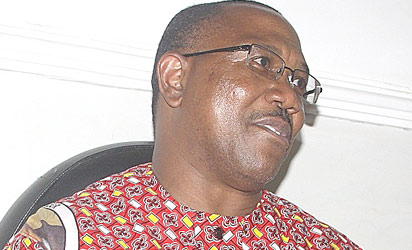
PETER OBI
By Jide Ajani
Because today has become yesterday’s tomorrow, good sense should compel every leader to sow good seeds today in the belief that when today becomes yesterday, people can look back and appreciate good deeds. It would, therefore, be safe to say most Nigerian politicians appear to lack good sense; so, good deeds in politics in this Republic are far and between.
Poor Anambra State! It is the stinging metaphor for this Fourth Republic.Blessed with intellectuals and businessmen of means, the state represents the good, the bad and the ugly of this Republic.

PETER OBI
Every vice in this Republic played out in Anambra in the build-up to the 1999 transition and even beyond. Mercifully, some shining examples of good governance and leadership also played out in this South East state.
From the way the Peoples Democratic Party, PDP, presented a governorship candidate in the state in 1999, manipulating the process to choose Chinwoke Mbadinuju above Professor ABC Nwosu, to the role billionaire Emeka Offor,
working hands-in-glove with former President Olusegun Obasanjo played, to the handover of the party to the cabalistic Ubas who, in turn, imposed Chris Ngige as governor, on the one hand; the crises that were to emanate from that imposition –
Ngige’s betrayal of trust, his alleged abduction, forced resignation and eventual control of his government, on the other hand; as well as the hiatus that was ushered in by the administration of Peter Obi, Anambra represents the best and the worst of the Fourth Republic.
Now, you will read in the following pages the good deeds of some individuals in this Republic. Deeds that have either set precedents; or deeds that go a long way to demonstrate that all hope cannot be lost. Interestingly, it is from that same Anambra State that good precedents were set.
We have merely selected 15 personalities spanning the 15 years of uninterrupted democracy.
The list may not meet some expectations but we believe, on average, it is reflective of some good deeds.
Until February 2010, all elections in Nigeria were uniform in terms of the date they held – apart from council elections which suffered irreparable damage on the altar of politicking.
Because the Constitution had prescribed four-year tenure for all other elective offices, they had, by necessity, held after four years – 1999 to 2003 and, expectedly, 2003 to 2007.
But Peter Obi, after hopping from one court to the other for over 1,000 days to demand that the mandate freely given to him by the people of Anambra but stolen by PDP’s Ngige, must be surrendered, changed all that. Just about a year was what was remaining of that four-year tenure when Obi won on March 15 and was sworn-in on March 17, 2006, to become governor.
After seven months in office, on November 2, 2006, he was egregiously impeached by the PDP-dominated state House of Assembly and replaced the next day by his then deputy, Dame Virginia Etiaba, making her the first ever female state governor in Nigeria’s history.
Obi challenged the impeachment and was subsequently reinstated on February 9, 2007 by the Court of Appeal sitting in Enugu.
Barely two months after, another governorship election was held generally – Anambra inclusive.
Obi had argued that all he had served was just about a quarter of the four-year tenure and, therefore, needed to complete his term. The Independent National Electoral Commission, INEC, simply conducted another election for that same seat.
Again, Obi headed for the courts. Andy Uba, who won that chimera of an election, was thrown out of Government House Awka because an election was not even supposed to have been held.
 Prior to the ascendancy of Obi, Anambra bore all the negativism of this Republic: Political gangsterism, political assassination, kidnapping, militancy, corruption in high places. You could go on.
Not that these vices were not happening in other parts of the country – they were. What made Anambra’s situation particularly stinging was the unbridled nature with which these acts of criminality were orchestrated.
Obi’s presence made all the difference.
And at no time was the quantum leap this soft-spoken man engendered for his state most manifest than when he was leaving office. Everyone who spoke about Anambra’s giant strides on the eve of Obi’s departure explained the truly uncommon transformation that Anambra enjoyed.
From a state that was becoming ungovernable, Anambra had peace and with it came development. In assets, Obi left behind billions of naira for his successor.
But Anambra also represents what is wrong with Nigeria’s democracy.
That for as long as people who are disposed to unconscionable acts continue to dominate the political space, for so long would the country not move forward.
Therefore, if an individual could ascend the governorship of a state and turn its fortunes around, there is hope that, some day, a good individual would become President and Commander-in-Chief and transform the fortunes of this country.
Disclaimer
Comments expressed here do not reflect the opinions of Vanguard newspapers or any employee thereof.