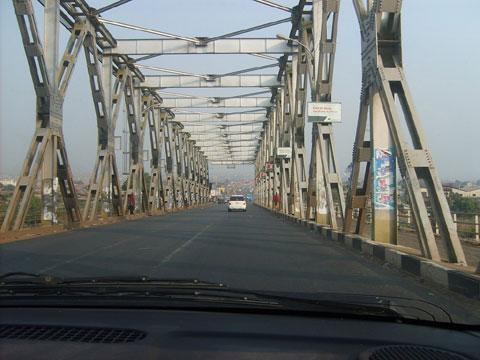
Niger Bridge
By AKINTOLA OMIGBODUN
The Federal Government of aNigeria, FGN, has recently flagged off the construction of a new bridge across the River Niger at Onitsha.

There have been reports that requirements for an Environmental Impact Assessment, EIA, study could delay the construction of the project. However, the Federal Ministry of Environment, FMENV, has indicated that it has given approval for the construction of the project to go ahead pending completion of an EIA study.
The FMENV has responsibility for the protection and development of the environment in Nigeria. Any new construction is expected to be environmentally and socially sound, economically viable and in compliance with the Environmental Impact Assessment Act No. 86 of 1992. An EIA study puts together information on existing conditions in the project’s area of influence.
The EIA study would then evaluate the likelihood that adverse ecological effects may occur in the process of the planning, construction and operation of the project. Furthermore, for social, cultural, economic and health conditions the EIA study would look at the effects of the project on the ways in which people live, work, play, relate to one another, organise to meet their needs and cope as members of society.
The second River Niger bridge at Onitsha is being executed on a design, build, finance, operate and transfer model. The bridge is located downstream of the existing bridge on a new alignment.
It would be dual carriageway with 8 traffic lanes and pedestrian walkways. The length of the bridge is 1590m as part of an 11.90km long road project with the cost of construction put at N117.86billion. The promoters of the project are to be given a concession for a period of 25 years.
An EIA study has the advantage that the public has to be consulted with relation to the project. Government actions are normally shrouded in secrecy and for this project, the public should be consulted on how much it would cost for a vehicle to use the bridge.
The public wants new infrastructure but we are ambivalent as to who should pay for the infrastructure. When a project is completed and ready for use, the public then comes up with the position that our taxes could readily have paid for the project. The government would also have to indicate if there would be any payment for a crossing of the existing bridge at some future date.
I expect that the existing bridge would be strengthened and renovated once the second bridge has been put into use.
I recall that in the 1950s, I travelled by road between Osogbo and Calabar and between Osogbo and Port Harcourt. On each journey, the travelling party and our vehicle was carried by ferry service between Asaba, Delta State and Onitsha, Anambra State. At that time, apart from the railway/road bridge crossings of the River Niger at Jebba and the River Benue at Makurdi, vehicular traffic was carried across all major rivers by ferry services.
The journey to Calabar required a second ferry journey from Oron to Calabar. During the 1970s, a number of bridges were constructed across the major rivers and tolls were paid by vehicles using these bridges until tolls were cancelled during President Obasanjo’s term in office.
Would the EIA study give us an idea of what a ferry journey would cost today between Asaba and Onitsha? A credible EIA study must provide information to support any tolls that would be charged on this new bridge.
There are a number of other things which the EIA study should look into. The study should ensure that the owners of parcels of land acquired for the right-of-way of the road are paid their compensation promptly.
The promoters, the Delta State Government and the Anambra State Government must ensure that layout plans for the development of land areas adjacent to the new road are specified by the state governments. In particular, these plans must ensure that the road is truly an expressway which would imply that access to the road is only at a limited number of locations.
Disclaimer
Comments expressed here do not reflect the opinions of Vanguard newspapers or any employee thereof.