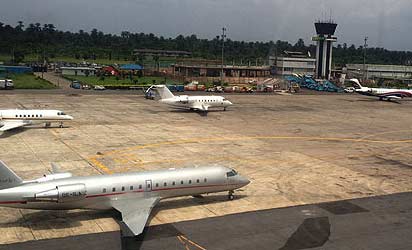
Akanu Ibiam International Airport, Enugu.
By Tonnie Iredia
Exactly one week ago, I left Nigeria for Dubai to attend the annual international broadcast exhibition -CABSAT 2014. Considering that the Dubai Emirate is a rich country, it was easy to appreciate the magnificent difference between Dubai, its main city and Abuja – our own self-acclaimed fastest growing city in Africa. However, some of my professional colleagues could not help discussing some of the structures that were put in use during the exhibition.
They noted for instance that without being uncharitable, our most beautiful International Conference Centre in Garki, Abuja can only pass for a village square when compared to the Dubai World Trade Centre-the venue of CABSAT 2014. Yet, our so-called conference center in Garki serves as a tourist centre for our fellow citizens who often travel long distances to see the marvels of Abuja.
Of course, in Dubai, we saw real beauty – wonderful things and processes that are absent in Nigeria but as I said those did not really bother me. I was rather weighed down by the fact that there was no Nigeria Airways to fly us to the exhibition. So, it was Ethiopia Airlines that came to my rescue. I probably would not have bothered about that choice if my trip was to Addis Ababa.
That I had to fly Ethiopia airline to Dubai left me with some pains more so as I had to be taken first to Addis Ababa –the capital of the airline’s home country; a stopover I didn’t really require. If so, why didn’t I use Dubai’s national airline – Emirate airline? The airline, we were told is ‘allowed’ to fly only to and from Lagos. It doesn’t operate in Abuja. In other words, for Abuja travellers who prefer Emirate airline, Lagos is an unavoidable stopover.
If I chose to go through Lagos would I not have missed the flight while struggling with the city’s characteristic traffic congestion? But why can’t an airline fly from its own capital city to ours? In this instant case, why can’t Emirate fly from Abuja to Dubai? What is International about the Nnamdi Azikiwe Airport when some international airlines are barred from operating there?
This was a poser my broadcast team first discussed while waiting to board. An unofficial source told us that for that to happen, top Nigerian aviation officials would have to be ‘seen’. Did the recent reforms by our aviation ministry consider this? If so, was it not clear that the concept of “seeing” dents the country’s image?
Anyway, my first experience on board Ethiopia Airline was that the flight took off on schedule as if it was a British airways flight. Thus, daily apologies by our indigenous airlines about every flight being “delayed due to operational reasons” didn’t happen. On arrival in Addis Ababa, there were no military, police, custom, DSS and protocol officials etc. to give travellers any directions. Well displayed signs did all of that.
We were led into the transit lounge which was simply decorated but quite functional. While there, we had nothing to worry about as flight movements were announced at regular intervals in different languages. The microphones ably amplified the announcer’s voice; loud and clear. It was a far departure from the typical Nigerian airport where travellers need to solicit the aid of different persons to translate for them into English, announcements that were supposedly being made also in English. So, is the installation of quality microphones in our airports part of our proclaimed aviation reforms?
The Addis Ababa airport was eventful – there were activities; shops, shops and shops that were arranged to invite travellers to procure duty-free items. On its part, our own Abuja airport is virtually barren. Are there no entrepreneurs to make our airports business-like or is the allocation of space for such businesses also subject to “seeing” decision makers?
From the lounge, we were conveyed in a bus to the Dubai- bound aircraft although the distance from the lounge to the aircraft was less than a stone throw. In fairness, this also happens in Nigeria just that the movement of passengers by bus to an aircraft in Nigeria is occasional as buses are sometimes unavailable. In Addis Ababa, no one, no matter his status is allowed to walk on the tarmac. As a matter of fact, the young man who sat by me in the bus introduced himself as one of the senior ministers of the host country but there was no policeman around him to provide him with what is called security in Nigeria. He did not also have a team of special assistants to carry his hand-luggage.
On arrival in Dubai, it was like a new world. The International Airport alone has several Terminals. The large crowd that had to pass through the immigration posts tells clearly that we were at a tourist destination making it unnecessary to publicise how much investment was coming to the city. Their own aviation officials did not isolate any passenger with likely huge foreign exchange for special handling.
Again, there was no crowd at the arrival gate notwithstanding that the distance between the gate and car parks was not too close. The arrangement is that everyone has to walk there. We didn’t also see ‘big’ men whether legislators or tycoons whose cars as in Nigeria blocked the entrance routes. So, we have quite some work to do in our reforms.
Most importantly, we need to note that Ethiopia and Dubai have not under the guise of searching for viable institutions privatized everything in their country. In Nigeria on the other hand, all our assets apart from may be the Presidential Villa have been sold off over the years, hence we sold the Nigeria Airways some years back to un-named fronts at give-away prices. Our current reforms must reverse that. If Nigeria is not a strong brand, the adverse effect of the absence of Nigeria Airways cannot be wished away. If brought back, Nigeria Airways has to be run by a leader with a strong character and not those who are put in office because it is easy to manipulate them.
Disclaimer
Comments expressed here do not reflect the opinions of Vanguard newspapers or any employee thereof.