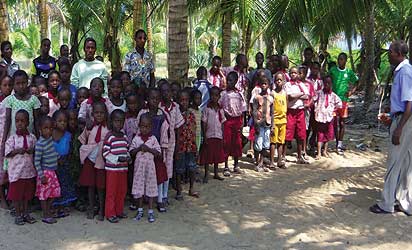
*Pupils of Ancore Life Primary School taking instructions from their teacher.
By Chioma Obinna
Hope has rises for parents and children living with autism as scientists have found that 24 percent of children with autism were non verbal or minimally verbal and the problems can persist into adulthood. The study published by Autistica consultation noted that professionals have long attempted to support the development of language in these children but with mixed outcomes.
Scientists at the University of Birmingham publish a paper in Frontiers in Neuroscience showing that while not all of the current interventions used are effective, there is real hope for progress by using interventions based on understanding natural language development and the role of motor and “motor mirroring” behaviour in toddlers.
An estimated 70 million people worldwide have autism, a neuro-developmental condition which is life-long. In Nigeria, “1 in 145 children are autistic and in 2011, prevalence of autism spectrum disorders was 0.8 percent in a south eastern hospital and this means 1 in 100.
Discrimination and stigma
Unfortunately, many people who affected are faced with various forms of discrimination and stigma both in the home. Their cases are made worst in countries like Nigeria where little or no attention is paid to persons with disabilities.
Scientists at the University of Birmingham publish a paper in Frontiers in Neuroscience showing that while not all of the current interventions used are effective, there is real hope for progress by using interventions based on understanding natural language development and the role of motor and “motor mirroring” behaviour in toddlers.
The researchers, led by Dr Joe McCleery, who is supported by autism research charity Autistica, examined over 200 published papers and more than 60 different intervention studies, and found that: Motor behaviours, such as banging toys and copying gestures or facial expressions (“mirroring”), play a key role in the learning of language.
Children with autism show specific motor impairments, and less “mirroring” brain activity, particularly in relation to strangers in whom they show very little interest. This finding may hold the key to language problems overall. Despite extensive use of sign language training to improve speech and communication skills in non-verbal children with autism, there is very little evidence that it makes a positive impact, potentially due to the impairments in motor behaviours and mirroring.
Picture exchange training can lead to improvements in speech. Here, children gradually learn to “ask” for things by exchanging pictures. This may work well because it does not depend on complex motor skills or mirroring. Play-based approaches which employ explicit teaching strategies and are developmentally based are particularly successful.
New studies involving a focus on motor skills alongside speech and language intervention are showing promising preliminary results. This is exciting because these interventions utilise our new understanding of the role of motor behaviours in the development of speech and social interaction.
With the support of Autistica, the UK’s leading autism research charity, Dr McCleery’s team have now embarked on new work which builds on these findings to design interventions which specifically target the aspects of development where there are deficits in non-verbal autistic children.
Dramatic breakthroughs
In the views of Dr. McCleery: “We feel that the field is approaching a turning point, with potentially dramatic breakthroughs to come in both our understanding of communication difficulties in people with autism, and the potential ways we can intervene to make a real difference for those children who are having difficulties learning to speak.”
CEO of Autistica, Christine Swabey said: “80 percent of the parents in their recent consultation wanted interventions straight after diagnosis. The work shows how critical it is for all intervention to be evidence-based, and that the best approaches are based on a real understanding of the development of difficulties in autism.
We are proud to be supporting the next steps in this vital research which will improve the quality of life for people with autism.” A parent of an autistic child, Alison Hardy, said: “The publication of this research is an exciting step in giving us that confidence.”
Disclaimer
Comments expressed here do not reflect the opinions of Vanguard newspapers or any employee thereof.