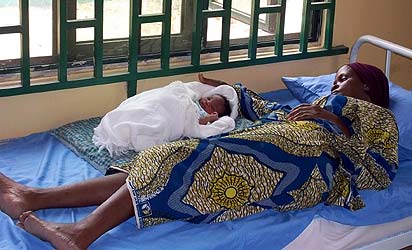
*Mother and child
By Sola Ogundipe
The last time she was pregnant, Nana developed pregnancy induced hypertension, but she was lucky because she lived to tell the story. When she first became pregnant, Nana hadn’t a single worry about her unborn child. She had no cause to be worried.
As long as she could remember, she had always been in tip-top shape. From all accounts, Nana was young and healthy and had no reason to expect a problem pregnancy. She was excited about welcoming her first child when, just a week short of her seventh month, she developed a serious high blood pressure condition. Her blood pressure was so precarious during her checkup her obstetrician admitted her immediately to the hospital for permanent bed rest.
The doctors did not mince words. It was a shock when she learned that the elevated blood pressure during pregnancy carries many risks to her and the unborn child. The medics did their best, but Nana’s BP continued to rise and just a little over there weeks later, her “tiny, but healthy” baby daughter was born prematurely through Caesarean Section.
Handling her condition involved daily blood pressure readings, medication adjustments, diet instruction and monitoring for the signs of pregnancy induced hypertension. The monitoring and medication continued alongside postpartum care, breastfeeding, nutrition and the importance of rest. Gradually, Nana’s blood pressure stabilised to a normal and safe level.
By then, her daughter was released from the ICU and was taken home. Nana was able to cope with all the routine and “normal” things a new mother does in order to care for her baby, such as bathing, feeding and managing a newborn’s care.

*A mother and her new born child
Medical records show that in Nigeria, pregnancy induced hypertension is more common during first pregnancy after the 20th week of pregnancy, according to medical literature. It is currently a leading cause of foetal and maternal morbidity and death in Nigeria and many other countries in the world, leading to increased risk of foetal growth restriction and induced premature delivery due to disease progression on the maternal or foetal side.
A hospital study showed the incidence and contribution of pregnancy -induced hypertension to maternal and perinatal morbidity in the health institution was significant. Intervention strategies for reduction of the incidence of eclampsia and its associated complications were recommended.
According to the study, “The incidence of pregnancy-induced hypertension in the study was 2.4 percent.
The conclusion was that “pregnancy-induced hypertension remains a common reproductive health problem and contributes significantly to maternal and perinatal morbidity and mortality in many parts of Nigeria. The failure to utilise antenatal care services may have contributed to the high incidence.
Medical literature shows that high blood pressure problems occur in 5-8 percent of all pregnancies in Nigeria, about 80 percent of which are first-time pregnancies, up to 40 percent of in certain areas.
Preeclampsia is just one of several causes of maternal death in Nigeria and the sub-Sahara Africa as a whole. Data show that although the proportion of pregnancies with gestational hypertension and eclampsia has remained about the same over the past decade, the rate of preeclampsia has increased by nearly one-third. This increase is due in part to a rise in the numbers of older mothers and of multiple births, where preeclampsia occurs more frequently.
The indication from what clinical conditions women are dying, what factors led to their deaths or whether the majority of deaths occur amongst women from any particular groups in society or geographical areas. One of the commonest factors is lack of regular contact with the health services.
The reality is that the vast majority of women die usually because they do not receive the health care that they need. This may be the result of a lack of basic health care provision or through, for whatever reason, an inability to access the local health care services.
Lack of skilled care, denial of access to care because of cultural beliefs and practices, seclusion or because responsibility for decision making falls to the husband or other family members and failure of support for pregnant women are among the obstacles to overcome.
Overcoming such inequalities in access to health care was part of the resolutions in Kampala. But even as the historic Women Deliver consultative meeting on maternal health held in Kampala, Uganda, gave way to the meeting convened by the Partnership for Maternal Newborn and Child Health (PMNCH) and the Africa Maternal Newborn and Child Health (MNCH) Coalition, it was clear that the death of a woman in pregnancy or childbirth is no longer acceptable anywhere on earth.
It was another day of hope for women and children, especially as the emergence of a strong resolution to fashion an expedited action plan that would enable African countries achieve reasonable milestones towards meeting the MDGs 4 and 5.
Cutting maternal and child deaths began as a global movement several years earlier when a global coalition of governments and organizations launched a major advocacy drive entitled Deliver Now for Women + Children. Agreeably, the African region has lagged behind in reaching the Millennium Development Goals for reducing maternal and child deaths by 2015. More than 10 million women and children still die each year mostly from preventable causes, while investment in basic maternal and child health remains insufficient.
Participants at the Kampala meeting are hopeful that with several global and regional plans and commitments in place, there is renewed hope that maternal and child survival will continue to improve in the region. It is in line with this that they are hoping to ride on frameworks, conventions among other available platforms to make major strides towards achieving the MDGs.
However, every year 4.4 million children , including 1.2 million newborns and 265,000 mothers still die in sub-Saharan Africa, amounting to 13,000 deaths per day or almost nine deaths every minute. Sub-Saharan Africa has half of the world’s maternal, newborn, and child deaths.
Information provided by the World Health Organisation, UNFPA, PPD, UNDP , reveal that the five biggest challenges for maternal, newborn, and child health in sub-Saharan Africa are: pregnancy and childbirth complications, newborn illness, childhood infections, malnutrition, and HIV/AIDS.
“It is an irony that while many scientifically proven health interventions are available for maternal, newborn, and child health, but they are currently underutilised to save women’s and children’s lives.
While avoiding maternal deaths is possible, it requires the right information and understanding of the underlying factors such as preeclampsia and others, that led to the deaths. Each maternal death or case of life-threatening complication has a story to tell and can provide indications on practical ways of addressing its causes and determinants.
Maternal death or morbidity reviews provide evidence of where the main problems in overcoming maternal mortality and morbidity may lie, produce an analysis of what can be done in practical terms and highlight the key areas requiring recommendations for health sector and community action as well as guidelines for improving clinical outcomes. Even with all these advances, in sub-Sahara Africa, a pregnant woman continues to have one foot in the grave.
Disclaimer
Comments expressed here do not reflect the opinions of Vanguard newspapers or any employee thereof.