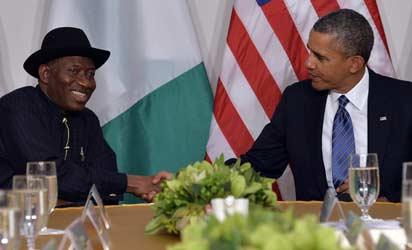
US President Barack Obama (R) shakes hands with President Goodluck Jonathan of Nigeria before their bilateral meeting in New York on September 23, 2013 on the sideline of the United Nations General Assembly. AFP
By Obi Nwakanma
As I write this, I have right here before me, the full text of the speech made to Nigerians by Dr. Nnamdi Azikiwe, first president of the Federal Republic of Nigeria, on Republic Day, October 1, 1963, titled, “Bravely Struggling Against Odds.”
Dr. Azikiwe was crisp and presidential in that speech. But I quote the more relevant part directly: “The achievement of independence brought many responsibilities with it, not least of which was that Nigeria as a sovereign nation, should become responsible for its own defences.
The policy of the Federal Government in this regard, has been to build a defence system for the country which would not only ensure internal security, but would also serve as a deterrent to external aggression.
In pursuance of this policy, the Nigerian Army is being re-organised to bring it up to operational standards, and it is being expanded and re-equipped with modern weapons. New war ships are being acquired by the Nigerian Navy, and construction work on shore facilities at both Apapa and Calabar are proceeding steadily.
In view of the fact that in the modern world, no country can consider its defences complete without an air cover, the Federal Government, after seeking expert advice, has begun preliminary work for establishing a Nigerian Air Force.”
Two important phrases are fundamental to our understanding of the irony of our current situation: first is the first president’s clear position that sovereignty confers on a nation the responsibility for its own defences, and second, that a defence of that sovereignty means the creation and mobilization of a defence system that would “ensure internal security and serve as a deterrent to external aggression.”
Before a president assumes power in Nigeria, he swears an oath of allegiance to the Republic of Nigeria that binds him to these commitments and the duty to defend Nigeria’s sovereign power with his life. Last week, President Goodluck Jonathan’s administration accepted the offer of the United States and the UK Governments, to send military operators in “aid” to Nigeria to smoke out the Boko Haram abductors of the girls from Chibok.
Jonathan’s action quickly ignited the discussion fora by Nigerians on-line, as well as in various Nigerian living rooms, about the implications of ceding Nigeria’s territorial space to a foreign military power to operate freely. Sovereign nations do not permit that kind of intrusion.
Many Nigerians are furious that President Jonathan has used the excuse of Boko Haram to allow his handlers to “invade” Nigeria and begin a process of dismantling and recolonizing Nigeria. They do not see American or UK charity or goodwill, they see something more subtly dangerous: the United States government’s use of the Boko Haram insurgency as coverage or excuse to establish its long-thought military operations called “Africom” which had been opposed by other presidents in office in Nigeria before Jonathan.
They see a US military presence smuggled through the back door as dangerous to Nigeria’s long term interests in Africa, particularly in Central West Africa. A great criticism often levelled against the president aside from his weakness is a lack of faith in Nigeria, and that this lack of faith makes it impossible for him to see beyond his narrow interests and to see the bigger picture.
This decision by President’s Goodluck Jonathan is possibly going to haunt him: it is going be the greatest single factor that will now shape the debates on his presidency, and finally hobble it because it provides the greatest example to his critics of his inability to govern; his neophyte sense of the meaning of his own powers as President and Commander-in-Chief of Nigeria’s so-called, and apparently non-existent Armed Forces;
and the fact as it is increasingly felt and widely circulated in Nigeria that by inviting foreign armies to operate freely in Nigeria and intervene in Nigeria’s internal security operations, Jonathan has abjured the oath of his office to defend Nigeria’s sovereignty with his life.
The president apparently said on Thursday, at the opening of the World Economic Forum in Abuja: “By God’s Grace we will conquer the terrorists.” But God has nothing to do with this menace, or with how Nigeria deals with its internal problems. Unless by God, the president means the US and the UK governments who have come to the rescue. Self-respecting nations defend themselves.
They do not wait for God or for some foreign power to do it for them – unless of course, you’re a banana republic. These are the issues that Jonathan will now have to deal with going forward. Of course, Jonathan has his defenders: a friend of mine, once himself a newspaper columnist wrote very tersely to me: “There isn’t a thing wrong in foreign powers coming to help.
It is not the same thing as deploying US troops in our backyard” Dr. Doyin Okupe came on record also to say, “Nigeria will accept help from anywhere.” But of course, he works for the Jonathan administration, and I put these statements down to either naïveté or deadly cynicism.
It is the same kind of cynicism that roused key leaders of North, when they met with the President, to reject any use of foreign troops on “Northern soil.” First, there is no “northern soil” – it is all Nigerian territory. Secondly, when the governors of what used to be the “northern region” flew to meet with the US government in Washington, they implicitly accepted foreign intervention. There are no saints in this situation, only reality.
And the reality is quite simple: when the Maitasine movement, deadlier, far better organized, and more widespread, attacked in 1980, President Shagari did not invite the Americans to flush them out, nor did he seek the intervention and help from the US and the UK to flush out the armed Chadian rebels that began to terrorize Nigerians in 1980.
He simply issued the orders and General Buhari mobilized the 3 Division from Jos as GOC, and flushed them out, pursuing them deep, deep into Chad, and securing the borders and internal peace of Nigeria. So, what is different today? Does Nigeria no longer have an effective National Defense system? If the Nigerian government would now depend on foreign military powers to flush out a rag-tag group like the Boko Haram, what happens if it is faced by an external military force engaged in war against it? What is the meaning of Nigeria’s sovereignty?
Meanwhile, our American friends should know the implications of their current engagement with Nigeria: soon, the talk will be, however untrue, how America secretly funded Boko Haram as an excuse to establish a military presence in Nigeria. Such an image will unite Nigerians far more than the issues of terrorism.
The trouble with most of these interventions is that Africans have a deep suspicion of the West based on their history with the West. There is a deep sense felt by Africans of disrespect of Africa and Africans by Western powers who generally only offer left-handed charity to a “dark continent” riddled by disease and war. The framework for this intervention rests clearly on this premise, and the US ought to stop a little and rethink this engagement. It might be counter-productive.
Disclaimer
Comments expressed here do not reflect the opinions of Vanguard newspapers or any employee thereof.