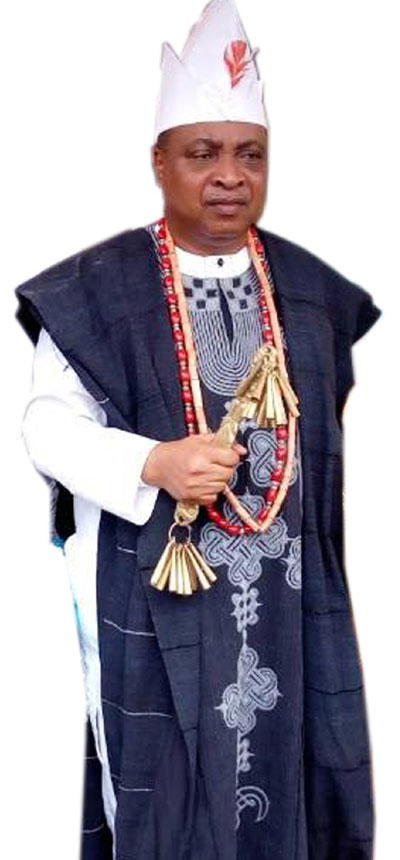
Oba Ajayi
Oba Babatunde Adewale Ajayi, an actuarial scientist, a chartered accountant and a lawyer, is the new Akarigbo of Ijebu Remo. In this interview, Ajayi speaks on his journey to the throne and his aspirations for his people.

Oba Ajayi
Did it ever occur to you that you will one day become a king?
To be honest, it never really occurred to me that I’ll one day become an Oba. I have never used the title ‘prince’. I think the consciousness came when the past Akarigbo passed on and it was all over the town that I will be the successor, even before the kingmakers chose me two months after the Akarigbo’s demise.
That was when I asked somebody, ‘What is with me and this throne thing?’ And then they said, ‘Don’t you know that your dad was the head of the Torungbunwa ruling house?’ Then somebody showed me a copy of the gazette and it became clear that our ruling house was next in line. Before then, the late Oba Sonariwo, anytime he saw me, would say ‘Tunde, better go and start getting ready for the throne’, and I would just reply, ‘Me, what is with me and the throne?’
So, I started thinking about this about 12 months ago.
Your selection by the kingmakers was almost unanimous. What do you think accounted for this?
It beats me. And that’s why I decided to throw my hat into the ring. Before the selection process started, I already had plans to travel for summer and I took off. Then it was all over the place that I ran away, but my mum said it wasn’t true. But it’s humbling.
In life, you reap whatever you sow. I have done a lot for our people, but it is not with the mind-set that I will be paid back. I was the National President of the Old Students’ Association of my secondary school for a long time and we did a lot.
And when it was time to invest … I remember a joke one old man cracked… that we had a good investment in Sagamu. The man said, ‘Don’t you that Irunmole (spirit) brought you to build this in Sagamu?’ But, to me, it was an investment decision, since Remo provides a good investment opportunity for the project.
So, I think people see in me someone who has given a lot to the community. I have been in seclusion now for almost three weeks and the support has been overwhelming.
What’s the selection process all about?
The kingmakers are guided by Ifa (oracle), but they cannot use Ifa to select. The key thing is that you have seven kingmakers who come together and consult the oracle, which guides them on which candidate is good for the community. Once they have that pool of candidates, they put it to a vote and recommend the most popular choice to government. And the moment government ratifies, the king is selected. We have two forms of ceremonies: Traditional and government. When I leave here, which is the traditional one, the icing on the cake is the government ceremony, the presentation of the staff of office.
Speculations were rife before and during the selection process that the high and mighty supported one of the candidates. How did you feel during that period?
All I know in my life is that when you work hard, you’ll get results. We worked hard and we knew we would get results. Besides, the people were on our side. So, we knew there was no other power that is beyond God and the community. So, I never doubted for once that we would get results.
There is an erosion of traditional institutions. Are you not worried by this development?
If you’ve asked me this question 12 months ago, honestly I would not have had a shade of idea. But in the last couple of days when I see my people, a lot of them, with so much expectations; the burden of expectation is so huge that many think when you get in there, with your power, you will just say ‘let there be road, let there be schools, let there be this, let there be that’.
And it is so painful – personally – that our Constitution has not provided a clear cut role for traditional rulers. If I have a budget and the resources, the expectations of these people would be met immediately. But the good thing there is that the throne is not tenured.
It is a lifetime thing, not something I’d do for four years or eight years and quit. I owe it to my people to do something. So, if roles are properly carved out for traditional rulers, I think there will be a meaningful transformation within the society. Having said that, we are in this business to serve. And I have told people that one thing that we will not be accused of is not trying. We will try, we will demand, we will parley, we will talk to whoever we need to talk to, so that my people will be empowered. We know that we are going to do something.
In July 1999, there was a crisis in Sagamu between the host community and the Hausa resident-settlers. But there has been absolute peace since then. How do you intend to sustain that?
We’ve already started. The Emir of Kano was the Guest of Honour at this year’s Sagamu Day. Unfortunately, he could not attend but he sent a representative. Beyond that, the Hausa community is part of the coronation process, serving on the committee.
How do you ensure that youths do not veer off completely from the Yoruba culture?
I have never been someone who is into tradition before now. But, of course, part of the things I was considering was ‘how do I handle things?’ However, you will be amazed that a lot of our people are still involved in traditional methods. In fact, I have had to give assurances while meeting with various groups and sects and units. All they need is proper arrangement. There is the need to be compliant with modern developments.
The tradition too needs to move with the modern trend. We have to be more organised so that we are not left behind. Someone asked me if I was going to attend local festivals, and I said ‘why not?’ but they need to plan. If I have my iPad and I have scheduled all the festival days, there is no way I won’t be there. I have even been told that we have an Ifa (oracle) School.
As far as Remo is concerned, support for tradition is huge and sacrosanct. I’m not going to say because I’m a Christian, I won’t join them. The same way I attend to Christians is the same way I attend to Muslims and people of other faiths.
And if we give these traditional people the resources, you will be amazed at the results. I cannot see our culture dying, based on my experiences in the last couple of weeks.
For a boardroom person, how has the confinement experience been? The seclusion will be on for some weeks.
I have not really been so much of a boardroom person. I have been an insolvency practitioner. I’m somebody that is always up and down and, for the first time in my life, I will say this has never happened to me, to be confined to a space for a period of more than three days, not to talk of weeks.
But by and large – and this is what I say about modernity – we’ve tried to modernise things. I was told that my predecessors, when they woke up, because they slept on the mat, they had to raise their legs and applied hot water.
That’s different now because we can have our mat and still put the mattress on it. We have a fairly conducive room. I even have CCTV in my room and can see what is going on outside. So, we’ve tried to make the best use of this situation. But it’s not really a bad thing. It just teaches me about humility, about sacrifice; you learn a lot and have time to think about so many things.
Don’t you think you are losing money by ascending the throne?
I have attained the age when you start thinking about retiring. But by and large, I think it is about sacrifice. When my friends heard, they could hardly believe it, because I am not just that kind of person. But I looked at it and said it is time for me to make a difference in the lives of my people.
And it is worth it when you consider the reaction of a 90- year-old woman coming and crying and saying it has never happened before that we will have an Akarigbo that is appealing to everybody. This is the first time that there won’t be rancour even amongst contenders after the selection.
Can you share with us a bit about your educational and professional background?
I went to Remo Secondary School. I also attended University of Ibadan for my first degree in actuarial sciences. When I finished, I trained as a chartered accountant. And, since I knew I was going to go into insolvency, I thought I needed to study law.
So, I went to Calabar for my LL.B. I did very well in school; I had the best result and in Law School too. And that’s me – when I want to do something, I am focused. Then I went to the University of Lagos for my LL.M. And I have taken lots of fellowship exams. I was the first INSOL Fellow in Nigeria. Now, we have three fellows in Nigeria.
What informed your choice of Calabar for your law degree? Why not in the South-West?
There is a story behind it. I was an accountant working and we got a massive contract in Calabar. At 26 then, I was a General Manager. But then, Calabar was a civil service town, so by three, four o’clock, you had nowhere to go. So, I told my principal that I wanted to do MBA, but he encouraged me to do law.
And because I was GM of a massive company, I had the connections; I was able to call the Vice Chancellor and tell him about my intention to enrol for a law programme. So, I packaged my documents and started the admission process. The trouble was when we finished the job we had in Calabar and I had to go back to Lagos. And Law School too; we were the first set of students to go to Law School in Abuja.
What is your agenda for the Yoruba nation?
I think a lot has been said about that and I don’t think I really have anything to add to the idea of unity, cohesion, because once we are divided, we cannot get what we rightly deserve. The Yoruba are trailblazers. We have achieved a lot in every sector of the economy and we cannot be pushed to the background; and I think one of the institutions that can be a voice for the Yoruba nation is the traditional institutions.
When we are installed, we will be a voice, because our people will know that we are truthful. What we are bringing to the table is sincerity. Our people don’t want much; so once you are sincere with them, you won’t have problem pushing your agenda through.
Disclaimer
Comments expressed here do not reflect the opinions of Vanguard newspapers or any employee thereof.