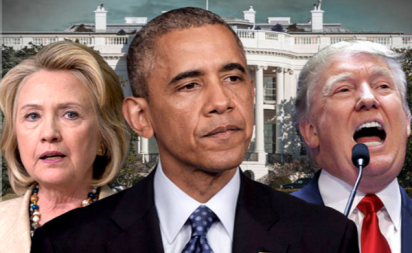
Obama-Trump
By Prof Osita Agbu & Kelechi Nwogu
In this piece, the Head, International Politics at the Nigerian Institute of International Affairs, NIIA, `Prof Osita Agbu and a Research Fellow at the institute, Mr. Kelechi Nwogu analysed the US 2016 Presidential Poll for Vanguard and its impact on democratic processes in the world.
This report raises the curtain on Vanguard’s special coverage of the election which would be covered in the US by our Group Political Editor, Emmanuel Aziken & Gbenga Oke, also of the Political Desk.
We are at a period in the history of America’s electoral history that the ordinary American citizen and indeed, the global citizen have never witnessed. While the electoral process and the developments arising therefrom are at once entertaining and intriguing, they are at the same time puzzling and dangerously close to questioning all the democratic credentials of the civilized world, and the United States as its purveyor. And who are the main actors, billionaire Donald Trump and the Republican party on the one hand; and Hilary Clinton and the Democratic Party on the other.
The stage is set, and there are all sorts of stage hands all trying to outdo each other to please the main actors, not to make the play pleasing to the audience, but to satisfy their perceived and mentally constructed finale. We just cannot wait for the play to end as presented by the CNN.
One thing is for sure, we all now know more about American democracy than ever before. While we kept waiting for the real issues to be thrashed out in the debates as befitting an advanced democracy, what came through was thrash, abuses, a lack of civility, bad blood, bitterness and a confused electorate as never seen before.
Integrity issues

Prof Osita Agbu
The question, therefore, is: How did the US electoral system throw up candidates that appear to have baggages trailing them, in this case psychological, egoistic and integrity issues.
As we know, democracy and respect for human rights have long been central components of US foreign policy. Supporting democracy not only promotes such fundamental American values as religious freedom and worker rights, but also helps create a more secure, stable, and prosperous global arena in which the United States can advance its national interests. In addition, democracy is the one national interest we know that that helps to secure all the others. The thinking is that democratically governed nations are more likely to secure the peace, deter aggression, expand open markets, promote economic development, protect American citizens, combat international terrorism and crime, uphold human and worker rights, avoid humanitarian crises and refugee flows, improve the global environment, and protect human health. Although, democracy is an ideal, however, you must agree with me that the virtues are noble, and so far, we are yet to see a type of government better than democracy for the selection of leaders and protection of rights.
It is against this backdrop that the United States sought to promote democracy and is seen as doing so as a means to achieve security, stability, and prosperity for the entire world, assist newly formed democracies in implementing democratic principles, assist democracy advocates around the world to establish vibrant democracies in their own countries; and identify and denounce regimes that deny their citizens the right to choose their leaders in elections that are free, fair, and transparent.
Transparent elections
In the past 25 years, the United States through policy and support of International Non-governmental organizations exported democracy to far-flanged areas of the world.
The goal, therefore, is for the United States to remain committed to expanding upon this legacy until all the citizens of the world have the fundamental right to choose those who govern them through an ongoing civil process that includes free, fair, and transparent elections. However, are these ideals coming through in the mudslinging characterizing the present presidential elections in the United States with even the FBI being accused of trying to influence the voters by announcing that there are more leaked email communications, which may further question the integrity of Hilary Clinton as a presidential candidate?
In respect of the US electoral process proper, according to the US Department of State in-house publication – Diplomacy in Action, the series of presidential primary elections and caucuses held in each US state and territory forms part of the nominating process of the United States presidential elections.
The United States Constitution has never specified the process; political parties have developed their own procedures over time. Some states hold only primary elections, some hold only caucuses, and others use a combination of both.
National convention
These primaries and caucuses are staggered, generally beginning in either late-January or early-February, and ending about mid-June before the general election in November. State and local governments run the primary elections, while caucuses are private events that are directly run by the political parties themselves.
A state’s primary election or caucus is usually an indirect election. Instead of voters directly selecting a particular person running for President, they determine the number of delegates each party’s national convention will receive from their respective state. These delegates then, in turn, select their party’s presidential nominee. Each party determines how many delegates it allocates to each state. Along with those pledged delegates chosen during the primaries and caucuses, state delegations to both the Democratic and Republican conventions also include unpledged delegates who have a vote. For Republicans, they consist of the three top party officials who serve At Large from each state and territory. Democrats have a more expansive group of unpledged delegates called super delegates, who are party leaders and elected officials.
If no single candidate has secured an absolute majority of delegates (including both pledged and unpledged), then a brokered convention occurs, all pledged delegates are released after the first round of voting and are able to switch their allegiance to a different candidate, and then additional rounds take place until there is a winner with an absolute majority.
Anti-establishment businessman

Kelechi Nwogu
As have been observed by many the ongoing presidential campaign in the United States stands out for its lack of civility and the vast differences between the candidates: the anti-establishment businessman Donald Trump and the polished and experienced politician Hillary Clinton.
The contest has exposed deep fault lines within American society and may have damaged the country’s global reputation. But has the campaign gone too far? And what comes next? The Republican nominee Donald Trump could be said to be a most unlikely populist. Having inherited a fortune and added value to it, he is self-confident, sure of himself and distasteful of other less achieved humans. He talks of an economy he understands, and surprisingly shows little knowledge of diplomacy and international politics. But he has somehow managed to tap into a deep vein of distress and resentment among millions of white working- and middle-class Americans who want some change, a departure from the establishment politics they have seen over the years. To them, Hilary Clinton represents this establishment.
The current Polls suggest that Clinton, a former senator and secretary of state, will defeat the controversial Trump, even though her lead is increasingly narrowing by the day as the play reaches crescendo. But the polls could be wrong as has been experienced severally on several other issues around the globe in recent times, from the Brexit vote in Europe to the Peace Deal gone sour in Colombia. The only poll that will finally put this speculation to rest is that of November 8.
The basis for Trump overcoming the lead already established by Clinton, and by extension Barack Obama and the democrats is for him to win the “battle ground” states, the states which swing more frequently from Democrat to Republican and back over the decades. The other states are considered “safe I seats” as it is easy to predict who the winner will be.
Greater confidence
The safe seats account for 418 of the 538 Electoral College votes to be won on Election Day. These states are Florida, Pennsylvania, Ohio, North Carolina, Virginia, Colorado, Iowa, Nevada and New Hampshire.
Yet some predictions can be made with greater confidence. There is very little doubt that the US will emerge from this election with bruises and a divided government, regardless of who is president or which party has a majority in either chamber of Congress. In a post Trump-Clinton Presidential battle, it will be more difficult to achieve a centrist position on issues in the United States as the divide is not only between the Republicans and Democrats, but also within the wider American society. Indeed, it is said as seen from the polls that both presidential candidates are actually unpopular with about 60 percent disapproval rate by Americans. If Clinton wins, it will be a case of the – devil you know is better than the one you do not – and only because of Trump’s flaws.
And if Trump wins, after we recover from the surprise and probably miracle, it will create a situation in which most Democrats and even some Republicans will make it their highest priority to ensure that he does not have an opportunity for a second term, given his many flaws, governing would be rather very difficult during his administration. But what are the policy issues that somehow got sidelined in the heated media war on trivialities during the campaign – they are issues to do with how to enact legislation to fund the modernization of America’s aging infrastructure, reform of the US tax code – in particular, lowering the high rate for corporations and raising taxes on the wealthy, and some reform of health care – President Barack Obama’s signature achievement, which has suffered implementation problems.
In addition, there is also the lingering and nagging border and immigration issues and reform, which are as controversial in the US as it is in Europe, as well as trade issues. It is on record that both Trump and Clinton oppose the Trans-Pacific Partnership, even though its ratification could benefit America’s economy and strategic standing.
The foreign-policy implications of the election is quite interesting as under Clinton, the discretion of the president to execute foreign policy could translate into establishing one or more safe areas in Syria, providing more defensive arms to Ukraine, and taking a tougher line toward North Korea as it continues its nuclear and missile buildup. On the other hand, it is more difficult to guess what Trump would do as one cannot seriously guess how his many campaign rhetoric would be translated into policy. Still, it is possible to anticipate a Trump administration distancing itself from some traditional allies in Europe and Asia and standing mostly aloof from the Middle East crisis as noted by experts.
Electoral experience
How will America and the global community be after this election? No one can really say with any certainty, but only to hazard a guess that American electoral experience will never be the same again, and that both parties – the Democratic and the Republicans parties would have learned some serious lessons about who not to put forward as presidential candidates.
For the global community at all levels, it is plausible that the choice of Americans in this unprecedented and dramatic electoral process will impact one way or the other. Has faith in democracy been eroded from this experience? With Donald Trump refusing to say that he will accept the result of the election during the third debate for instance. Perhaps! Our faith in democracy American style is shaken!
But the lesson for all is that with over 200 years of practicing democracy America still makes mistakes, and this implies that for younger democracies hope must never be lost in incrementally building better and transparent selection processes of our leaders.
- Osita Agbu is Research Professor and Head, Division of International Politics at the Nigerian Institute of International Affairs, Lagos. Kelechi Nwogu is a Research Fellow at the Institute.
Disclaimer
Comments expressed here do not reflect the opinions of Vanguard newspapers or any employee thereof.