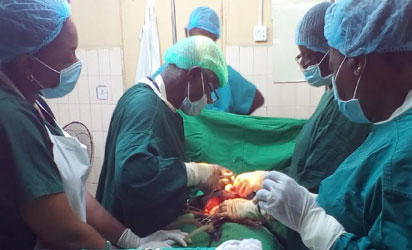
FIBROID SURGERY
By Sola Ogundipe
FIBROIDS. The mere mention of the word sends cold shivers down the spines of millions of Nigerian women, particularly those of child-bearing age. Such was the experience of Taiwo Adewale who has been married 11 years without getting pregnant.

FIBROID SURGERY: Research shows that an estimated 7 in 10 black women are affected.
“I was really afraid when I was diagnosed with fibroid. I have been to so many places with this problem, but I was told the only way out was surgery.,” she told Good Health Weekly in a chat.
Taiwo recalled that she blatantly refused because many of her friends told her she would never conceive and even risked death if she did fibroid surgery.
“But doctor said surgery was the only solution to my problem. They said there was no alternative, because the fibroid I had was large.
“I had terrible pains and was always bleeding heavily even between periods. At one hospital, I was even told that I needed to have my womb removed but my husband and I were very worried about that because we do not have children yet.
Taiwo coped with her agonising situation until one day, her husband was watching the Televison and came upon a programme about a Foundation that was offering free fibroid removal surgery for women. “When my husband got to know about this initiative by the Irene Fibroid Foundation, IFF, he told me and we did all we could to contact the organisers.
“It was like a dream come true. We were really broke because we have spent a lot of money on this problem all to no avail. But we came in, and they began the follow up and my expectations were sky high. Taiwo, who did her surgery last year is now pregnant and expecting to put to bed soon.
Investigations by Good Health Weekly show medical experts are divided about why fibroids occur. A gynaecologist explained that during a woman’s reproductive years, her estrogen and progesterone levels are high. “When estrogen levels are high, especially during pregnancy, fibroids tend to swell. When estrogen levels are low fibroids may shrink, for instance, during a woman’s menopause.
Heredity is also a noted factor. It is known that women whose mothers and/or sisters have/had fibroids have a higher risk of developing them. In most cases, the symptoms of fibroids are rarely felt and the patient does not know she has them. They are usually discovered during a vaginal examination.
Generally, most women have no symptoms of fibroids, but when symptoms do develop, they may be severe. Common examples include anemia (as a result of heavy periods), backache, constipation, and discomfort in the lower abdomen (if the fibroids are large).
Access to right information
Others are frequent urination, heavy painful periods, pain in the legs, painful sex, and swelling in the lower abdomen. Women with possible symptoms of uterine fibroids may have labour and/or pregnancy problems, fertility problems and repeated miscarriages. “Many women with fibroid are suffering. Having access to the right information has not been easy,” she remarked.
In the views of Dr. Moses Ani, an experienced family physician and surgeon, estimates show that fibroids affect at least 20 percent of all women sometime during their life, however, clinical evidence shows that women aged between 30 and 50 are the most likely to develop fibroids. Overweight and obese women could be more at risk of developing fibroids, compared to women of normal weight.
Ani, who created Irene Fibroid Foundation as an outfit to help women tackle the menace of fibroids and its related effects on the family and lives of women especially the indigent, recently carried out free fibroid removal surgeries for 10 women to mark his 60th birthday last July.
“We have seen people who are indigent and cannot help themselves and are at the mercy of quacks. I started nursing the idea of having a Foundation in 2015, which was the only way we could offer help to the indigent. And we constituted the Irene Fibroid Foundation.
“In 2013 we collaborated with the Association of Rural Surgical Physicians of Nigeria, ASPRON, to conduct three days free surgical outreach in Festac Town. Over 100 women benefited. That outreach gave birth to the desire to tackle the issue of fibroids in our indigent women,” he remarked.
The physician said the plan was to mark the occasion by doing free fibroid surgeries for six indigent women. “We later increased it to 10 after we did a TV enlightenment and women with this problem rushed here. “If the fibroid is inside the womb, it could afftect conception or if she gets pregnant, lose the pregnancy. It will not allow the baby to grow and causes abortion.
“If it is located in the Fallopian Tube, there cannot be conception because it blocks the tube.” Ani explained that sometimes there could be fibroids and conception together. “In this instance, it might produce a small-for-age baby or trigger premature deliveries or babies that are squeezed inside the woman. They often die at delivery.
A lot of women that have had their fibroids removed do get pregnant. Ani debunked widespread belief that women would usually die, or fail to get pregnant after undergoing fibroid surgery. “It is not true,” he remarked. “There is a 50-50 chance, but noted that the African woman has it more. “Back home, a woman may have fibroid and it will not disturb her, but if it disturbs her, she should remove it.,” he avowed.
In a chat, Matron Christy Ekhoeveh, Head of the IFF medical team, described fibroid as a mass attached to the womb. “It is not part of the womb, and there is need for sustained education and enlightenment to enable women appreciate that this mass is removable and that they do not have to live with it and suffer. Once a fibroid is removed, it increases the chances of a woman becoming pregnant.”
Ekhoeveh,who lamented that attention given to fibroids is not yet enough, called for greater enlightenment. “The belief that fibroids can be passed out is yet to be proved right because even as a medical personnel, I am yet to experience it. It may shrink, but will remain there as a mass without surgery.”
Findings show that on the average, fibroid removal surgery in a private hospital costs N500,000-N600,000. This cost is certainly beyond the reach of many of those affected, but who have the expectation of ending up with their own babies.
“Having fibroid is not normal. In times past people did not know what fibroids were, then we came to find out that fibroids are real in African women. Actually 70 percent of our women have fibroids. If you talk about infertility, fibroid is one of the cause on its own depending on the location and how much of it the woman has.”
Disclaimer
Comments expressed here do not reflect the opinions of Vanguard newspapers or any employee thereof.