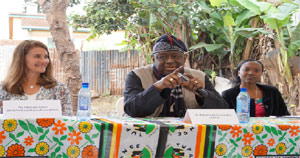
FAMILY PLANNING MEETING: From left: Co-Chair, Bill & Melinda Gates Foundation, Melinda Gates; Executive Director, UNFPA, Professor Babatunde Osotimehin and Youth Representative, FP 2020 Reference Group, Margaret Bolaji, during the High Level media briefing held in Nairobi, Kenya, recently.
By Sola Ogundipe
“FAMILY planning is about saving the lives of women and children. Family planning is one of the keys that unlocks the potentials of women and girls. If a girl or woman is able to voluntarily space the births of her children, it frees her and her family from the cycle of poverty.” These remarks by the Co-Chair of the Bill and Melinda Gates Foundation, BMGF, Melinda Gates, set the tone for a High Level media briefing recently,

FAMILY PLANNING MEETING: From left: Co-Chair, Bill & Melinda Gates Foundation, Melinda Gates; Executive Director, UNFPA, Professor Babatunde Osotimehin and Youth Representative, FP 2020 Reference Group, Margaret Bolaji, during the High Level media briefing held in Nairobi, Kenya, recently.
She spoke to journalists from Uganda, Tanzania, Ethiopia, Central Africa Republic, Senegal, Kenya and Nigeria who gathered at the 7th Day Adventist Church, Kangemi, Nairobi, Kenya to meet with representatives of the Bill and Melinda Gates Foundation, UNFPA, and Government of Kenya officials. The forum was the midpoint assessment of the landmark 2012 London Summit on Family Planning, FP2020, a global partnership that supports the rights of women to access family planning services voluntarily.
Gates, who spearheaded the 2012 London Summit along with UNFPA, UK government and USAID, adopted the goal of delivering contraceptives to an additional 120 million women and girls in 69 least developing countries by 2020, however said the world was not on track to meet the global objective. “I talk to women all over the world about family planning. They tell me that if they can space the births of their children, if they can feed them, clothe them, educate them, and get a job, that would do it for them.”
“We are at the halfway point and we are not on track. We are yet to meet the FP 2020 goal of 120 million women having voluntary access to contraceptives.” Gates stated that the world has achieved voluntary access to 24 million women, “but if we want to reach the goal that the UN member states put forward from 193 nations, that is, providing modern contraceptive access to all women by 2030, we need to get back on track.”
Further, Gates stated: “It means we must have the right political will and sustain it. It means giving services, talking to the people and making sure they understand their bodies and family planning. It also means looking at the data and using it.” In his contribution, Executive Director, UNFPA, Professor Babatunde Osotimehin said family planning has been around for a long time and had its up and downs.
He recalled that in 2012, the context was that there were 221 million women in the world who were in need of family planning sevices but were not getting it. “So we felt it was totally unacceptable and we had to correct that. We promised ourselves to do this in six years. A lot has happened. We have increased the uptake of family planning services, but it is also to say that it has not been exactly on target.”
Osotimehin said even though many countries have increased their commitment to family planning since the London conference, with more bilateral and multilateral funding, not much progress has been recorded. “There is still a lot to do for us to meet out target,” he remarked. “So this particular event of coming to Nairobi is to access where we are and recommit ourselves to what we did in 2012.”
In her own remark, Programme Officer, Population and Reproductive Health Initiative (Nigeria), and Vice President, UNFPA Youth Advisory Group, Margaret Bolaji, said it was time to change the policies the sociocultural and implementation barriers around youths, such as adolescent pregnancy, forced child marriage marriages or barriers to youth leadership to participation.
Bolaji who is the Youth Representative, FP 2020 Reference Group, noted: “We must involve young people in every aspect of development and implementing solutions, remove policy barriers that prevent young people from accessing resources they need to plan their families. “We must also ensure providers are trained to educate young people and to provide services for them free of barriers and opinion,” she argued
Disclaimer
Comments expressed here do not reflect the opinions of Vanguard newspapers or any employee thereof.