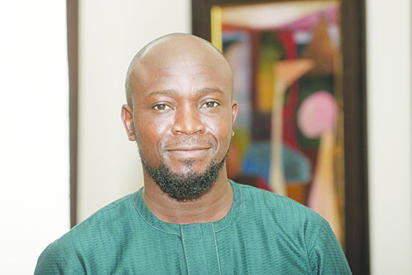
• Jeff Ajueshi, CEO Thought Pyramid Art Centre, Abuja
By JAPHET ALAKAM
Thought Pyramid Art Gallery is one of the biggest galleries in the country, and definitely the biggest in Abuja. The gallery which has changed art history of Abuja is the brain child of Mr Jeff Ajueshi, who incidentally is the curator and Director. A native of Oghara, Ethiope West Local Govenment Area of Delta State, Jeff who did not study art, but is now one of the greatest art promoters in the land, in this interview reveals the motivation for establishing the gallery, the challenges, the choice of Abuja and other sundry issues. Excerpts:
You are not an artist, why arts among other business and what inspired you?
Since I was born, I have always been fascinated and almost obsessed with visual images and bright colours. And ever since I left school, I have been engaged in the art business and I have been involved in extending the frontiers of art in this country in my little way, and I have also been living by it, in economic terms. What actually drives my passion is that I see art beyond money making; I view it as a way of life which should be sustained, for my survival and my pleasure. In order to survive, I realise that we need to be able to tell the difference between different objects.

• Jeff Ajueshi, CEO Thought Pyramid Art Centre, Abuja
Art for me offers a moment frozen in time that is available to the ages, as it takes on the form of a touchstone for those who follow; something to visit along the way and to hold in common with others in their culture; something that will allow us to see how we hold ourselves relative to the object beheld and relative to our contemporaries, as well as something to feel. What you see as beautiful, wonderful, spectacular, astonishing or nauseating supplies you with a kind of cultural pulse rate, a way to measure your relative metabolism.
Lagos is the commercial capital of Nigeria where art business thrive, why the choice of Abuja?
Of course, we knew that Abuja was not a city where people were interested in the art. But, do not forget that it was not as if the Abuja people had an offer for visual art interface that they turned down, in terms of where they could have a good art gallery to see and appreciate art.
We had to set up here, in order to help communicate that if a work of art intrigues you – any art – no matter how much or how little you know about it, just ask questions. The answers to your questions might intrigue you even the more, and your increased understanding of art may well evolve into an exceptionally enlightening experience. We cannot be any happier and delighted than how we responded to this particular question; we can strongly tell that there is hardly anything that we like better than talking art with anyone who shows any interest whatsoever. Believe it. We as a gallery are in business because we love art, and we love sharing our knowledge about art, welcoming people into the realm of art, and putting art into the hands of people who genuinely appreciate it. We have patiently been doing this in Abuja, and it is paying off. So, gradually, Abuja is becoming a vibrant art city, and I can assure you that in a very short while, Abuja would give Lagos very stiff competition, in terms of art patronage.
How has it been since the establishment of the gallery?
Well, it hasn’t been a smooth ride. There has been an avalanche of challenges at different points. I think that one of the biggest challenges of my continuing on full scale, and of my being in a full-time art business now is the pressure of competing with the big money stores and cheaply made items brought in from other countries. Another challenge for me is reserving uninterrupted creative time as the cornerstone of growth and success for my business, since the vibrant nature of art is what differentiates art from other things. At the same time, I am happy to see that it is important to be creative in finding non-conventional ways to keep my work visible to the public. I also think that with the way marketing is trending, it is wise for us to make a constant effort to stay on top of traditional as well as social and digital strategies to broaden our audience.
In just few years, your gallery has hosted high class exhibitions and have made name as one of the best in the land, what is the secret behind the success story?
We were able to manoeuvre what could have killed us from the onset because we knew that there were a handful of risks ahead of us. What we did was to identify and as well mitigate those risks. We started promoting art in this Abuja when the economy was seriously looking down. Though such a period was unforseen for us, we had already taught about that from the beginning. So, we had to pay more heed to our peculiar risk management principle which I hold dearly to heart and we were able to spot the flip side of risk which is an opportunity for survival.
Art buying is no longer on the weight of the very wealthy people. I have observed that the gallery is for everyone, and that is a great thing because now I can speak to the whole world as an art promoter. We opened to cater for the art lovers here in Abuja and even beyond. We have so far achieved the feat that our customers talk about us and our environment and our location has become our unique selling point. Our highpoint this year was the visit of the President of the Federal Republic of Germany to the Centre, last month.
A look at the building, the art works and other infrastructures that adorn the centre. Its clear that you invested much on it. Why did you invest such in art knowing that it is not all that lucrative?
I invested a lot in the centre because I have a passion for promoting art and have always dreamt of having a space that will house and promote art works and artists.
How is the centre coping in this period of economic recession?
Now is a difficult time for many people in the world. The current economic trends have not favoured the art market. Selling art is never easy, even in the most robust of economies, and at times like this, it can seem nearly impossible. But confronting adversities is a fact of life. Therefore, we have adjusted to prevailing conditions in order to survive. We are very flexible, particularly with respect to selling prices, realizing that art prices fluctuate according to supply and demand. So we monitor the health of the art market on an ongoing basis in order to respond appropriately to changes as they occur.
You established the Foundation for Arts and Creative Talent (FACT) in Oghara, how is the facility impacting on the youths?
The establishment of the Foundation for Arts and Creative Talent in Oghara is one of my efforts to encourage entrepreneurship and creativity among the youths of the Niger delta and create a positive energy diversion. Although this centre is still being developed, it will have among other things a residency space for visual artists and writers alike. The Visual artist in residency programme will provide opportunity for the youths in the community to work with a selection of professional artists to receive informal training. Programmes like craft and textile workshops will go a long way to provide entrepreneurship opportunities and alternative income for locals. It is our hope that with this project, youth restiveness in the region will be curbed to a large extent.
Disclaimer
Comments expressed here do not reflect the opinions of Vanguard newspapers or any employee thereof.