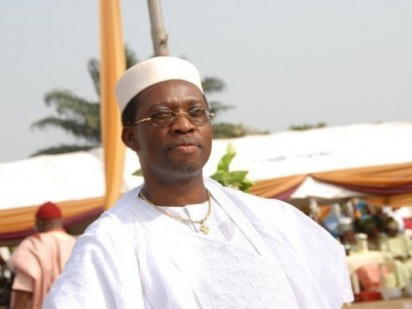
Okowa
By Emmanuel Aziken, Political Editor
ASABA- DRAWING analogy from the Governorship Election Petition Tribunals at Akwa Ibom and Rivers States, which quashed the elections of Governors Udom Emmanuel and Nyesom Wike, the All Progressives Congress, APC and Labour Party, LP, governorship candidates in Delta State in the April 11, 2014 governorship election, Olorogun O’tega Emerhor and Chief Great Ogboru may have anticipated Delta State to follow the bandwagon last Monday.
However, this was not to be, as the three-man Governorship Election Petition Tribunal in the state, chaired by Justice Nasiru Gunmi, darted their expectations. It did not invalidate result in a single local government, not to talk of ordering a re-run.
The tribunal not only sustained the election of Governor Ifeanyi Okowa, the candidate of the Peoples Democratic Party, PDP, in the election, it dismissed their petitions with ignominy.
Starting with the petition by Ogboru and his party, the tribunal held that the petitioners were under obligation to prove their claims that the election of Senator Okowa as governor did not substantially comply with the provisions of the Electoral Act, 2010 as amended, but contrarily, they abandoned the roadway and pursued shadow during the proceedings.
TELLTALE signs: As far as
the tribunal was concerned, Ogboru and Labour Party woefully failed to prove their assertions of ballot stuffing and other electoral malpractices. As if saying the petitioners came to waste the time of the tribunal given that their witnesses appallingly contradicted, themselves in their testimonies, the tribunal awarded N50, 000 costs against each of the petitioners.
Justice Gunmi gave clue of the tribunal’s displeasure with the demeanour of the petitioners’ witnesses when Mr. Turner Ogboru, a younger brother to Ogboru, appeared before it earlier on September 16. He commented that the way he answered questions by lawyers to respondents might be injurious to the case of the petitioners.

Okowa
He said, “Don’t stretch our patience, maybe we have to take an adjournment and ask your counsel to advice you on how to behave. You are a witness in this matter, whatever relationship you have with counsels does not count here, and you should answer the questions directly, so please help us. I want you to know that the evidence you give will determine your case, if you do not comport yourself, I do not know how you are helping in this matter.”
Flawed theory: The conclusion of the tribunal, especially in the Emerhor/APC case against Okowa, was that the petitioners incorrectly thought that with the verdict of the Rivers tribunal to the effect that INEC compromised the election in the state with the use of incident forms, rather than adherence to card reader, would automatically ricochet in Delta.
Shoddy preparation
Though the tribunal overrode the preliminary objections of the respondents that Emerhor was not competent to bring the action and lacked locus standi, it said the uncorroborated malfunction of the card reader, a complement to the accreditation process at some polling units did not invalid Okowa’s election.
What dumbfounded the tribunal the more and which counted greatly in favour of Okowa, was the seemingly clumsy manner the petitioners went about the case. Indeed, this was the decisive factor for the governor.
As the panel said, “The petition is unusual for a gubernatorial electoral petition; it contains only 17 paragraphs, on seven pages of A4 paper. There are 25 local government areas in Delta state and by virtue of polling units…, there are at least, 3,329 polling units in Delta state. One would have thought that there would have been pleadings on what transpired in the polling units but this was not the case.”
The panel said it was, therefore, not surprised at the lean pleadings of the petition, as the petitioners dwelt more on the use of card readers vis a vis their deployment for the election and the authority of INEC introducing it in the first instance, instead of proving the allegation of corrupt practices they canvassed.

*Ogboru
In fact, it wondered why the petitioners did not adduce factual situations that occurred at some of the over 3,000 polling units in the state to substantiate their case. For the avoidance of doubt, it said the electoral umpire had the authority to introduce card reader and make other regulations for the conduct of elections in the country.
The tribunal did not see how unproven hitches experienced with the card reader would amount to a failure of a device used for the first time in the country to eliminate the same corrupt practices the petitioners complained.
Toxic votes: The panel said it was not enough for the petitioners to seek declaratory reliefs from it, saying they should prove their case before looking forward to reliefs, adding that it was their responsibility to establish the existence of toxic votes in the ballots counted for Okowa. It held that out of the 715,392 votes earlier uploaded by INEC from its server in June and the 715,592 votes at the end of August, the petitioners did not bear out the toxic votes and it was not the assignment of the tribunal to prove the case of the petitioners. In any case, it said the petitioners’ dependence on the uploaded figure of INEC was insufficient and never advanced their case.
Fatality of petitions: The tribunal ruled that it was wrong for the petitioners to rely on the weakness of the case of the respondents, saying in all, they failed to demonstrate that INEC did not conduct the election in substantial accordance with the Electoral Act.
Okowa’s confidence: Counsels for the various respondents, Alex Iziyon, SAN, Timothy Kehinde, SAN, Daiman Dodo, SAN and Ken Mozea, SAN, seemed to have spotted the weakness in the petitioners’ strategy and acted dumb to the incongruity during the proceedings because it was in their best interest to act in like manner.
Governor Okowa, frequently briefed by his counsels, was self-assured that since he won the polls, there was no way the tribunal would upturn his election, but he was not oblivious of the fact that anything could happen, especially with the shattering breeze from Rivers and Akwa Ibom, where the elections of his colleague governors were nullified.
Gbagi’s destabilizing projectile
The pervasive rumor that some persons have compromised the tribunal and the annulment of his election was a done deal unsettled PDP leaders in the state.
Former Minister of State for Education, Olorogun Kenneth Gbagi, who has an axe to grind with the Urhobo Progress Union, UPU the apex Urhobo body of the Urhobo ethnic nationality, over its role in the run-up to the PDP primaries and the elections proper, picked the gauntlet for Okowa.
The criminologist and lawyer launched propaganda barely 48 hours to the judgment that it would be illegal for the tribunal to annul an election that everybody knew Okowa won.
Game plan
If his game plan was to pre-empt the tribunal from delivering a dangerous blow at Okowa, then, his hit was on target, as it not only rankle feathers in certain quarters, it aborted some calculations.
Gbagi confirmed to this writer that some highly placed persons, who he refused to mention their names, contacted him to find out exactly what he knew, but he fenced them off.
Former Chief of Staff to the Delta State Government, now an APC tactician, Chief Paulinus Akpeki, plotting to unseat Okowa not through the tribunal, but the ballot box in 2015, is one of those who decoded Gbagi’s stratagem. He asked him to name names if he was sure of his charge, but it was too late in the day to outfox the Oginibo chief, as the tribunal upheld the election of his man, Okowa, 24 hours later.
Disclaimer
Comments expressed here do not reflect the opinions of Vanguard newspapers or any employee thereof.