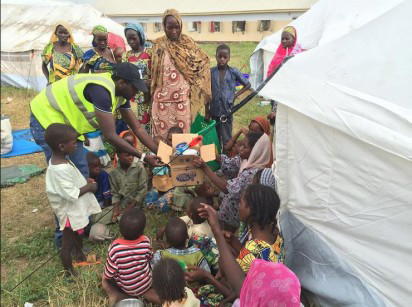
File: IDP camp
By Lekan Bilesanmi
Until recently, Adamawa State was in the news for the wrong reasons: it is just emerging from the devastating effects of insurgency. Besides, the state seemed ungovernable with an unstable political leadership tussle that saw the impeachment of one governor.
 Adamawa was not originally to be included among the states where state of emergency would be declared under the Jonathan government, but included because of a tussle that exposed a contrived plot to impose political control from the centre. With state of emergency and troops deplored in parts of Adamawa state it eventually became one of the major battle grounds between the army and Boko Haram.
The teeming numbers of people driven from their homes and forced to live in IDP camps across the state are a stark reminder of the devastation caused by insurgency.
But there are some obvious changes already. Governor Mohammed Umar Jibralla, who is fondly called ‘Bindow’, has been commended for continuing some of his predecessor’s projects and there seems to be a heightened pace in the new government’s efforts at improving social indices in Adamawa and improving on its infrastructure. Street lighting projects, started by the previous government on some of the main streets of the state capital, are ongoing.
Political observers say there are already signs of change in governance. The governor’s cabinet list appears to have been welcomed by a large segment of the people, a feat in itself, judging from previous experiences. Towards the end of his first three months in office, Jibralla sworne-in the cabinet of 21 commissioners, each member selected to represent all the local government councils in the state. The next day, the governor gave marching orders to the commissioners to join him to monitor projects he had earlier embarked upon and for them to see other projects due for take-off.
Traveling in mini-buses without the usual retinue of aides and expansive convoys, the governor spent several hours showing the commissioners the challenges trailing their jobs. Contractors at project sites were taken unawares and found themselves answering questions from the governor’s delegation regarding the level of work done. The SSG, Dr. Umar Bindir, who introduced the commissioners to projects directly under their mandate, kept telling them they have to work as a team. Joining the governor on the trip was the Speaker of the state House of Assembly who assured Jibralla that appropriation would be made when and as required by government to fast-track processes. Also on the bus trip was the deputy governor, Martins Babale, who, like the governor, previously served in the House and Senate respectively.
The team of commissioners is expected to deliver the government plans to improve on the state’s development. Bindir said with the team appointed by the governor, “Adamawa, henceforth, has no business being regarded as a backward state.”
The projects shown to the commissioners numbered 26 roads currently under construction in Yola, the state capital, and the roads linking the rural areas to the capital. Among the roads is the circular Yola road being widened to four lanes. All the roads were started by Jibralla in his desire to reverse infrastructure deficit. Another concern for Bindow has been health.
Arrangements between government and a Dubai-based group are in place for the building of an ultra-modern specialist hospital on BOT basis whose ownership returns to the state after an agreed period. Similarly leading district hospitals have been contracted by the government to Chinese contractors for modernization. Everything in Adamawa appears to be crying for attention. Among them are housing, educational institutions, youth unemployment and empowerment. A Public Private Partnership (PPP) scheme has commenced to build a 300, housing estate in Yola and a micro-credit scheme, which provides critical financing for small and medium scale entrepreneurs, initiated in the first months of the government.
Two projects key to the governor is completing the large sports complex including a sports stadium which he believes would open more avenues for the development of the youth. Government’s efforts to combat social challenges, and it’s willingness to build a cohesive political space, will eventually determine the level of success it records in its four, year term. In Jibralla’s opinion, these projects are only a first step towards improving the living condition in Adamawa. With his programme, tagged, “Bindow for Social Change,” Jibralla believes the challenges the state faces will be overcome by his government.
Disclaimer
Comments expressed here do not reflect the opinions of Vanguard newspapers or any employee thereof.