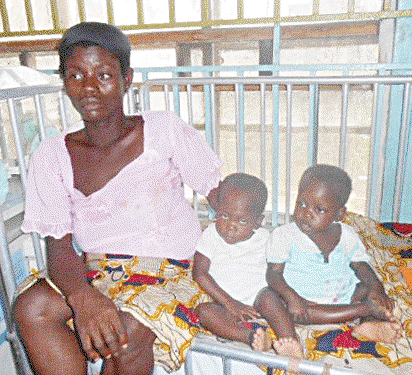
Malnutrition: Miracle; Affiong Umoh with her twins.
By Chioma Obinna
THE 21 –year- old mother of a malnourished child sat by her baby’s bed at the paediatric ward of the General Hospital, Calabar, Cross River State. Along with several other mothers and their infants inside the expansive ward, the stark reality of the silent crisis of malnutrition is apparent to her. Left, right and centre, hepless children aged below 5 are crying persistently. Malnourished and stunted, they barely hang on to life.

Malnutrition: Miracle; Affiong Umoh with her twins.
A walk around the wards revealed the reality of a crisis unchecked. In one corner, an octogenarian is breastfeeding a sickly 9 month-old baby that could be mistaken for a sickly three month-old. The emaciated child, whose mother died at his birth had never been breastfed until few days after he was admitted into the hospital and was being breastfed by his aged grandmother.
One of the nurses told Good Health Weekly that the grandmother was made to put the child to the breast as part of efforts to regain some nutrients he had lost. He is not alone. Miracle Essien, 16 months, once the joy of her parents is now a burden since she fell ill few months ago. Her confused mother, Blessing, 21, could only mutter incoherently “Why my baby?”
“It started three months ago when she clocked one. She was born on 13th February, 2014 in the house. There were no complications. I gave her breastmilk for two months before I mixed it with NAN infant formula. I also mixed it with custard.
“I was here Tuesday (last week). I bought a card and since then I have bought some of the drugs and they are expensive. I bought one for N150.00. I cannot afford this. This is my first child. When I was pregnant there was no pain or sickness to cause this problem. This is why I am confused. Since the treatment, she is changing gradually.
“It started like fever, she could not stand or eat well. That was why I went to the health centre and the nurse discovered there was a problem.”
Blessing‘s case is not isolated. Mbie–Paul Okon and her three month- old daughter have had their fair share of malnutrition. Mbie who could not communicate very well in English said her daughter’s case was peculiar as she has refused the breast since birth. Her inability to produce enough milk complicated her case.

Malnutrition: Blessing Essien with her baby
“It is painful that a baby of three months looks like a few weeks old baby.” Blessing, Mbie and Umoh are not alone in this ordeal. For Affiang Umoh, her 18-month-old twins are malnourished. She said they are from her 5th pregnancy and confessed that catering for one malnourished child is a challenge, not to talk of twins. These helpless children are part of the one million under 5 affected by Severe Acute Malnutrition, SAM, each year.
Burden ofNutrition
No social class in Nigeria is spared from the burden of malnutrition as reports show that 18 percent of malnourished children are from homes of the rich. In recent times, there are increasing reports of growing rate of malnutrition nationwide. While the rate continued to soar higher on daily basis, experts are worried that with over 1,200 children dying from malnutrition everyday in Nigeria, the future of the nation is at risk.
A paediatrician attached to the hospital ward of the General Hospital, Calabar, Cross River State, Dr. Friday Odey said in August alone, over 20 cases were admitted while, every week, about seven cases are seen. Odey blamed the development on ignorance and poverty. “Many people are too poor to afford the necessary foods. Some who have the money don’t know how to combine the right foods. Ignorance, poverty and infections, are the issues.”
Odey, however, lamented that some of the cases of malnutrition they treated relapsed due to the inability of the mothers to continue with the right foods at home. “We teach them what to do, how to feed the children but to be able to remain in a good state of health, poverty must be addressed. Government should begin to think of how to alleviate poverty. When parents are empowered they will be able to take care of their children.” Further, he explained that although the basic treatment is standard, they also experience resistance particularly in cases of infections.
UNICEF reports that the first 1000 day period – from the start of a woman’s pregnancy until her child’s 2nd birthday represents a critical window of opportunity. Adequate nutrition during this period can avert malnutrition, ensuring that children have the best possible opportunity to grow, learn and rise out of poverty. When nutrition is not optimised during the 1,000 day window, the effects are often irreversible.
But, many parents seem not to be aware of this fact as they lack appropriate knowledge about what to eat, how to prepare it and the quantity to be taken. The 2013 Nigeria Demographic and Health Survey, NDHS, documents that 55 percent of children below five in the North West are stunted; 42 percent in the North East;;29 percent in the North Central, 22 percent in South West; 18 percent in South South and 16 percent in South East.
Each year about one million Nigerian children die before their 5th birthday and malnutrition contributes a half of these deaths. The main indicator of malnutrition can range from stunting which is when children are too short for their age. Stunted children have poor physical growth and brain development, preventing them from thriving and living up to their full potential. With over 11 million children stunted in the country, experts say Nigeria is facing a crisis of malnutrition.
A recent UNICEF report revealed that there are approximately 1.7 million severely acutely malnourished children under five in Nigeria – accounting for a 10th of the global total.
Current situation
The Head, Nutrition, Federal Ministry of Health, Dr. Chris Isokpunwu, quoting the latest NDHS Report, said over 2,300 under five children die daily in Nigeria, half of the number due to malnutrition. “Malnutrition in Nigeria is not exactly as a result of lack of food but what we eat. Even the rich are affected because they do not know the right food to give their children. Many do not know that exclusive breastfeeding in the first six months will prevent illnesses”, he said.
One intervention is to give micronutrient supplements and deworm the children periodically as well as encourage behavioural changes such as cleanliness, immunisations and complementary feeding.
UNICEF Child Nutrition Specialist, Arjan De Wagt, said malnutrition is associated with 55 per cent of child mortality in Nigeria. And this is the reason why childhood killer diseases such as malaria, diarrhoea, measles and others thrive more in the country despite medical interventions.He said two out of every three children are not fed properly and the situation has contributed to high infant and child mortality.
Wagt said the Federal government recently started a community based management of Acute Malnutrition, CMAM, for severely malnourished children in 11 northern states of Nigeria. Arjan expressed worry that two out of every three children in the 11 states currently receiving CMAM still have not received the treatment as a result of low funding.
“Most states need CMAM so there is a need for government and donor agents to scale up their support”. Mothers must put their babies to the breast in the first half – an hour after birth and breastfeed exclusively for the first six months. After six months, babies should be given variety of healthy foods such as fruits, vegetables, eggs, meat, along with continuous breastfeeding up to two years. Mothers and children should ensured access to vitamins and minerals and nutrients.
Disclaimer
Comments expressed here do not reflect the opinions of Vanguard newspapers or any employee thereof.