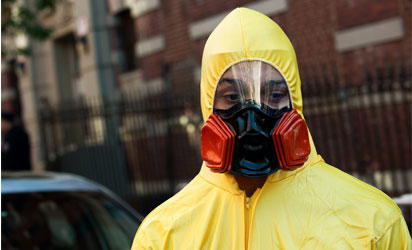
NEW YORK, NY – OCTOBER 25: A young man, dressed in a biohazard costume, stands on the corner of 546 West 147th Street on October 25, 2014 in New York City. After returning to New York City from Guinea, where he was working with Doctors Without Borders treating Ebola patients, Dr. Craig Spencer was quarantined after showing symptoms consistent with the virus. Spencer was taken to Bellevue hospital to undergo testing where he was officially diagnosed with the Ebola virus on October 23. Bryan /AFP
By Sola Ogundipe & Gabriel Olawale
It was an outpouring of emotions weekend at the First Consultants Medical Centre, Lagos, as survivors of the Ebola Virus Disease and relatives of those that died of the disease, recounted their personal encounters in the wake of the disease.

RELATIVES OF EBOLA VICTIMS- From left: Stella Abaniwo, Nonso Uko and Godwin Igonoh.
The hospital lost four people – Dr. Stella Adadevoh, the Lead Consultant Physician; Dr Amos Abanigho, who was Head of Anaesthesia and Critical Care; Nurse Aide Evelyn Uko and Nurse Justina Ejelenu.
Those that survived include Dr Fadipe Akinniyi, Dr. Ibeawuchi Morris, Dr Ada Igonoh, Dr. Adejoro and Nurse Nkechi Esilioko-Imo. Some of them spoke to Good Health Weekly. Excerpts:
FG should assist us – Stella Abaniwo
First to speak was Mrs Stella Abaniwo, widow of the late Dr Amos Abaniwo, who was an Anesthetist and Critical. “It has been quite challenging, but what we want is that the Federal government should help us because to some extent Lagos State tried for us.
Today they are celebrating Nigeria. Nigeria survived Ebola, but what about those of us with the pain, that lost our dear ones? We were not recognised. The Federal government has not stepped in. There are children who have been orphaned as a result of the incident, but there is no tangible assistance. I think Federal government they should reach out to us.
Around where I was living, there was stigmatisation. but I have moved to another area. Even my neigbours and their children were avoiding us. Whenever we were coming, they tried to distance themselves from us. Our government should protect us better.
I was there when the 1st person died – Godwin Igonoh
Narrating his experience on hearing that his wife had contracted Ebola, Godwin Igonoh, husband of Dr Ada Igonoh, one of the survivors, heaved a sigh. Then he began talking. “I got a call from my father saying that something was wrong and they were trying to find a way to tell me because my wife (Ada) was alread with her aunt.
When they told me, I was truly very shocked. I asked what is Ebola? I didn’t know what it was, so the first thing I did was to begin to browse on my phone and all I got was also a kind of panic information. It illustrated that Ebola victims had just about two weeks to live, and I was trying to calculate how many days she had been there. I lost my mother in 2002 and I wondered if I was also going to lose my wife. While the drama went on, friends started calling me.
There were some meetings I usually attended. I knew I dared not let it be known at any of the meetings that my wife had Ebola. Later, it was even announced at the meetings that in case there was any of the members that had a relative or friend that had Ebola, such person should be very careful. I was there and just kept quiet because I was wondring how the people would respond if they knew my wife had contracted Ebola.
Who was I going to tell and would believe that she was not actually with me at that time? It was a big challenge. I kept going to the quarantine centre at Yaba where they were isolated, everyday but I was prevented from seeing her. I went there everyday, I was there when the first person died. Each day I went there, I would hear news of someone else that had died. There was a day I got home and the next thing I heard on CNN was that a female doctor had died.
I knew there was only one female doctor among those that were in the isolation centre and I feared the worst. It was not until Aljazeera confirmed that it was a male doctor that died, that I was convinced it was not my wife. Even then, I went back to the centre and discover that it was indeed a male doctor.
I would say the incident made us responsible and understand that some people gave their lives so that we can have our own. I dont think their is any stigma again, but some people still ask my wife if she is sure Ebola is no more there.
The lesson for me is to live life with the awareness that time is of essence and that everyday you spend, you must understand that life is worth more than money because when Ebola came, all the things that once mattered, all of a sudden, didn’t matter anymore. For the first time, I came to understand that the things that I used to argue with my wife over were totally irrelevant. For instance I sued to get angry if she called me and put me on hold, now I want her to do those things.
Sawyer asked me if his blood touched my hands
I don’t want to remember Ebola. Even my husband hates hearing about the disease because of the trauma he and other family members passed through when I was ill. But I thank God I am in the land of the living today. Actually, I was on night duty they brought the man (Patrick Sawyer) around 7pm. He was unconcious and I was the one that received him. I admitted him and made him comfortable.
This is a private hospital, so he was given 100 percent attention. He was assisted to remove his shoes. He had urinated and passed faeces on himself so we helped him change his clothes.We gave him every necessary support. The doctor saw him and prescribed drugs, but I noticed that those drugs were not effective. They had no effect on him. Normally, paracetermol injection ought to reduce high body temperature, but for Sawyer, it did not.

EBOLA SURVIVOR: Nkechi Esilioko-Imo (Nee Ekeigbo).
Spurting blood: So we called the doctor’s attention and explained the situation. The doctor said we should allow him to rest. I also noticed that his blood spurted when he was given injection. I thought that was strange because ever since I became a registered nurse in 2008, I have never administered injection to a patient intramuscularly and blood would spurt out the way his blood did.
I knew it was unusual but I had no idea what the problem was, . So I drew the doctor’s attention to it, but was told there was no problem.
Sawyer actually asked me if his blood touched me. He was concerned about that and told me to hurry up and wash my hands. I complied but was uneasy. I felt that for a patient to have urged me to wash my hands, something was definitely out of place, especially as I didn’t wear gloves.
My unease grew. In my heart, I had the feeling that whatever was wrong with this man was not a good thing. And for him to have told me to wash my hands, I believed he did not want me to contact it.
So I went to Sawyer personally and asked him what was wrong with him. He told me that he had been treated for malaria, and showed me his antimalaria drugs. The next day, I was off duty. Trip to Enugu: When I got home and narrated the incident to my husband, he said it was not our portion. He was traveling to Enugu for his cousin’s wedding, so I joined him since the hospital had given us two weeks off.
My husband said he would be back the following day, so I decided to join him on the trip.
It was during the journey that I noticed I was running a high temperature. I called the hospital and the hospital contacted the Enugu quarantine centre. An ambulance was sent to pick us and we were brought back to Lagos. So you see that I did not intentionally go to Enugu or escape or anything like that. I didn’t know much about the disease, but in the quarantee centre, I had a bad experience because I was unconscious for two days. In fact I still don’t know how I got there.
It was when I regained consciouness later that I asked Ada (Igonoh) what we were doing there. She laughed and explained everything to me. She told me to read my bible.
Disclaimer
Comments expressed here do not reflect the opinions of Vanguard newspapers or any employee thereof.