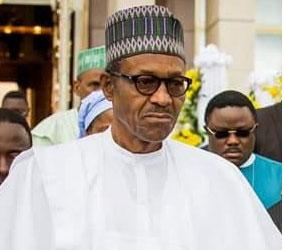
Buhari
By Obi Nwakanma
In just a couple of weeks, it will be one hundred days that the president, Mr. Muhamadu Buhari, assumed office as the elected president of Nigeria. There will be a lot of panegyrics commissioned as usual in the buyable spaces of the Nigerian media by sycophants and hangers-on, in praise of the president. Some will compare him to God – in his, well, God-inspired-omniscience.

Buhari
Some will tell him that he is the best thing to have happened to Nigeria since the first woman went out first to discover how to fry Akara. Many, like the musician Onyeka Onwenu will find their way to Aso Rock, just to bow and kneel before him. There will be such carnivals staged by his partisans to celebrate this great Nigerian who has come to save Nigeria from Nigeria. Many will top it by committing that sacrilege of reason: ‘Ranka dede,” they will say to him, “only God makes rulers.
God has selected you, so, carry-go!’ It will be all foie de grass – goose liver fattened for your money. They’d of course conveniently forget to add that nobody saw God near any electoral booth in Nigeria, or that God never appeared in any of Buhari’s campaign stops, nor is God even a resident, or a registered voter in Nigeria. Only voters – the common people of Nigeria – elected the president and gave him the mandate to govern, not God. And it is t these ordinary Nigerians that he owes duty, obligation, and explanations, as well as accounting. Without them, he is nothing.
But in the moments when Nigerians, driven mad by faith, can neither sense the autonomy of their own acts, nor the necessary power in networking at the most basic levels for their own interests, in order to determine the direction of power, such institutions as the office of the president, even under a democracy will have the aura of the Emperor. That is what I sense of President Buhari’s presidency, and it is a dangerous trend.
It is imperative that the Nigerian National Assembly intervene immediately to restrain the Presidential from presidential overreach. It will be one hundred years soon, and many Nigerians have not at all forgotten the president’s campaign promises, and the agenda he set for himself in the first hundred days of office. We are still to see these happen, all Nigerians hear are declarations of intent. The intention soon, for instance, to make Boko Haram history. Boko Haram is still terrorizing Nigeria, and Buhari has not achieved any more success than the former president Jonathan, and it is nearly one hundred days in the making of his presidency. In fact, within the month after Jonathan ceded power to Buhari, the economy slid down a good notch.
Within weeks of his presidency, the Naira weakened substantially; reports indicate greater number in unemployment; economic policy is unclear, and presidential action in that area is a wash. The president has spent his first hundred days handing out jobs, and taking jobs, and apparently positioning his own team. He is yet to appoint a Federal Executive Council, and therefore, the operational capacity of Nigeria without the complement of the ministers of state, has been reduced to the lone acts of the presidency. In many instances, appointments which the president has so far made, which require ministerial input, has been made, in breach of the law. Some of the appointments, like those into the board of AMCON remain unconstitutional because the law that established that body was clear in requiring certain Legislative oversight an inter-agency process; and the nomination of the MD of AMCON by the Central Bank of Nigeria.
The president in overstepping his bounds risks the countermand of the law, since not even he, is above the laws of the Republic. In some quarters of course is the worry that the president is staging a purging of the South, particularly of the South East, from public positions. Again, on this, one is personally indifferent; and I should restate these views again and again: the president is at liberty to appoint even his favorite dog to a position, if he feels that dog capable of delivering on his promise to serve Nigeria, and fulfil that hopeful promise of his electoral campaigns. The president can make appointments based on his best judgment.
But it should be clear also that the president will be judged by the deliveries of his promise, as well as for the precedents he establishes. Today, we now know that a president can, unless it is explicitly changed in the laws of Nigeria, govern for as long as he desires without appointing a Ministerial council. It is the Buhari precedent.
An elected President may also choose to appoint all his key presidential staffers from one region. Indeed, Nigeria has come to a great moment when the office of the president, the leadership of the National Assembly, and the Chief Justice of Nigeria for the first time in its history, are occupied by individuals from one part of Nigeria – the North –and no one has yet batted an eyelid. Perhaps it will teach us all to drive gently, just as the witty former Governor of Imo state, the late Dr. Sam Mbakwe told the police driver of the Black Maria conveying him from the Tribunal to Kirikiri: “Drive gently, because if you don’t, when next it is my turn to drive, I might be rough!” President Buhari should drive gently.
But I do believe, it will require an active, and engaged National Assembly, and a highly independent National Judicial Council to keep presidential power in check. The president for instance has been busy talking about probes. But nobody yet, even the lawyers, have pointed out the tricky question of whether the president has the constitutional mandate to probe any administration. The institutions established by the Acts of our Union as a federation, cannot be circumvented by presidential power, and these institutions are sui generis to the order of the republic. The president can certainly order his Attorney-General to prosecute, after gathering evidence, in a constitutionally established court. But the power to investigate the government, past or present, belongs to the National Assembly.
The National Assembly may then require the president, to use both the Attorney General’s office, who should normally compel the Investigative arms of the police to gather evidence forensically, to be presented before the courts on behalf of the state, and not the other way round. President Buhari may be overstepping his bounds in these matters, and must learn to work with the National Assembly, which must also give him the proper legislative backing, to investigate former public servants, some of whom still enjoy legal immunity. Finally, the president must certainly see that changing heads of organizations and loading them with his personal choices from one region of Nigeria cannot stem corruption.
Corruption is system, endemic, and institutional. It would require a radical overhaul of the corrupted systems of public accounting and oversight, to change things. Recruiting one hundred new policemen nationwide, for instance, will not stem police incompetence and corruption. Changing the orientation, the operational mode, the quality of personnel and requirements for recruitment and training, as well as the reward benefits for the police will. It is time to civilize the police; create an office for the Inspector-General for Internal Reviews, reposition the Criminals Investigation Department, merge the EFCC to it, and overhaul the entire technical and scientific capacity of the Police services.
It is the process that needs to be changed, Mr. President, not the symbolic heads. It is about time the National Assembly probed the process of delivering services that have often failed in Nigeria, and it is going towards the hundred days of Buhari’s presidency; and the president is still mostly full of talk.
Disclaimer
Comments expressed here do not reflect the opinions of Vanguard newspapers or any employee thereof.