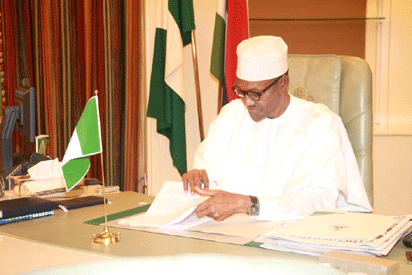
President Muhammadu Buhari Photo by Abayomi Adeshida
By Douglas Anele
On the other hand, President Muhammadu Buhari must find a way to immunise himself from the toxic sugary insipidities of praise-singers and search within himself for the intellectual and moral stamina required for actualising the most important components of his campaign promises. Of course, the President must be commended for frankly admitting that his advanced age would limit his performance, even as some of his supporters and aides were pretending that age does not matter in a demanding position such as the presidency of a fractious, democratically immature, and economically underdeveloped country like ours, by making tendentious allusions to Ronald Reagan, Nelson Mandela and Robert Mugabe of the United States, South Africa and Zimbabwe respectively.

President Muhammadu Buhari attending to some files in his office . File Photo by Abayomi Adeshida
Going back to what I consider areas of concentration for President Muhammadu Buhari, the most important item on his to-do list is the defeat of the Boko Haram terrorists in the North-Eastern part of the country. The reason for this is not far to seek. Peace and security are the conditio sine qua non for the achievement of both individual and collective goals in the society.
Therefore, it is imperative that the federal government should deploy its military resources, including covert intelligence mechanisms, to liquidate the Islamic fundamentalists in the shortest possible time. In addition, governors of states where the Boko Haram plague is deadliest, namely, Adamawa, Borno, Gombe, and Yobe, should work assiduously in concert with the federal government to embark on serious social engineering programmes anchored on poverty alleviation through employment generation, education, and advocacy for deradicalisation of the youths from extremist Islamic teachings in order to discourage them from joining the murderous group.
But the Boko Haram problem is not the only security challenge facing the federal government right now. Kidnapping, for instance, is still rearing its ugly heads, particularly in the South-East and South-South, with disastrous consequences on the economy and well-being of the people. Mutatis Mutandis, the same programme of social reconstruction and education recommended as a non-military strategy for discouraging young women and men from joining Boko Haram is also required to reduce the rate of kidnapping and, indeed, other social vices that stem from poverty, unemployment and lack of proper education.
The next critical issue for the President to tackle working closely together with members of the National Assembly is corruption, the irrational ruinous perversion of official position for selfish interest or personal gain. Historically speaking, the problem of official corruption began during the colonial period. But it worsened after the attainment of independence in 1960. In fact, corruption amongst politicians of the First Republic was the major reason Major Chukwuma Kaduna Nzeogwu and his fellow coup plotters attempted to overthrow the lacklustre government of Alhaji Abubakar Tafawa Balewa, with disastrous consequences for the country. Since then, corruption has evolved into a very deadly virus eating away the resources of our country such that unless creative, bold and drastic measures to kill it are embarked upon right away by the relevant anti-corruption agencies, Nigeria’s quest for rapid sustainable development would remain in the limbo of unfulfilled expectations. Corruption is not a mono-causal phenomenon. An aetiology of corruption in different countries of the world would reveal that poverty, greed, weak or unavailability of safety nets that protect individuals from the vicissitudes of changing economic fortune, socio-cultural values and practices that extol materialism and psycho-spiritual disequilibrium tend to engender corruption. In Nigeria, the problem is compounded by inappropriate obsolete laws that prescribe extremely light punishment for those found guilty of horrendous acts of corruption, poor investigative and prosecutorial skills of public officials handling top-level corruption cases, as well as by extremely corrupt judicial officers, especially magistrates and judges. From the foregoing, it is clear that any serious attempt to fight corruption and reduce it significantly to a level that would not hinder the emergence of a truly great Nigerian nation must be creative, comprehensive and decisive.
President Muhammadu Buhari, based mainly on the War Against Indiscipline (WAI) he inaugurated during his tenure as military head of state, has managed to make a name for himself as an incorruptible leader, a man of integrity with zero tolerance for corruption. Many Nigerians in the appropriate age bracket still remember how soldiers dealt severely with people for minor infractions such as throwing pieces of paper or banana peels along the street, jumping the queue and so on. Also in their minds are the lengthy jail terms handed to several politicians of the Second Republic for corruption, although it later transpired that several of them, including former Vice President, Dr. Alex Ekwueme and Chief Adekunle Ajasin, former governor of old Ondo State, were completely innocent of the charges levelled against them. Since retired Gen. Ibrahim Babangida unceremoniously kicked Buhari out of office in August 27, 1985, it appears that successive administrations had been competing among themselves for the thoroughly despicable title of “the most corrupt government in Nigeria since independence.” It is within the context of escalating corruption and impunity in governance over the years that one can situate the successful packaging and presentation of Buhari to the electorate by the APC media machine as a better alternative to Dr. Goodluck Jonathan in the war against corruption. Since he assumed office, President Buhari has made it clear that he will fight corruption to a standstill. Many Nigerians really believed him, on the strength of his anti-corruption reputation.
In my opinion, Nigerians must support any President who, through words, deeds and exemplary leadership boldly confronts the problem of corruption. But that support must be based on objective assessment of concrete results with respect to the calibre and status of those caught in the anti-corruption dragnet and the quantum of funds and assets recovered from them. In otherwords, Nigerians should be careful and try not to be deceived by relentless media reports that the President said he will do this, he will do that against corruption, or that this-and-that will be recovered from so-and-so not backed up with further investigation to ascertain whether actions matched the fine rhetoric.
When one thinks about the billions of dollars stolen by members of the ruling elite especially since 1970 and the tremendous value such funds could have added to different sectors of our national life, one expects every patriotic and reasonable Nigerian to support President Buhari’s anti-corruption pledges. Irrespective of the year the stealing was perpetrated, all corrupt public officials, particularly those at the topmost echelons of power and authority, must be dealt with severely as a deterrent. Now, some Nigerians believe, uncritically, that the APC federal government under Buhari can deliver on its promise to “kill corruption before corruption kills the country.” But, sentiments aside, I am not so sure for the following reasons.
To begin with, it seems that the President is as squeaky clean as his media hirelings and ardent supporters portray him to be. Certainly, because of the inherent fallibility of humans no one in this planet is squeaky clean, and it would be futile to expect Buhari to be so simply because his admirers think that he is. Although it does not follow that every successful war against corruption must be led by a saint, in order to win and retain people’s trust and confidence in such a herculean task, a leader should not ignore or treat as inconsequential allegations of corruption against him or her weighty enough to be investigated by an organ of government.
President Muhammadu Buhari, to the best of my knowledge, has not addressed adequately the allegation of missing $2.8 billion from the Nigerian National Petroleum Corporation (NNPC) when he was federal commissioner for petroleum resources. Exculpatory hot air on the matter from some self-acclaimed experts in economics or oil and gas is insufficient.
Nigerians have forgotten that a committee of the Senate of the Second Republic, headed by the late Dr. Olusola Saraki, was about to scrutinise the Ayo Irikefe Report concerning the missing NNPC funds when Buhari came to power through a military coup in December 31, 1993. Since then, the Irikefe Report seems to have disappeared without trace. So where is the report? What did the military administration do with it after Buhari took over power from Alhaji Shehu Shagari?
As far as I am concerned, President Buhari’s anti-corruption reputation will remain tainted unless the contents of that report were made public or he publicly addresses the matter himself. Probably, one of the main reasons the President refused to appear before the Oputa Panel set up by Chief Olusegun Obasanjo to address some troubling national issues was to avoid embarrassing questions and revelations concerning the $2.8 billion scandal. To be continued.
Disclaimer
Comments expressed here do not reflect the opinions of Vanguard newspapers or any employee thereof.