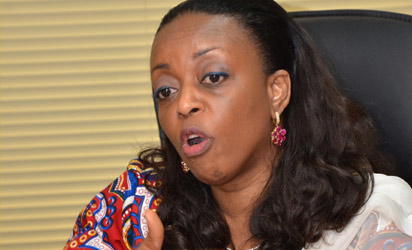
Petroleum Minister, Diezani-Alison-Madueke
Says FG should subsidise production not large scale consumption
By Udeme Clement
As controversy continues to trail the persistent fuel scarcity and subsidy allocation, the incoming government has been advised to subsidise production rather than large scale consumption, such that if an investor wants to build a refinery but has no money, government can give him loan to pay back within 20 to 30 years, says the Director General, West African Institute for Financial and Economic Management (WAIFEM), Professor Akpan Ekpo.
In a chat with Sunday Vanguard in Lagos, Ekpo, who is also a Professor of Economics, advised government to look at the supply side of petroleum products, stressing that some people in Nigeria need targeted subsidy, especially the poor using kerosene. “However, everything depends on oil in the medium and long term. So, the incoming government must diversify the oil industry to commercialise Nigerian National Petroleum Corporation (NNPC), by selling shares to Nigerians while government continues to manage it”, he said.
He added, “The new government should scrap Ministry of Petroleum Resources to replace it with Ministry of Natural Resources, to deal with petroleum and other minerals. They must also diversify the oil sector itself, because the sector only exports crude oil without refining petroleum products. Our oil sector has no linkage to petrol-chemical industries, that is why there is recurring scarcity of fuel in the country.
We need more refineries to enhance competition, in order to force down prices of refined products. For example, Singapore has no crude oil, yet they have refineries. This shows that Nigeria can refine for local consumption and export. In the 80s, Nigeria exported refined products, but suddenly it stopped. That period, the refineries worked well, but now the plants are producing below installed capacity even with the Turn Around Maintenance (TAM), which takes so much money.”
On the recent ban of dollars for local transactions by the Central Bank of Nigeria (CBN), he explained, “The CBN in my view is only reminding the public that Naira/kobo is the only legal currency to be used in economic activities in Nigeria. This is in the Constitution as well as the CBN Act. Nigeria’s economy is not a dollar dominated economy. I suspect that the apex bank has realised that most transactions and deposits in the banks are mostly in dollars. If about 20 percent of bank deposits are in dollars, that is not healthy for the economy.
Do not forget that we are a sovereign nation. The other issue to address is why confidence in the dollar? Economic agents in the country see the dollar as a store of value. In addition, it is a convertible currency anywhere in the world. Consequently, our economy must be well managed to give confidence to economic agents that the local currency can be convertible at a reasonable rate. Therefore, the economy must not only be productive but also export semi-finished or some value (exportable) in the production chain”.
Responding to the claim by the Finance Minister that government borrowed about N473billion to finance the budget and to pay salary, he said, “It is not surprising that Nigeria is broke. As an observer of the economy, this was perceived about two years ago when the country started borrowing despite the existence of the excess crude oil account. It is one thing to borrow to finance capital expenditures in the budget, but borrowing to finance overheads and salaries (recurrent expenditures) makes no economic sense, particularly if the economy is not in a prolonged recession. The implications are many. It is clear that for the last two years, there has been no meaningful capital projects in the economy, implying that growth has slowed.
“It would be important to know the status of on-going projects particularly those on infrastructure. One wonders, where the positive growth rates have been coming from. Without growth, there can be no development. It is always dangerous to borrow to pay salaries. I have always argued that the economic performance of Nigeria cannot be satisfactory given the rising misery index.
Fortunately though not comforting, the borrowing was mostly domestic debt (government bond issuance) and not printing of money. Reliance as to whether the economy is within the debt/GDP threshold is not helpful. GDP does not pay debts. Debts are paid broadly from revenues. It means the oil revenue before the sharp decline was inadequate to run the economy.
Hence, government spent more than the expected revenue from oil. The decline in oil revenue exposed the fiscal rascality of government. The economy has no fiscal buffers. The excess crude account only exists in name! It is, therefore, crucial to think strategically on how best to reduce dependence on oil revenues. This is the time to reduce wastage in government, block leakages and prioritise government expenditures.”
On the drop in electricity generation from about 4,000mw to 2,912mw, he added, “It means the epileptic power supply would not only continue but worsened, meaning growth of the economy may decline. It means there is no hope for job creation and no hope for Small and Medium Enterprises (SMEs) to fast-track economic growth.
More importantly, this calls into question all the claims regarding the progress made in unbundling the Power Holding Company of Nigeria (PHCN). I suspect that Nigerians are getting tired of excuses as to why the economy cannot boast of at least 15-18 hours uninterrupted power supply. The mechanics of electric power supply is not a rocket science, particularly when almost 75 percent of the required inputs are available in the country. The country has gas, yet gas supply to power plants is now a problem! It is always one excuse or another.
Recently, the Minister of Power said the in-coming government should not reverse the privatisation process of the power industry. The privatisation process was carried out by government through its agency the Bureau of Public Enterpsis (BPE) not by invisible agents. Persons were involved in the process not ghosts. So, the in-coming government has the right to probe the process, especially if the promised outcome has not been realised. Selling-off public assets is a serious matter. Government and the players in the power sector should be honest to tell Nigerians that power would be available after 10 years.
For instance, now, Nigerians are reacting to what they were promised four years ago that epileptic power supply would soon be a thing of the past. The decline in power supply confirms that the economy would remain generator-driven and no economy grows and develop with generators as the major source of power supply.”
On if the government can force down the price of petrol from N87 to N40 per litre, he said, “N40 for fuel pump price is realistic if corruption and bottlenecks are removed. In the 90s, government wanted to use the market to determine the pump price below what was prevailing at that time. Government must block revenue leakages from the system, and can increase Value Added Tax (VAT) by one percent to give State governments enough money to deliver services. It is embarrassing for a country that exports crude oil to experience incessant scarcity of fuel.
Government at all levels must expand the Civil Service and invest massively in the housing sub-sector to tackle unemployment crisis, which stands at about 30 percent now. Influx of Foreign Direct Investments (FDI) into the economy is crucial. The investors must come here and build factories to create jobs, not portfolio investments in the stock market, where they gamble and pull away their investments at a slightest uncertainty in the economy.”
Disclaimer
Comments expressed here do not reflect the opinions of Vanguard newspapers or any employee thereof.