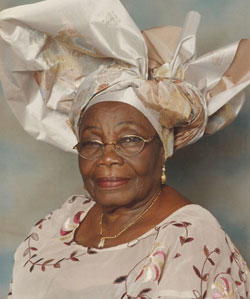
Late Mrs Mercy Amachree
By Donu Kobgara
SINCE Christmas, I have mostly focussed on current affairs issues on this page. Now I want to take a break from politics and remember 2 remarkable women who quietly left us at the height of election fever and will be sorely missed.
Mercy Omamuromu Amachree was a traditional woman of substance who was, from a young age, called “Mummy”, even by people who were older than her.
Born in Igboland in 1927, to a technician father and successful entrepreneur mother – a truly independent spirit who vigorously participated in the anti-colonial Aba Women’s Protest of 1929 – Auntie Mercy enjoyed a Christian upbringing, loved to read books, graduated from various distinguished academies with flying colours and was offered a scholarship to train as a teacher.

Late Mrs Mercy Amachree
But nursing appealed more, so she enrolled, aged 19, at Massey Street Dispensary in Lagos. While there, she acquired a local nickname – “Igi Iwe” (“tree of knowledge”), lived at Lady Abayomi’s, an elite establishment for young ladies, became genteely immersed in the cultural diversity of the then capital city and learned how to speak Yoruba and cook Sierra Leonan/Creole dishes.
When she qualified as a midwife, the colonial service posted her to Benue, where she met her future husband, Ayibo Amakiri Amachree, a genial, highly intelligent Kalabari pharmacist who also worked for the colonial government.
Their marriage was blissfully happy (even as pensioners, they were often spotted holding hands in public) and was blessed with 8 children – Stella, Doris, Anita, Tekena (now sadly late), Betsy, Benjamin, Fama and Chisom – who say that she had a very hands-on attitude towards her maternal duties and was a stylish “pillar of support who ran a comfortable, elegant, warm and secure home”.
But she was also a dedicated career woman and was said to have never once been late for work during her 40-odd years as a nurse and nursing tutor.
She worked in many hospitals, went on several courses here and abroad and was, for many years, in charge of the maternity ward at the General Hospital in Jos. She retired as Vice Principal of the School of Nursing & Midwifery in Port Harcourt (to which the Amachrees had relocated at the beginning of the Biafran civil war).
She spoke 5 languages, was very interested in current affairs, travelled extensively and was an Elder of Wesley Methodist Church, a tireless philanthropist and a founding member of the Corona Society and YWCA in Jos.
In l965, her husband was installed as the Paramount Chief of the Ojuka War Canoe House of Buguma. In 1992, he left her to meet his Maker. She also lost her handsome adored son, Tekena, last year. Now she has finally joined these two wonderful men who were so important to her. May she rest in peace.
…. To Auntie Gloria too
THIS loving tribute was written by her distinguished photo-journalist nephew, Jide Adeniyi-Jones:
Gloria, the second daughter of Justice Stephen Bankole Rhodes and Mabel Jones de Rhodes, was born in Lagos in 1923 and sandwiched between an elder sister, Olga, and a younger brother, Steve.
The atmosphere in their family homes, first on Broad Street and later at Igbosere Road (now City Hall), was set by the strictness of their conservative father; but its hard edges were tempered by the joie de vivre of a music-loving mother.
Gloria, an academically gifted scholarship recipient, went to Queens College, then proceeded to the UK where she completed her studies at Edgehill College, Bristol University and the Middle Temple (the same Inn of Court as her father).

Late Auntie Gloria
In London, she shared a flat with her childhood friend Aduke Alakija (daughter of her godfather, Sir Adeyemo Alakija) and (being adventurous) earned extra pocket money during her spare time by touring England, Switzerland and France with Boscoe Holder, a professional Afro-Caribbean dance troupe.
At one point, she appeared in a magazine that found its way into the hands of the Governor General of Nigeria, who showed it to Justice Rhodes.
My grandfather returned home in a rage, ranting to his wife: “Have you seen what your daughter is up to? She will never be called to the Bar.”
But Gloria proved him wrong; and when she returned to Nigeria in l952, she founded a law firm with her former flatmate, Ms Alakija. And, a couple of years later, she joined the Attorney General’s office as a State Counsel.
The adventurous spirit persisted and, having purchased a convertible MG roadster, she became an enthusiastic participant in motor rallies.
Oliver Jackman, a Barbadian national who had a law degree from Cambridge University, was a talented cricketer, jazz drummer and journalist; and he moved to Nigeria, became Editor of our Sunday Times newspaper and married Gloria.
In the buzzing cosmopolitan social scene of 1950’s Lagos, the Jackmans were part of the weekend swinging set. But they still managed to hold down highly responsible jobs and were, at various points in time, based in the Congo (when Oliver got a job with the United Nations) and Barbados (where they separated).
Gloria never lost her wanderlust, curiousity and fun-loving streak, but she planted her feet firmly on the ground when her marriage ended; and in addition to doing charity work in the South-East after the Biafran civil war and being a Samaritans volunteer, she concentrated on her profession, edited law reports and was the Chief Registrar at the Supreme Court when she retired.
Her final years were spent living with my mother, Olga, in Ikoyi and Victoria Island; and their residences became havens for friends of all ages.
Having lost her only child, Carol, to illness at a tender age, there was plenty of room in Gloria’s warm heart for every single child who came through their door.
At 91, she danced in the New Year in Nairobi and returned to Lagos with a sparkle in her eye. And then, after a stroke on Valentine’s Day and 5 days in limbo – right side paralysis – she smiled and joked deep into the night; and then she slept and she slept and she slept and she never woke up and still, she sleeps.
Disclaimer
Comments expressed here do not reflect the opinions of Vanguard newspapers or any employee thereof.