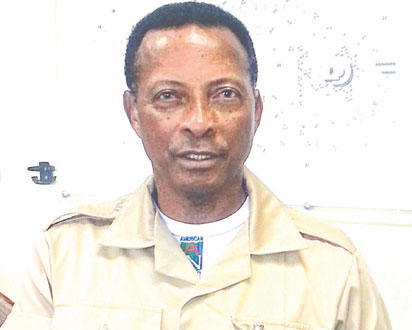
Recently, a former Minister of External Affairs, Professor Bolaji Akinyemi, warned of a possible post-election crisis this year and the need to do everything possible to avert or minimize it. There have also been calls from some quarters that the military has the right to protest. Following this development, Sunday Vanguard sought the views of forensic criminologist and the Security Coordinator at the American University of Nigeria, Yola, Dr Lionel Von Frederick Rawlins.
Excerpts:
By EBELE ORAKPO
On post-election violence
Although Rawlins agreed that there are indications to show that there is the possibility of post-election crisis, he strongly believes that if certain steps are taken, the crisis could be averted or minimized.
His words: “Yes, I have heard that these elections will be filled with violence and all indicators show that, but I am hoping that it does not happen. If it does, the entire world would judge Nigeria negatively as just another African country where politicians will kill anyone to be elected.”
Nigeria is very important
“Nigeria is much too important for this to happen and since all already believe or know that the 2015 elections will be riddled with violence, this is the opportunity to stop it.”
How to stop post-election violence
The first step towards stopping post-election violence, according to the counter-terrorism expert, is to reach out to the Nigerian youth.
The youths:
 “We can stop it by getting through to the youths of Nigeria; they are the ones who will be used to commit electoral crimes and political violence and they are the ones who can stop it. You can get through to them by having town hall meetings etc with the youths of violence-prone areas and get them to agree not to take up arms in the name of politics.
“We have to make sure that we reach out to those youths in those communities and talk to them about the ills and destruction such behaviours could cause during the elections. We must tell them to resist any attempt by anyone to cajole them into plundering. Youth leaders, community leaders, and all civil-minded people need to go out on a regular basis and start talking to them now. You can’t wait until a week before the election. You have to start now. If you start doing this and get them to understand, it will cut down at least half the possibility of violence,” he said, adding: “It must be done each and every day of the week coming up to the elections. It is not going to be a one day affair.”
Politicians: Dr. Rawlins also believes that politicians can stop post-election violence because everything begins and ends with them. “If the politicians want to really stop the violence, they can. They can stop it by talking to their people and saying, ‘Look, no matter what, if I lose, no violence. Don’t take to violence, go home. Don’t burn down anything.’ Of course the people will listen because it is their candidate, their party. They will listen.”
The nation:
Apart from politicians, Rawlins believes that countries have a role to play. “As a matter of fact, some countries do hold the candidate and the political party accountable for any violence. They have them sign a contract that they will account for any violence that occurs.” He said South Africa is already doing that. “Nigeria is a developing country with challenges common to other such countries such as illiteracy, poverty, and unemployment which constitute a fertile ground for electoral violence.”
He noted that politicians usually go to people who cannot read and write. “Because they cannot read and write, there is low reasoning. There is no critical and analytical thinking. You tell them go and burn a house down, they can’t read and they can’t think and they burn it down. The intelligent man would think: Why would I burn that house down? Who is in that house? What do I get from burning that house? What does it get me? But, what if I get into trouble? They ask these critical analytical questions. An illiterate cannot do that because he can’t reason. And he kills hundreds of people who are sleeping by burning down the building.”
Uneven distribution of wealth
Advising the wealthy to find ways to employ the poor so that some of their wealth trickles down, Rawlins said a situation where 10 per cent are wealthy and 90 per cent are poor, is a recipe for disaster. “Anywhere in the world where there is a high level of unemployment, you have problems – problems of crime or terrorism. If people are working, even if they are not making much, they are keeping busy and making enough to feed and support themselves and their families, they are okay with it.” He said such people would not easily be lured by politicians to go and kill and maim for them. “ Killing becomes a job for the unemployed who have nothing to do because they have to find ways to survive. And that is how you get people to kill for N5,000 because it is better than nothing at all.”
Involve others:
“Another way forward is to get the international community, governments, non-governmental organizations etc involved and give them responsible roles to play within and without the Independent National Electoral Commission (INEC).
“Finally, have the responsible people in the political parties sign treaties condemning violence and pledging not to engage in violence, no matter what. This way, you have their signatures and pledges that you can use against them should they resort to violence,” he said, noting that
“Nigeria, being the most populous country in Africa, plus one of the upcoming world leaders, has to demonstrate to the world that it is as capable as the rest of the world in carrying out free and fair elections.”
On possible military intervention
Rawlins is strongly opposed to the idea of a military take-over in Nigeria, saying it is not an option. “A military take-over will be the death knell for Nigeria. It will be like going backward instead of going forward and the world will be watching once again. The free world is ridding themselves of military regimes anyway so Nigerians should pay strict attention to that. I do not believe that would happen anyway; perhaps people just joshing around with empty voices.”
Disclaimer
Comments expressed here do not reflect the opinions of Vanguard newspapers or any employee thereof.