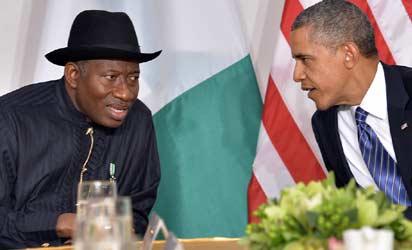
US President Barack Obamar) talks with President Goodluck Jonathan of Nigeria before their bilateral meeting in New York on September 23, 2013 on the sideline of the United Nations General Assembly. AFP Photo
By Vera Samuel Anyagafu & Prisca Sam-Duru
Globally, an estimated one in three women worldwide has been beaten, coerced into sex, or otherwise abused in her lifetime. According to the World Health Organization, at least 35 percent of women worldwide have experienced such violence at the hands of an intimate partner.
Moreover, women and girls with disabilities are two to three times more likely to suffer physical and sexual abuse. According to a E. Brewer, Charge d’Affaires, ad interim, U.S. Embassy to the Federal Republic of Nigeria, “Gender-based violence occurs in Nigeria just as it does in the United States and every other nation. According to the Nigeria Stability and Reconciliation Programme, approximately 80million Nigerian women and girls are victims of this type of violence.
Society as a whole pays a huge price for gender-based violence in the areas of health, justice, economic and international security. According to a recent World Bank report, the estimated costs of such violence run from 1.2 percent to 3.7 percent of GDP—the equivalent to what many governments spend on primary education.
In Nigeria, that would roughly equate to between 1.1 and 3.4 trillion naira. Gender-based violence also fosters the spread of HIV/AIDS by limiting one’s ability to negotiate safe sexual practices and by limiting disclosure of HIV status and access to services due to fear of reprisal.” Ending this global epidemic she posited, “Will require all of us to take action. We must recognize that gender-based violence is, at its root, a manifestation of the relatively low status of women and girls around the world. When women and girls can live free from violence and are afforded equal opportunities in education, healthcare, employment, and political participation, they lift up their families, their communities, and their nations and act as agents of change.”
“Prevention and elimination of gender-based violence require a multi-faceted approach. It will require increased advocacy and partnerships between the international community, governments, multilateral organizations, private sector companies, and grassroots advocates. It will require empowering women and girls to speak up for themselves and educating men and boys to speak up and speak out for their mothers, wives, partners, sisters, and daughters. It will also require adequate legal and judicial frameworks.” She also disclosed that many nations have passed legislation addressing gender-based violence.
Her words, “In March 2013, the Nigerian House of Representatives passed the Violence Against Persons Prohibition bill. The signing of this bill into law would empower all parties to work together on its implementation in order to increase accountability and address impunity.”
Continuing Marie pointed out that to commemorate the International Day for the Elimination of Violence Against Women, and to reaffirm the U.S. commitment to ending human rights abuses around the world, the U.S. Embassy in Abuja and U.S. Consulate General in Lagos this year are organizing a number of activities, including screening films on preventing gender violence, organizing workshops and panel discussions with civil society members and expert panelists, and promoting “Orange Your Neighborhood” activities that create safe spaces for women and girls.
As U.S. Secretary of State John Kerry said recently, “This is a fight that demands action from every single one of us. We have to communicate in a unified way with a single loud voice that there is no place in the civilized world for those who commit gender-based violence,” she concluded.
Disclaimer
Comments expressed here do not reflect the opinions of Vanguard newspapers or any employee thereof.