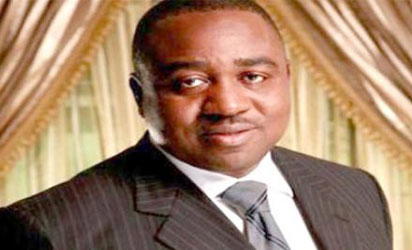
Gov Suswan
BY PETER DURU
Few weeks after successfully resolving its differences with striking primary school teachers which led to the closure of primary schools for about eight months, Benue state is at a crossroads again.
The state government and organized labour are neck deep in a dispute over the decision of the Gabriel Suswam led administration to harmonize the salaries of its workforce in order to ensure some form of equity in the system.
The decision obviously roused the ire of labour which saw no sense in the policy which was intended to ensure that workers in the state were on uniform scale, unlike what obtained in the past where there was over 100 percent disparity between what was paid teachers and core civil servants in the state.
That discrepancy actually sparked the dispute between teachers and the government which led to eight months shutdown of public primary schools in the state; hence the decision of the state government to address the anomaly so as to be able to augment the salaries of teachers.
That policy entailed that the take home pay of political office holders would be slashed by 25 percent while civil servants on grade levels seven and above were made to forfeit between five and seven percent of their salaries.
Before the commencement of the new salary regime, Governor Gabriel Suswam had indicated at the last May Day rally that the state government would take the decision to enable the administration augment its finances in order to pay the then striking primary school teachers.
The Governor had at the time noted that he had an option of downsizing the workforce, “but after weighing the implication of that decision, the best option left to the government and the people is to harmonize salaries.”
“Though the decision might be painful, the new policy would affect only political office holders and high earning officers on grade levels seven and above in the civil service.
“We are today faced with a situation where over 90 percent of all revenues accruable to the state government goes to recurrent expenditure while 100 percent of revenue from the local government goes completely into salaries which is certainly against best practices in governance, but we are helpless.
“I also vividly recall that at the inception of this administration, we unilaterally increased workers salaries, across board, by 40 percent without agitation because we had enough to accommodate the increment.
“After that first increment, we went ahead to affect two more upward reviews of salaries in the state because we could accommodate the adjustments unlike what we have today.” Suswam said.
In a Benue state workers’ salary schedule that was made available to newsmen by the state ministry of finance, it was discovered that between 2006 and 2011 all workers in Benue state enjoyed three successive upward reviews of salaries.
These reviews led to between 240 and 710 percent increments in salaries for all cadre of workers in the state with the least paid worker going home with N18,000 as against N5,000 before the advent of the Suswam led administration.
Same is the situation with the permanent secretaries who, as highest paid civil servants took home N73,458 monthly, before the advent of the present administration, but now earn N436, 784, which amounted to over 585 percent increment.
Hence, it was on the basis of this unsolicited increases in salaries that the state government has also resorted to pleading for understanding on the part of same workers to allow a minimal slash in their salaries to accommodate the harmonization policy.
The plea of the government has ostensibly fallen on deaf ears as labour has remained unwavering in its rejection of the new policy.
In fact, at the end of a joint meeting of the Nigeria Labour Congress, NLC and the Trade Union Congress, TUC, held in Makurdi few days back, organised labour insisted that the government abolish the policy and ensure a refund of all supposed deductions from workers’ salaries.
The 24 hour ultimatum which the state government could not meet, prompted a complete shutdown of government activities and the picketing of commercial banks and major business outlets in the state by the leadership of labour.
Though a reprieve came after five days of the action following interventions from several quarters, and labour temporarily suspended the action to allow for few days of negotiation, with a caveat to resume its action in full swing after a month, if government failed to yield to its demands.
Bothered by labour’s tenacity on the matter, the state government has continued to lament that if the new harmonization policy failed to sail through, it would not be able to meet its commitments to workers let alone carry on with government activities.
The implication of this is that the state government has been caught in a balance and if labour fails to yield to pleas from major stakeholders in the state to sheath its sword and appreciate the government’s position, the state might in the coming days, be in for a long season of strikes.
Reacting to the unfortunate development, the state chairman of the Nigeria Union of Teachers, Comrade Godwin Anya, described the action of labour as unfortunate and regrettable.
“This policy is intended to help the government pay us the minimum wage that other workers in the state started enjoying several months ago, which we did not benefit as teachers.
“I vividly recall that when we were on strike for eight months, the NLC abandoned us to our faith, but now they are rejecting a policy that is intended to address the anomaly, it’s unfair.” Anya added.
On its part, the state chairman of the Conference of Nigerian Political Parties, CNPP, Mr. Baba Agan urged the government to revert the policy, stressing, “though the policy could be in the best interest of the people, but the present economic realities do not warrant any form of salary cut.”
Pundits however believe that the coming days will certainly proof decisive for the state government, but all eyes will obviously be on the leadership of labour, watching if it would stand on the side of the teachers by supporting the harmonization policy or turn a deaf ear to the plea of the teachers and concerned citizens of the state.
Disclaimer
Comments expressed here do not reflect the opinions of Vanguard newspapers or any employee thereof.