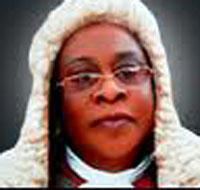
Justice Ayotunde Philips
JUstice Ayotunde Philips on July 26, retired as the Chief Judge of Lagos State, a position she held for two years. In this interview, she speaks on her life as a lawyer, on the bench and what her experiences were as Chief Judge.
She also bares her mind on the corruption in the judiciary and measures that can help curb corruption in the system. Excerpts:
By Abdulwahab Abdulah

Justice Ayotunde Philips
GETTING to the pinnacle of ones career is challenging. What were your feelings when you were sworn-in as the Chief Judge of the Lagos State judiciary two years ago?
I felt very fulfilled, it shows that you don’t have to lobby, you don’t have to make a nuisance of yourself as it were to get to the peak of your career.
If you trust in God and do your work properly and you stay above board, you don’t get involved in scandals in Lagos State, you will definitely get there. Once you get to that point where you are the number two and you are younger than the most senior person, you will definitely succeed the number one person. That’s why I thank the Lagos State Judiciary so much because we have it in place.
You wait for your turn, when your turn comes, you will be the next Chief Judge so far the person ahead of you is not younger than you. If the person ahead of you is younger, then you definitely retire before him or her. But if the person is older than you, definitely you will get there and you would be fulfilled and then you will be able to contribute your quota not only on the bench as a judge, but administratively because you are going to wear three caps.
You are going to wear the political cap because it’s a political office, you are going to wear the administrative cap and then still be a serving judge. I felt good, very fulfilled and I was glad that I was able to contribute in my own little way to the administration of justice in Lagos State in particular and in Nigeria in general.
What were some of the major challenges you encountered as a Chief Judge?
My first challenge was with the union, Judiciary Staff Union of Nigeria, JUSUN. It was then led by Mr. O. Adekanye. Immediately I assumed office, he came into my chambers and reminded me that they were having a problem over payment of N10,000 allowances owed the workers and that if I don’t find a way of paying the allowance, they were going to down tool. That was even before I was sworn-in.
Long list of demands
They came to welcome me with a long list of demands, chief of which was the N10,000. He said I should leave all others things, but that they were warning me that if I didn’t pay that N10,000 they would down tools. That was my first challenge. So, I called one or two of the principal officers then, Mr. Safari now Justice Safari, was the Chief Registrar and we had a discussion.
I called the person in charge of finance asked how much it would take us to pay the N10,000 to all the staff. He calculated it, and it was a tangible sum and I said I have to pay that money to give myself peace. I resolved then that the workers must be paid the N10,000. And within three weeks of my being sworn-in, they started receiving bank alerts. They came to my office to thank me and that was where prayers for me started.
And I don’t think they have stopped praying for me, even now. So, that was my first challenge and since then, I did not have problem with them. The atmosphere is calm, even the strike they are on now, they came to explain to me that they were very sorry, but it was for the betterment of the Judiciary and it was something they had to do, but that it will not disrupt activities marking my retirement.
What were some of the innovations and reforms you introduced into the justice delivery system?
I am sure you’ve heard of the Judicial Information System, it was started by my predecessor. The contract was awarded before I came on board and they had started putting the infrastructure in place, but I just made sure that the whole system was put in place properly and became functional.
Now lawyers can file processes from their offices, but just that you can’t pay yet because there are still issues with the Naira Master Card due to some technicality that only accountants can understand. But at least, lawyers can access the website, upload their documents and then pay at the court cash office.
The libraries are now been upgraded as I speak, the contracts had been awarded. Igbosere has started work, Ikeja is yet to start but the money had been given for them to upgrade. I made sure that all the judges and magistrates were IT compliant.
Judges and magistrates
I love gadgets, my I pad is my fifth child, I carry it around with me everywhere. I read my speeches from my I pad, all the judges and magistrates have Ipads. I also tried to enforce and implement the 2009 Magistrates Court Laws. If you notice, the latest thing we did was that all of them now wear robes.
So, just a few of the things I’ve mentioned we have done to uplift the Lagos State Judiciary to make it better. I had told the governor when he came in last week to commission the Achieves and that the last thing I did to put all our process online so that any time you want to access information on any file in respect of any case, it would be easily accessible.
Why has prison congestion remained a problem despite the efforts of your administration to decongest prisons in Lagos State?
I really don’t know, but I’ve thought about it. In May this year, myself and members of the Judicial Service Commission visited the United Kingdom to talk to our counterparts over there and I really thank God for the trip, it was arranged for us by a company here in Nigeria, it was an eye opener.
In England, they have Sentencing Guidelines. When it was shown to us, it was very voluminous, I’m not exaggerating. Sentencing Guidelines where they have envisaged every single, possible eventuality that can come up in a criminal case and the Guideline says Magistrates and judges when this happen, do this, when that happens, do that. I think we need something like that here and we need real guidelines too.
I tried to work on it but I was so busy doing so many other things and my time was too short, so my successor should be able to handle that. We need to put special guidelines for our magistrates. Of course, the police have their own part of the blame, so do we as judicial officers. There are certain defendants that should not go into prison. With the community service, the probation, all those new innovations that has been introduced by the Criminal Administration of Justice Law in Lagos State 2011, are the things we need to look into now and to ensure that we don’t congest the prisons.
Criminal administration
The people appreciate what I did, but I think there’s something wrong with the system and we need to address that. So, I think Sentencing Guidelines, bail guidelines, full implantation of the new features introduced by the Criminal Administration of Justice Law in Lagos State 2011 and above all training and further training for our judges and magistrates on these issues. if these are done, we should be able to conquer the problem. But right now, we seem to be using the backroom to win the war.
Corruption has been a major problem in Nigeria, as a stakeholder, how do you think the problem can be addressed in the judiciary?
There are two parts of the judiciary, the judicial officers and the support staff. For the judicial officers, just make them comfortable. In Lagos State Judiciary now in my two years tenure, no judge or magistrate was reported to me over allegation of corruption.
There was an instance I must confess and we dealt with the situation and the magistrate was removed from the service when we found out that the complaints were getting too much and some of the allegations were confirmed to be true. But apart from that, I’ve had no problem whatsoever with my judicial staff. In respect of the support staff, there are still one or two bad eggs that we’ve heard reports of. Some of them have been removed for bad behaviour, one or two who were caught with their hands in the cooking jars as they say, have also been separated from the service.
We still have this nagging problem because even just last week, the Code of Conduct Bureau commissioner and director informed me that some people were still taking money from those who want to sign Code of Conduct forms. I’ve asked the Chief Registrar to look into that, because we are yet to identify whether it’s our staff or some touts.
You know we still have problem of touting. Luckily for us, the Judicial Information System, JIS, has removed the issue of signing affidavit and that kind of thing as far as the High Court is concerned. I will not deny that the problem might persist but the best way to tackle it is to tackle it head on and once you catch anybody, you deal with that person accordingly. By the time two, three persons lose their jobs, it will serve as a lesson to others.
But generally, in Nigeria, workers are not very happy with their remunerations. There’s need for total overhaul of the public service salary structure to meet the present day Nigeria.
So, government need to take the welfare of the workers more seriously, once that is done, I’m sure to most people, except you are born greedy or a criminal, you will not need to be corrupt, extort or steal.
If you have good salary, nice place to stay in and of course good transport to and from work, then their will be nothing to further complain of. I think government still needs to look into the welfare of the workers and when that is done, there will be less fraud.
Don’t you think there is need to also examine the appointment of those on the Bench as a way of checking the problem of corruption?
Yes, we need to appoint judges now on merit and when I say merit, it is not just being brilliant alone; you need to have the character and be above board. The Constitution provides that any legal practitioner, who is 10 years at the Bar and above is eligible for appointment as a judge. In 10 years, if you bring a private practitioner or even you’ve been working with the ministry or a corporation or a bank or wherever you may be, you would have acquired your reputation. And if there’s any coma, any black spot in that person’s reputation, you are automatically disqualified from being appointed as a judge.
But you know in Nigeria today, you might want to go by merit and somebody will come to say this is my brother, he wants to be a judge because we want a judge in our family and they just put him there without being tested. And of course, when you get the wrong people on the Bench, you are going to get bad report about that person.
They say one bad apple spoils the whole apples, the judicial appointment is very sensitive, once one is tainted, it will taint everybody. They will say that’s how they are. In order to do this, no bad words must be said about you because once you are bad, then you don’t belong to the class of people who are to adjudicate.
I must add that in the appointment, the National Judicial Council, NJC has put guidelines in place. So, they’ve done their best to make it transparent, but you know the Nigerian factor. But the same governor who is not supposed to be involved in the process will still be the one to approve the appointment and even swear in the appointees.
All the NJC does is to say Chief Judge Lagos, we approved your list then I will send the list to the governor. If the governor does not like somebody on the list, what would we do? We are stuck. He would say I’m not going to swear in number six. So, we still have to look at the process of appointment of judges.
I believe in tradition because that is what separates the legal profession from other professions. And that is why we call it the noble profession. But with politics and politicians here and there, I must confess we are not getting the best people on the bench.
Which among the cases you handled on the Bench do you find most challenging?
I found the Miracle Baby case a bit challenging. I did the Miracle Baby case and it was quite challenging. Then I’ve done some land matters. I’ve done one recently, I delivered the judgment about two, three weeks ago in a case we had about 26 witnesses and we had several legal issues. The judgment runs into about 90 pages, I delivered it about three weeks ago just before the vacation started.
In the land matter, two contending parties all bought land from one family and each one said the land was his. The claimant said the land was his, the defendant too said the land was his. You know land matters are always intricate, a lot of issues had to be considered and I found that very challenging. As I was writing the judgment, you get to understand the issues involved. But for the Miracle Baby case, in particular, I think it was more challenging because of the outside attention.
There was a lot of media attention and I refused to talk to the press, I refused to appear on the television, in fact I drove them away from my court that they should not come into my court. That was challenging, but I was glad that at the end of the day, the person who I found to be the mother of the child was the true mother of the child because you could even see from the facial resemblance.
And the mother still sees me and will come to introduce herself to me. So, those were some challenging cases I handled.
Disclaimer
Comments expressed here do not reflect the opinions of Vanguard newspapers or any employee thereof.