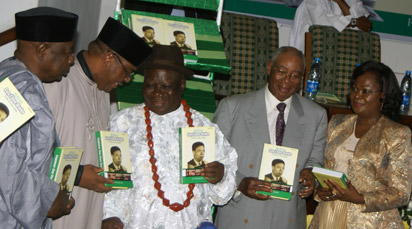
L- R Former Minister of FCT, Alhaji Amza Abdulahi; Minister of Works, Arch. Mike Onolememen; Dr. Edwin Clark, father of the day; the author of the book, Engr. & Mrs Guy Eboe Otobo, during the book launch by Engr. Guy Eboe Otobo in Lagos. Photo by Diran Oshe
BY AMBASSADOR DR. PATRICK DELE COLE (OFR)
By definition the shortest distance between two points is a straight line. Simple. Q.E.D. (Quad erat demostratum). All those definitions were before Nigerians burst on to the scientific or political scene. No Nigerian that I know of believes that the shortest distance between two points is a straight line. Why do I say so? Well, I do not know about many of you but try and employ a bricklayer and I wager you anything you like, he would be unable to draw a straight line! If he plasters your walls it looks like a tsunami up and down, curves – anything but a straight line, despite the most accurate plumbing material ever invented. Why are we like that? We have this penchant for obfuscation; when we want to leave a job, we do not resign or retire, we step aside.
All Nigerian engineers must be driven to distraction by this inherent inability to draw a straight line. When engineers drewthe plans for the autobahn, or expressway or freeways the idea was to drive as quickly as possible from point A to point B. In fact the cars were so designed that speed controls were installed so you could set your car at 65mph and the car would go at that speed without your foot on the accelerator.
Now in Nigeria (and some of you are laughing already) could you imagine your setting your car with speed control? One thing is certain – neither you nor your car would know where you will end up – definitely not on that road.
So our friend Engineer Guy Otobo arrives from McGill University, Canada’s premier university. There are no express roads, no autobahn when he arrives; he is enthused- great challenge. He commissions express roads at first- 8 lanes. Then there are English engineers and road builders, Italians, Germans. French, Israelis, Scandinavians Icelandic etc. let us first look at the English – England is described usually as picturesque because the roads are narrow, winding, likely to be shared with cows and sheep – definitely not for speed control. You all remember the roads in old GRA throughout Nigeria – narrow, winding and full of that great English invention – The Round About!! No mind but the English could have devised a round about – a road going round and round but leading nowhere! And then people wonder why Nigeria is not going anywhere – we cannot, we are stuck in a round about. !!! But our Canadian trained engineer is not to be stopped. He was employed in the Federal Ministry of Works, Highway Division.
Design after design, quotations galore and what do we do – we give some of the roads to Italians, others to the French and yet others to Germans and Israelis. Italians? I beg you. These are the greatest fantasist of the world – Michael Angelo, Leonardo da Vinci, – artists yet unmatched by the beauty of their creations – the sculpture of David, the last super at the Cistern Chapel – people who paint on ceilings. Great artists but they had forgotten that once they were Romans who excelled in road building – The Appian Way and hydro physics- the Aqueducts. But by the early 1970s most Italians like their Nigerian counterparts could not tell a straight line from a cork screw!!
So forget the English and the Italian. How about the Israelis – they have been experts in digging tunnels and crossing the Red Sea without a bridge!! Then the Germans – middle name efficiency, until they came to Nigeria. They employed us who had no idea of the shortest distance between two points; a symbiotic relationship ensued. The German sees a road he thinks ought to be straight; he asks his Nigerian engineer – Onye Hassan Alabi – why is this road not straight? The Nigerian is non plussed and says – “but it is straight”; it may be straight but going at a totally different direction or it may be undulating – no matter what – an amendment is necessary, new drawings, cost overruns etc.
I have always believed that a lot of claims people make as to which schools they went would be unnecessary if we were each asked to name 5 persons who went to school with us. Engineer Guy Otobo’s book clearly shows that he was at Government College Ughelli, and at Mc Gill University by the abundance of names of colleagues. He is very unlikely, though he trained in Montreal, Canada, to say that he went to the University of Chicago in Toronto!
Guy is a guy – descended from a clan who had loved the King’s wife. This led to the deportation of the whole clan. Now I understand all I need to know about Isoko.
Ibadan Expressway – road designed to carry 10 tons, weigh bridge etc. installed: vandalized so that truck of 20 – 25 tons could use the road!!
The civil service he joined, was full of men of character and promise who understood obligations and duty. But the Ministry of Works was a snake pit and many fell into it. Within a few years there were commission of inquires – Justices Adebiyi, Adefarasin, Okuribido – Engineer Otobo was exonerated in all of these inquires.
But in 1986 there came a pharaoh who knew not Joseph. This Minister had it in for Engineer Otobo and accused Engineer Otobo of disloyalty – a cardinal crime to the military.

L- R Former Minister of FCT, Alhaji Amza Abdulahi; Minister of Works, Arch. Mike Onolememen; Dr. Edwin Clark, father of the day; the author of the book, Engr. & Mrs Guy Eboe Otobo, during the book launch by Engr. Guy Eboe Otobo in Lagos. Photo by Diran Oshe
There are ways to get rid of a top civil servant; but the way the Minister went about it was the wrong one. The Minister should report to the President that the civil servant was disloyal and that he could not work with him and he should be transferred; the Minister should make vague references to his holdings and property overseas (not in writing) tell the President that he wasafter his wife/ and or latest girlfriend of the President whom he just sent to Paris for shopping. If ever you are made a Minister please make sure that there is no one else with Mr. President when you report a top civil servant. The Minister reporting the top civil servant must weave into his story that the lady in question is one of high taste, with several Brazilian hair attachments, each not less that N250,000; that she would be staying at George V or Plaza Athenee in Paris a stone’sthrow from the exclusive shops at Rue Honore. The coup de grace of the Minister’s story is that he had just approved a conference for the civil servant in Rome but the true rendezvous would be Monaco where the love birds will spend two days before returning to Nigeria. Eng. Guy on level 17 then had a consolidated salary of £2212. To deck out a beauty of the type suggested will far overrun his annual salary; therefore he must be on the take.
In this scenario, the civil servant is gone. The President would make a perfunctory inquiry to the Head of Service who cannot say yes or no but that he would investigate. Make sure Mr.President calls HOS again in 5 minutes and ask him whether it was not time to shake up the whole service – sacking a few more top officials, Mr. Minister should leave Mr. President’s office with the list of those to be sacked. Make sure all this happens between 12 noon and 2 pm so that the announcement is made at 4 pm Radio Nigeria News. If, as in the case of Mr. Otobo,you give a good civil servant the opportunity, he will bury you in officialese and the Minister has one foot out of the door. This particular Minister should have withdrawn his charges by simply withdrawing the letter and saying that he would give Engineer Otobo another chance.
The eleven charges made against Engineer Otobo further illustrates my point – they were written by another civil servant who obviously knew Engineer Otobo would get off – e.g charge (vii) you usually exhibit signs of disloyalty and lack of commitment on issues where decisions are against your personal interest….. this is pure grist to the civil service mill.
Or
(vi)That in pursuit of your selfish interest you have systematically ruined indigenous construction companies.
Engineer Otobo’s reply is the example par excellence of the civil servant: he talks about his professionalism, team work in the office, management meetings (attached are minutes of the management meetings the procedures within the Ministry, the various levels of these procedures and appropriate minutes), the work of the Ministerial Tenders Board, Promotion Boards, Posting Boards, the Highways division – 5 sub sections progress a co-ordinating section, Highway Budgeting and General specifications Section – it goes on and on. The Minister’s goose is already cooked. Engineer Otobo knew more people in Government as friends than his Minister!!So how could the Minister accuse him of bad mouthing previous administration? The Minister’s accusations were tendentious, (he had favourites) he was high bamteal and had not done his home work well.
Nevertheless Engineer Otobo’s account itself provides small minded people ample opportunity to nit pick. He tells us that on the Apapa Road project the consultant’s figures were N56 million that only 7 of the original 17 contractors finally bided and the bids ranged from N61 million to N93 million. And that the World Bank had a fundamental disagreement with the scope of work – wanting two lanes instead of the proposed 3 lanes presumably if we had gone with the WorldBank they too would have been forced to revise their scope of work. Because of the difficulty of the terrain. In the end the road cost N175 million – the cost he has simply justified by the details given on the soil, topography and materials. For me, what stands out is that this was the first expressway in Africa built to International standard which should make us proud.
This episode between Engineer Otobo and the Minister also showed the strength of the civil service I joined – where civil servants could, with due respect, disagree with the Minister without losing his job. That attitude was due to the extensive knowledge of civil servants who had nothing to fear when you were diligent in your work. You would stand before Kings and not mean men.
There is the 17.3 miles of bridge in Lagos. Another 8.9 bridge between Lagos and shagamu over the Ogun River and expressway to Ibadan – Oyo etc.
The People of the Niger Delta do not begrudge any of these incredible works – I am not including the various arteries to Magodo, Berger etc. But put together they are over 200 miles of roads and bridges which was rightfully put in this project at that time derivation was 1½%! Spare a thought further; please people of the Niger Delta if they claim that a similar gargantuan effort should be made to connect them to the rest of Nigeria!!
The highlights of Engr. Guy Otobo’s life began soon after the Minister tried to remove him. He was promoted Director General (Permanent Secretary) Federal Ministry of works. In that capacity he designed the Federal Housing Policy in 1991 National Housing Policy, attempted to reorganize the Federal Mortgage Bank as the vehicle of choice. That was unfortunate because no Ministry ever wanted the Mortgage Bank to succeed even till today.
A few years later he was named as Director General of Ministry of Petroleum and Mineral Resources,
He proposed that the bonny state of our solid Minerals should be funded by crude oil allocation.
Engr. Otobo was active in the Nigeria Road Federation, International Transportation Research Board
In conclusion
This is an unhappy book for me. It is ultimately a record of how a brilliant competent nationalistic mind could be frustrated by Lilliputians whose stock in trade is denigration, gossip and abject hypocrisy.
The people of my village will do well in Abuja. Most of them have only one and one passion in life, to frustrate everybody: nothing suggested by anyone, no matter how meritorious, mustsucceed. If you want to build a hospital for the sick, someone will find an excuse why this would be unacceptable – including saying that the hospital will bring diseases hitherto unknown in the community, or let everyone contribute to the hospital knowing full well that no one would contribute or a committee be formed or that our ancestors are unhappy, all aimed at only one thing – you would not build that hospital.
Engineer Otobo after 30years of highway construction cannot bring to fruition his idea of a highway monitoring team, a functioning Highway Agency, or even a Highway Maintenance Agency that is not riddled with corruption and nepotism. He advises a Minister on what she should do to make her work succeed and immediately raises her hackles – he at over 70 is about to overshadow her!!
Engineer/Teacher, Scholar, Lecturer, Tennis and Cricket and golf player. Socialite, a born aristocrat who through excellence has learnt humility infused with a burning desire to serve. I salute you Engineer Otobo. To those of us who know you it’s been a great privilege. Your autobiography is a pleasure to read but above all a lesson in service, a beacon of hope, nevertheless tinged with sadness of what could have been.
Disclaimer
Comments expressed here do not reflect the opinions of Vanguard newspapers or any employee thereof.