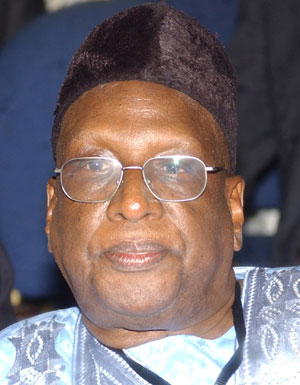
Alhaji Bamanga Tukur, the National Chairman of the Peoples Democratic Party (PDP)
BY LEVINUS NWABUGHIOGU
Pride, they say, goes before a fall. This age long maxim sure does find expression in the eventual exit of Alhaji Bamanga Tukur as the Chairman of the ruling Peoples Democratic Party (PDP) after days of intrigues and horse trading. Saturday Vanguard recalls some of the unfortunate incidents that culminated in Tukur’s shameful departure on Thursday.
Rightly or wrongly, his emergence and departure were both eventful. From March 2012 when he debuted in that exalted capacity to January 16 when he left office, controversy was one word in the literary lexicon that gained so much popularity in his regime. This means that from one end of the country to the other where his party rules, he courted challenges that gave him away. He is Tafida Bamanga Muhammad Tukur, the hitherto Chairman of the ruling Nigeria’s Peoples Democratic Party (PDP) who was forced out of the Office on Thursday, January 16, 2014.

*Alhaji Bamanga Tukur
To many people, Tukur’s eventual fall was long expected while to others, it was still a very big surprise. Those who expected it predicated their guess on the many allegations, hue and cry that made both the person and the office of the man obnoxious just as those who now flash a ray of surprise on their face thought that Tukur’s political sagacity, strategies and diplomacy conspicuously found on the threshold of the presidency and ostensibly tied to the fast- retarding come-back ambition of President Goodluck Jonathan would never fail him. But it has, even in the most disgraceful manner according to some analysts.
Here was a man who bestrode the PDP like a colossus, exuded unusual disciplinary powers, trampling upon serpents and scorpions all in the appeasement of a godly President. Here was a man who boasted, shouted it to the mountain tops that he would only leave his office through the same way he came – National Convention. But unfortunately, the reverse is now the case.
To say the least, Tukur’s exit heralded hate instead of applause
”So he finally left office after everything”, that’s the response that has continued to trail Tukur’s forced resignation.
For a man who has made more enemies than friends; a man who exhibited great pride; a man whose political support from home front in Adamawa State has drastically waned even at 78 years, it passes to say that he has carved a niche for himself. Unfortunately, the niche is such that many analysts won’t bat an eyelid in saying that Tukur’s end, politically, has come.
Indeed, only a chronology of the uneventful events that culminated in his forced exit can help one to understand the scenario.
How he emerged as the PDP National Chairman
Take or leave it, Tukur was not a popular candidate for the office of the Chairman of the ruling party in 2012. Though zoned to the North-East geopolitical zone of the country, he was not the best from the zone. He was only favoured by President Goodluck Jonathan. There were others. But his emergence followed a skewed political process heavily laced with intimidation not ruling out many monetary inducements from powers-that be to most stakeholders who voted.
Also, Tukur’s emergence was facilitated by the belief that he would gag former Vice President Abubakar Atiku who was just learning how to love again after losing to President Jonathan in the PDP primary election in 2011. To Jonathan and the PDP, Atiku needed an old hand to keep him at bay from that axis of the country. And it did work in the person of Tukur. But not too long, that machinery failed and Tukur unmasked his real self.
The Dissolution of Adamawa and Rivers Exco
Tukur chose to court trouble very early in his administration. Consequently, from the very first day of his coming, controversy became a popular word that defined his regime.
Not too long after he assumed office, Tukur opted to assert his authority in his home state. Before anyone could utter “Jack”, Tukur dissolved the state Executive Committee earlier set by Governor Murtala Nyako and swiftly called for a fresh congress. Finally, he succeeded in putting his own Exco. At this juncture, some governors intervened to help save Nyako from public shame, but with all his might and connection, Tukur rebuffed it and stood his ground.
This was even after a presidential committee that was put in place had submitted a report that favoured Nyako. A situation akin to Adamawa also played out in Rivers State. Angered by the developments, a group of governors soon after began to chant the Tukur-must-go song. Soon also complaints of how he was running the party as a one-man show began to filter in.
Another sore point was when Tukur dissolved the Sokoto and Kwara excos without consulting the National Working Committee (NWC) of the party. Then the suspension of Governors Wamakko of Sokoto State and Chibuike Amaechi of Rivers State from the party. He was accused of taking a unilateral decision by playing out a script.
Tukur also dazed the governors when speculation became rife that he had agreed to offer automatic seats to sitting senators without reaching out to the NWC members.
August 31, 2013 Special Convention and the aftermath
No one knew what was in the offing for the PDP at its Special convention on August 31, 2013. Hardly had the function got underway than former Vice President Atiku Abubakar and seven governors of the party broke away and later formed a faction whose chairman was Abubakar Kawu Baraje. Since then, peace has eluded the party. All efforts made at reconciling the parties became unsuccessful moreso, with Tukur talking and acting very tough.
G5 Governors/37 Reps Defection
Tired of Tukur’s double-game and insincerity, the governors except Sule Lamido of Jigawa State and Babangida Aliyu of Niger State defected to the opposition All Progressive Congress (APC) in December, 2013. Following suit were a whopping 37 PDP members of the House of Representatives. With this it became clear to the party authorities that peace had completely taken a flight under Tukur.
G5 vindication
Both President Jonathan and Tukur appeared not to have acted wisely. If they knew the battle would be lost from the beginning, why wait until now when the party has lost so much flesh to APC? This, at least is the question on the lips of most Nigerians who now sympathize with the PDP. But in a way, the exit of Tukur has vindicated the position earlier taken by the Baraje new PDP faction.
To this, one of the lawmakers who defected, Hon. Ogbonna Nwuke representing Etche/Omuma Federal Constituency of Rivers State said the truth has won.
”We were called all kinds of names for insisting that Tukur had all along been the problem of the PDP.
At last, in order to stem the tide of discontent, the PDP has eventually come to the same conclusion that we of the Baraje group reached months ago that Tukur was indeed an ill wind.Tukur was just one of the many viruses that afflicted the PDP. Bedeviled by worsening acts of impunity, hunted by crass abuse of power and hounded by growing attempts by some persons to turn the party into a private estate, the PDP I believe would have so much work to do, not just to re-invent itself but also to recapture the confidence of the Nigerian people.Unfortunately, the PDP has lost it to the APC and this is what the current wave of defections really suggest.
It is difficult to see how the PDP can survive the internal contradictions that are eating it up, how the PDP leadership would get members about to defect or those who have defected for good to return to its fold.I can only see more confusion enveloping the party which prides itself as the biggest party in Africa. The removal of Tukur in my opinion is coming a mite
too late, meaning there are still too many rivers to cross,”he said.
Tukur’s last fight
Tukur’s eventual fall became intensified on January 13, 2014 when he met with President Jonathan for the second time in three days over attempt to force him to resign before the PDP National Executive Council meeting.
He had vowed to stay in office, insisting that only the national convention can remove him from office. But on January 14, the campaign against him gathered momentum with 36 state chairmen of the party and their counterpart in the Federal Capital Territory FCT, rising from a meeting in Abuja passed a vote of no confidence on him.
They also demanded his resignation. The same day, the embattled Tukur agreed to resign. This was after a lot of pressure from embittered members of the party caucus, especially state governors, over the role he played in the crisis plaguing the party. The next day, he resigned. But surprise was later to greet the faces of most party men when Tukur denied his earlier resignation.
But then the die was cast for him. On January 16, Tukur handed his letter of resignation to President Jonathan who while informing party stakeholders opted to offer Tukur an Ambassadorial position
Lastline:
Now, that Tukur has left the party in a most horrible state, what would the fate of President Jonathan, the man whose political future he’s been claiming to protect ? Would the members who have defected return? Does the party have any more future? These questions will for sure agitate the minds of the PDP members as only time will tell what happens in the future of the self- acclaimed biggest political party in Africa.
Disclaimer
Comments expressed here do not reflect the opinions of Vanguard newspapers or any employee thereof.