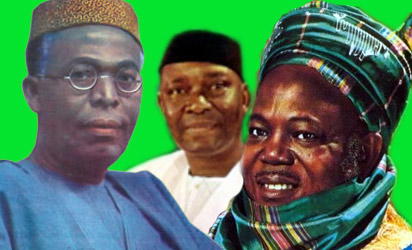
Obafemi Awolowo, Nnamdi Azikiwe and Ahmadu Bello – founding fathers of Nigeria
By Adisa Adeleye
The joy of political freedom is the realization of the fact that free people are their own masters. After independence in 1960, Nigerians assumed responsibilities for their own destiny as a nation endowed by nature with immense human and mineral resources. In size alone, Nigeria is known as the ‘Giant of Africa’.
If politics is, according to its dictionary meaning ‘the art of government’ and politicians are its practitioners, Nigeria has a reasonable degree of exciting experience. Before independence in 1960, Lagos had tasted politics, as being practiced by the Nigerian National Democratic Party (NNDP) and the Nigerian Youth Movement (NYM) of the 1920s and 1930s.
The colorful figures those halcyon days were Herbert Macaulay and Dr. C.C. Adeniyi Jones of NNDP and H.O. Davies, Dr. Azikwe, Dr. Abayomi of the NYM. The politics of the 1940s was dominated by the NNDP which later merged with the new party, National Council of Nigeria and the Cameroons (NCNC) of Herbert Macaulay and Dr. Nnamdi Azikwe.

Obafemi Awolowo, Nnamdi Azikiwe and Ahmadu Bello – founding fathers of Nigeria
The colourful political figures of the 1950s were Dr. Nnamdi Azikwe who became the leader of the NCNC (after the death of Herbert Macaulay), Chief Obafemi Awolowo, and the leader of the Northern Peoples’ Congress (NPC). Both Dr. Azikwe and Chief Awolowo were members of the NYM in the 1930s; but fell apart during the nomination of Ernest Ikoli(an Ijaw) against Akinsanya (Ijebu) for a vacant seat for the Legislative Council. While the Executive dominated by the Yoruba rooted for the Ijaw candidate, others including Dr. Azikwe on principle, supported Akinsanya (late Odemo of Ishara). Ernest Ikoli won the vacant seat. It could be inferred that Lagos politics of the time was without bitterness and tribalism, but based on principle.
The political panorama in the 1950s was less cloudy but little understood by the masses. Sir. Ahmadu Bello, the new entrant into national politics stood clearly for Northern solidarity while Chief Awolowo’s idea of separate development of the West was not hidden. The earlier nebulous concept of “one Nigeria” of Dr. Azikwe later became an illusion when the great ‘Zik’ became the Premier of Eastern Region after a party coup against the incumbent Prof. Eyo Ita, an Efik.
The post – independence political structure failed to support the envisaged economic aspirations of prosperity.
The crash of political experiment in 1966 which was caused by the military coup of that year introduced the men in uniform into the administration of the country, and the inability of the military rulers to solve political problems led to the unnecessary and costly civil war of 1967 to 1970.
If the past military rule destroyed the essence of party-politics, perhaps that would confirm the saying of former President Obasanjo that the Greeks that bestowed democracy on the world did practice it without political parties. According to him, ‘multi-party bickering is definitely a luxury we cannot afford’.
Many analysts have credited the dividends of democracy to the joy of being a clever politician who changes alliance at will to create fortunes and enjoy personal prestige and if possible, to pass the legacy to his family. On the number of terms for future Nigerian Presidents, a former president once proposed a ‘one six year term for the President, noting that once he has been elected into office he cannot present himself for election into office immediately, he can only succeed his successor. This would mean that there would be no need for any incumbent president to seek self perpetuation in office’.
THE ECONOMY;
It is now being observed that though the Civil War (1967-70) was destructive, wasteful and costly, it showed also the resilience of the Nigerian economy. “One of the lessons of the war is that the strength of the Nigerian economy does not depend on crude oil alone as the crucial determinant for growth. The pillars of the economy are the overall natural resources of the country. These include agriculture, livestock, forestry, fishing, water resources, mineral oil, solid minerals, fuel and energy, and the national manpower”.
Today, the economic scene has changed from the confident postures of the 1970s and 1980s; oil has become the mainstay of the Nigerian economy. The black gold (oil) and gas, provide more than 80 per cent of Nigeria’s export earnings and provide more than 80 per cent of the budgets of Federal, State and Local governments. It looks as if dependence on oil is total even with the loud cry of many for diversification of the economy. The increasing oil production in USA and oil funds in many parts of Africa should ring a bell of warning to Nigeria.
It is good news that the economy is stable according to our able and respected Minister of Finance and Minister for Economic Coordination, Dr.(Mrs.) Okonjo – Iweala. The GDP rate of growth is about 6.6 per cent, foreign exchange stability is assured and foreign exchange reserves are rising. Also, inflation is under control at less than 10 per cent and the President’s Economic Transformation Agenda is on stream. Also, the Banking Reforms have brought hope to the banking industry to the extent that the fortunes of the lending banks continue to flow (huge profits) while those of the industrial sector continue to ebb disastrously.
Perhaps the hardworking Minister might be asked, without being impolite, that at what cost has macro-economic stability been achieved? Certainly, there would be murmurings on unreported dislocation of economic activity and ‘a very high rate of unemployment. Inflation has been the mortal fear of the present administration in the adoption of the Central Bank’s tight monetary policy. As noted by past economic planners, ‘a fast growing economy is often subject to strong inflationary pressures, some of which are not bad, and may even be beneficial to the development processes’.
The present government, has at times, increased the prices of some commodities (gasoline, electricity tariffs, etc) to attract foreign investment. However, it is the essential duty of the Central Bank that inflationary pressures do not get out of control and become hyper-inflation.
It should be realized that any policy of macro-economy stability based on very heavy unemployment and low value of the naira (Nigeria being an import dependent nation) could be counter-productive at the moment.
Disclaimer
Comments expressed here do not reflect the opinions of Vanguard newspapers or any employee thereof.