By Chinedu Adonu
ENUGU — For decades, the sprawling farmlands of Nigeria’s South-East lay quiet, a forgotten engine of an era when palm, cocoa, and rubber powered Africa’s fastest-growing economy. Now, that green legacy is waking up in a big way.
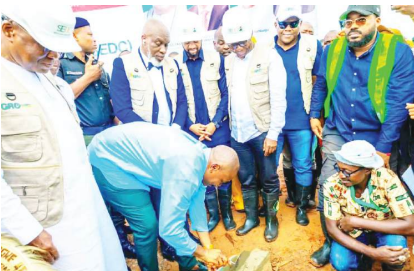
On September 22, 2026, the South-East Development Commission (SEDC) took a historic step toward ending regional food anxiety by driving the first tractors into Nomeh Unateze, Enugu State.
By launching a 200-hectare integrated pilot farm, the SEDC is not just starting a commercial plantation; it is deploying a modern blueprint to cure regional food insecurity and lift thousands of rural youths out of poverty.
This new 200-hectare integrated model farm is far more than a simple patch of crops; it is a structural economic lifeline designed to pull smallholder families into a high-yield, modern farming ecosystem. By linking dairy, fisheries, and automated processing directly to rural farmers, the commission is breathing new life into Dr. Michael Okpara’s historic, self-reliant vision to transform subsistence farming into a commercial powerhouse. Long before oil wealth introduced an era of economic complacency in Nigeria, the defunct Eastern Region was a global agricultural powerhouse. Under the visionary leadership of the late Dr. Michael Okpara in the First Republic, the region didn’t just feed itself—it built its entire economy on palm plantations, rubber, and cocoa.
SEDC’s decision is even more appreciated because the agriculture sector will generate a chain of economic development, jobs, food, food-processing industries, production, and enhanced commercial activities in rural communities. In fact, the rural communities will be the major beneficiaries as the projects will attract development and economic empowerment to them.
The administration of the defunct Eastern Region led by the late Dr. Michael Okpara showed a good example of what agriculture could do in the development of an economy. It invested heavily in palm plantations and produce, rubber, cocoa and other agricultural commodities, which paid good dividends. So SEDC has taken a wise route to pursue the development of the South-East, hoping that it does not derail, but pursue it with sincerity of purpose.
It is noteworthy that the commission said it took time to study the Okpara model before the decision was taken. The commission said it had
studied the development experience of the former Eastern Region under the late Dr. Michael Okpara, which resulted in the region’s remarkable economic transformation. The study led it to develop a programme christened: Vision 2050 and the South East Agricultural Development Programme (SEADP), aimed at positively driving food security, commercial agriculture, and youth empowerment.
With its preparations, including consultations, concluded, the commission procured a large expanse of land in Nomeh Unateze in Nkanu East Local Government Area of Enugu State to pilot a project to be replicated in other states. The commission called this agriculture venture South-East Agro-Development Programme, SEADP; a venture the commission wants to use to showcase how agriculture can be transformed from predominantly small-scale subsistence activity into a commercially viable ecosystem that helps to grow the economy and provide jobs.
Speaking at the groundbreaking ceremony, the Managing Director and Chief Executive Officer of SEDC, Mr. Mark Okoye Jnr, said the Commission deliberately designed the programme as a development intervention rather than simply a farming project.
“The South-East Agro Development Programme is about building productive capacity of the region,” Okoye explained.
According to him, the Nomeh facility will bring together dairy, poultry, fisheries, fodder production, greenhouses, processing, mechanization and practical agricultural training.
The concept, he said, is simple but potentially far-reaching: “the Nomeh facility will bring together dairy, poultry, fisheries, fodder production, greenhouses, processing, mechanization and practical agricultural trainingcessing; farmers should connect to markets; and training should connect young people to employment and enterprise.”
If sustained, the model could address some of the persistent problems confronting agriculture in the region, including poor access to modern technology, fragmented production, limited processing capacity, inadequate market access and the difficulty many young people face in seeing agriculture as a viable business.
Okoye believes the real measure of the project will not be the size of the land or the ceremony that marked its commencement. “The real impact is what happens around the farm and beyond the farm,” he noted.
To him, it could mean a young person acquiring modern dairy skills at Nomeh and establishing a farm elsewhere; a farmer supplying maize or soya beans to a feed mill; or a smallholder farmer increasing production because technical support and a reliable market are available. In that sense, the 200 hectares could become a nucleus around which a much larger agricultural economy develops.
He disclosed that though the Nomeh community provided the land for the pilot project in the state, SEDC believes that the benefit will extend far beyond the host community.
The Commission said that it will introduce an out-grower arrangement through which farmers in surrounding communities can participate in the value chain, receive technical support and connect their produce to markets. This is important because one of the major limitations of many agricultural interventions is their tendency to stop at the project site.
The idea is to avoid a situation where a modern farm produces efficiently, but its wider economic value remains limited if neighbouring farmers cannot connect to it. SEDC’s approach is different: to use the central facility as an anchor and allow surrounding farmers and businesses to plug into the system, the commission explained.
It is hoped that the model would create demand for agricultural inputs, transportation, storage, processing, packaging and other services, and also provide a practical pathway for young people who may not own large parcels of land but can participate through skills, services and enterprise.
The commission said it embarked on wide consultation before choosing Nomeh and charged the people to own and protect the project for the benefit of all.
For the Enugu State Government, the Nomeh project also fits into its broader agricultural development agenda. Governor Peter Mbah, represented at the flag-off ceremony by the Deputy Governor, Ifeanyi Ossai, said the project aligns with the state’s plan to establish modern farm estates across its 260 wards.
Mbah described agriculture as one of the most effective avenues for moving people from poverty towards greater economic prosperity. He said investments in roads, security, healthcare, education and transportation were being made partly to create the environment required for businesses and agricultural investments to thrive.
The Deputy Governor, however, challenged SEDC to think beyond Nomeh.
He advocated a decentralized model in which farmers and the private sector participants in other communities could produce for, supply, and benefit from the central processing ecosystem.
According to him, a farmer in another part of Enugu East Senatorial District, for instance, may not need to relocate to Nomeh. Instead, production could take place closer to the farmer while aggregation, processing and market access are connected to the larger system.
Such an arrangement, he reasoned, could create opportunities in logistics, transportation, agricultural services and mini-processing facilities. It would also prevent the Nomeh investment from becoming an isolated government project.
A Federal Government’s food security agenda
The project is also being presented as part of the broader national effort to strengthen food security. The Minister of Regional Development, Engr. Abubakar Momoh, said the agricultural challenge could no longer be viewed simply as one of producing food.
The country, he said, must produce, process, create markets, reduce post-harvest losses, increase productivity and improve farmers’ incomes.
Nomeh community appreciates SEDC for its choice
The President-General of Nomeh Unateze, Dr. Chukwudi Anyianuka, in his remarks, assured the Commission of the community’s support. He described the project as an investment in the future of the people and promised maximum cooperation from the community.
According to him, a project located on community land cannot survive on government ownership alone. Its long-term success will depend on whether residents see opportunities in it, protect it, and participate in its economic ecosystem. This, he hopes, Nomeh will get from the project and give it adequate protection.
We are reclaiming our legacy” — Voices from the ground
The flag-off ceremony brought together young community members, regional leaders, and organisers who shared their outlook on what this facility means for the South-East
During the official flag-off of the South-East Agro-Development Programme (SEADP) in Nomeh Unateze, the Managing Director and CEO of the SEDC, Mark Okoye, outlined a clear vision for the 200-hectare integrated facility.
He explained that the concept of the integrated facility is to bridge systemic gaps in local farming, stating: “The idea is simple. Production should connect to processing. Training should connect to employment and enterprise. Farmers should connect to markets.”
Okoye explicitly stated that the Nomeh facility is a pilot testing ground, not an isolated project. He emphasized: “Nomeh is our starting point, but it’s not our destination. Our ambition is to establish agricultural interventions across the South-East, working with the five state governments, the communities, the farmers, the development institutions, and the private sector.”
“Our people must not be left behind as the world embraces mechanised, technology-driven, and sustainable farming practices. This programme is a giant step towards transforming how we produce food, empower our farmers, and build a more sustainable agricultural future.
For Patrick Nwabueze Ubru, Enugu State Commissioner for Agriculture: “This project goes beyond establishing a central farm. It’s about creating a replicable system where an out-grower from another village can gain the technical support and data needed to run their small plot at maximum capacity, with a guaranteed market to sell their yield.” Also speaking, SEDC’s Executive Director, Natural Resources, Agriculture and Rural Development, Dr. Clifford Ogbede, said the project also carries historical significance.
He links the initiative to the agricultural and agro-industrial development associated with the old Eastern Region, particularly during the administration of the late Premier, Dr. Michael Okpara.
That history provides more than nostalgia. It offers a reminder that the South East once demonstrated how agriculture could serve as the foundation for regional economic development.
The challenge today is how to adapt that experience to a different economy, one driven by technology, mechanization, modern markets, processing and private-sector participation. Nomeh could therefore become an experiment in whether that transformation is possible.
Beyond the flag-off, the most important day for the Nomeh project will not necessarily be the day the tractors entered the land. It will be the months and years that follow. Will the 200 hectares become a productive agricultural facility or an abandoned project? The future will tell.
If the model works, the 200 hectares could become more than a farm. It could become a demonstration of how land, technology, farmers, young people, processing, markets, and government policy can be brought together to create a new agricultural economy that provides jobs.
Disclaimer
Comments expressed here do not reflect the opinions of Vanguard newspapers or any employee thereof.