By Ishola Balogun
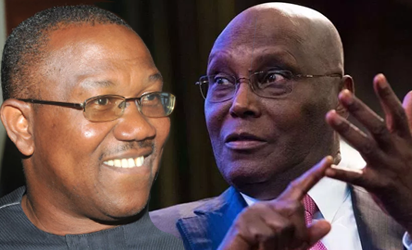
AS Nigeria inches closer to the 2027 presidential election, an early political forecast has placed the incumbent, President Bola Ahmed Tinubu of All Progressive Congress, APC, ahead of his two major potential challengers, former Vice President Atiku Abubakar of the ADC, and Nigeria Democratic Congress, NDC candidate, Peter Obi.
The Political Intelligence Group (PIG) of Politico.ng, Lagos, in its assessment of the country’s current political configuration, projects that Tinubu would win 20 states if the presidential election were held under the prevailing circumstances.
Atiku is projected to win nine states, while Obi is expected to secure eight states, with the Federal Capital Territory also falling into Obi’s column.
But PIG was quick to caution that the projection is a snapshot of the political mood rather than a prediction cast in stone.
The group stressed that Nigeria’s political landscape remained fluid and could change considerably before Nigerians vote in 2027.
“If the election were held today, based on the political realities and alignments currently on the ground, the APC and President Tinubu would have the advantage,” PIG stated in its assessment.
“However, this is a projection of the current situation, not a declaration of the eventual result. A lot can happen between now and 2027.”
Tinubu’s 20-State advantage
The projection gives Tinubu a commanding presence across the South-West, where he is expected to win all six states.
His projected dominance of the region is hardly surprising given his long political history and influence in the South-West, particularly Lagos, where he built much of his political structure before becoming president.
Lagos, according to the forecast, remains firmly in Tinubu’s column.
But perhaps more significant is the projection of Tinubu’s victory in Kano, one of Nigeria’s most populous states and traditionally one of the country’s most important electoral battlegrounds.
A victory in Kano would give the president a substantial northern foothold and potentially strengthen his prospects of building a nationwide electoral coalition.
PIG’s assessment suggests that Tinubu’s political advantage is not restricted to his traditional South-West base.
“Tinubu’s strength, as projected, goes beyond the South-West. His ability to secure states outside his traditional stronghold is an indication of the breadth of the APC’s current political structure,” the group said.
Still, the president’s prospects in 2027 could be heavily influenced by how Nigerians assess his administration.
Economic hardship, inflation, employment, security, infrastructure and the cost of living are expected to feature prominently in the election.
For many voters, the most important question may ultimately be whether their economic circumstances have improved by the time they enter the polling booth.
“The economy remains the biggest variable in this election. If economic conditions improve significantly, it could work in favour of the incumbent. If hardship persists, the opposition will have a powerful campaign issue,” PIG observed.
Atiku’s Northern challenge
For Atiku, the forecast projects nine states, with much of his strength concentrated in Northern Nigeria.
The former vice president is expected to retain significant support in parts of the North-West and North-East, with Kaduna among the states projected to go his way.
Atiku’s long political career, extensive network and experience in presidential contests remain important assets.
He has contested the presidency several times and has maintained a substantial political following across the country.
PIG’s projection suggests that the former vice president’s greatest challenge would be converting his northern strength into a sufficiently broad national coalition.
“Atiku remains a formidable northern political force, but the 2027 contest will require more than regional strength. His ability to make significant inroads into the South will be critical to his prospects,” PIG said.
One issue that could become central to Atiku’s campaign is the cost of living, particularly the price of petrol and transportation.
The former vice president has criticised aspects of the government’s economic policies and advocated measures aimed at addressing the burden of fuel prices on Nigerians.
If transportation costs and household expenses remain high, the issue could provide the opposition with a potent campaign message.
But the fuel subsidy debate could also present difficult questions for any candidate promising cheaper petrol.
Voters may demand to know how such a policy would be financed, whether it would be sustainable and what impact it would have on government revenue and other public services.
Obi’s eight-state base
Peter Obi, according to the PIG projection, would win eight states, with the Federal Capital Territory also projected in his favour.
Edo is among the states expected to fall into the NDC candidate’s column.
The forecast reflects the political base Obi built during the 2023 presidential election, when he emerged as a major force, particularly among younger voters and in several southern states.
Obi’s political appeal has largely centred on calls for improved economic management, accountability, prudent public spending and a more efficient government.
His challenge, however, would be transforming that appeal into a broader geographical coalition capable of delivering a nationwide victory.
“Obi’s support remains significant, particularly among voters demanding political change and a different style of governance. The question is whether that support can be expanded geographically and translated into sufficient state-by-state victories,” PIG stated.
The NDC candidate could also benefit from voter dissatisfaction if economic difficulties persist. But just as with Atiku, the strength of Obi’s candidacy could depend heavily on alliances, party structures and his ability to compete effectively beyond his established areas of strength.
Alliances Could Rewrite the Map
Perhaps the greatest uncertainty surrounding the 2027 election is the possibility of political realignment.
Opposition parties have continued to explore ways of challenging the ruling All Progressives Congress (APC), while discussions around possible alliances, coalitions and a single opposition candidate could dramatically alter the electoral arithmetic.
Defections, the choice of running mates, campaign structures and the emergence of new political movements could also change the current projections.
PIG acknowledged that the numbers could shift considerably as these developments unfold.
“The 2027 election is still sufficiently far away for the political map to change. Alliances, defections, candidates, running mates and the performance of the economy can all alter today’s projection,” the group noted.
Religion, ethnicity and regional identity are also likely to feature in the political calculations, particularly in the selection of presidential and vice-presidential candidates.
However, PIG’s assessment suggests that these traditional factors will compete with increasingly important bread-and-butter issues.
Security, jobs, inflation, food prices, petrol prices and the general standard of living could ultimately prove decisive.
A Snapshot, Not a Verdict
The projected figures — Tinubu 20 states, Atiku nine and Obi eight — add up to 37 states, excluding the Federal Capital Territory, which is projected to Obi.
But the figures should not be mistaken for an election result.
The forecast is based on what the political landscape looks like now and what could happen if Nigerians were called upon to vote under the present circumstances.
PIG therefore emphasised that its assessment is not a substitute for the ballot box.
“Our projection should be understood as a political snapshot. It reflects the balance of forces as they currently exist. It does not mean the election has already been won or lost,” the group said.
That distinction could become increasingly important as the country moves towards 2027.
The political temperature is expected to rise as the major parties begin to consolidate their structures, potential presidential candidates intensify consultations and opposition forces decide whether to contest independently or unite against the APC.
For Tinubu, the immediate task will be to convert incumbency, party structure and his projected regional strength into sustained national support.
For Atiku, the challenge will be to preserve his northern base while expanding beyond it.
For Obi, the task may be even more demanding: turning the momentum of 2023 into a wider national coalition.
For now, however, the PIG political compass points in one direction — towards Tinubu.
The president leads the early state-by-state forecast with 20 states, followed by Atiku with nine and Obi with eight.
But with the 2027 presidential election still ahead, Nigeria’s political map remains very much a work in progress.
Disclaimer
Comments expressed here do not reflect the opinions of Vanguard newspapers or any employee thereof.