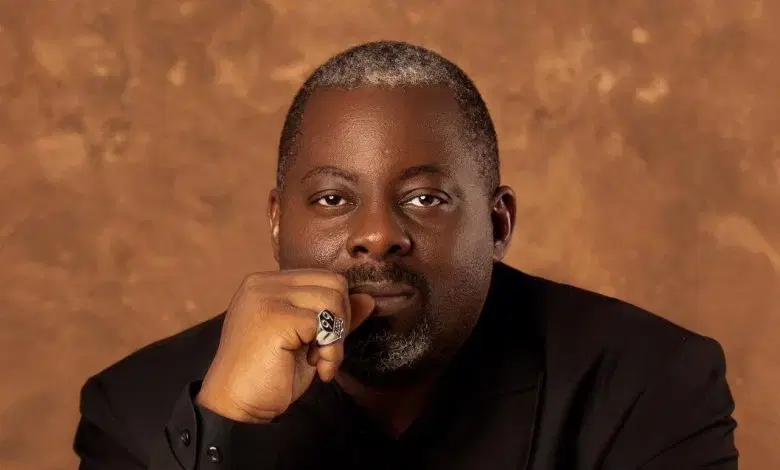
Obi Asika
By Fred Iwenjora
Since his return to Nigeria from the UK where he had most of his education due to his patriotism and sheer love for Nigeria, Obi Asika has played really big in Nigeria’s arts and culture domain, working in arts, films, music, tech and other related fields for over 30 years.
From disrupting then Nigerian music business statusquo by setting up a successfully radical records label and unleashing several crop of new styled artistes, to producing high pitched television shows or creating sports programmes and other matters relating to talent and creativity including his world renowned documentary Journey of the beats considered by many as a blue print for Nigerian afrobeat music culture shown on Showmax, Asika has already etched his name in the league of those whose views matter whenever the matter is arts and culture in Nigeria.
No wonder many believe that his appointment as Director General and Chief Executive Officer of National Council for Arts and Culture NCAC, Nigeria’s leading national cultural institution is a right choice.
Three years on, Asika has been traversing the entire gamut of his mandate spanning the breadth of the culture industries and creative economy — arts, crafts, music, movies, performing arts, animation, comics, literature, publishing, cultural festivals, heritage preservation, cultural diplomacy, and the formal interface between Nigerian culture and the global economy etc “doing the right things so far” according to stakeholders in that sector.
He speaks with FRED IWENJORA on all that’s been happening in Nigeria’s arts and culture and so called creative economic sector since his appointment.
He further discusses achievements so far and the onerous task of overseeing a multifaceted agency like NCAC.
Aside this, Asika also hints on how he is making the most out of his private sector experience in his new public sector position.
Can someone call you the official custodian of Nigerian culture?
(Laughs) I would say this: my role as Director-General of NCAC makes me one of the institutional custodians of Nigerian culture, that is the office I hold. However, I think Nigeria has a thousand or more men and women who are all custodians of our culture so perhaps we can agree that as part of my role I am a spokesperson and representative of that community.
I believe the Minister is the national custodian and all of us are here in supporting roles, but the simple truth is that it’s a privilege and honour to lead the NCAC and to represent my county at this level.
Many believe your appointment into NCAC leadership was the right decision, given your antecedents. Do you feel so?
The first thing is to thank the Hon Minister, Hon Hannatu Musawa who reached out to me and H.E the President of Nigeria, Asiwaju Bola Ahmed Tinubu, GCFR for the appointment and elevation. However, I’ll be honest with you; I don’t spend much time validating my own appointment. What I will say is that when I was appointed, I immediately understood the scope and brief. She was looking for someone who had built things in this industry—someone who had lived inside the creative economy, taken the risks, made the mistakes, and therefore understood at a granular level that creative people in Nigeria need to thrive. Thirty years of that experience, from Storm Records to Storm 360 to the work I had done in arts, culture, sports, television, live entertainment, all of it turned out to be preparation for this moment. Whether the appointment was right is for history to determine.
What I know is that I came here prepared to work and apply my wide experience and knowledge across the sector from years of work in policy and as an entrepreneur but always as an advocate and promoter for Nigerian soft power and the possibilities it presents for Nigeria and indeed the black world.
Plenty must have changed since your appointment?
Absolutely, the energy around Nigeria’s creative economy is extraordinary right now. Globally, people are paying attention to Afrobeats, Nollywood, Nigerian fashion, Nigerian Food. Nigerian literature continues to produce global stars and our fashion designers are also pushing globally. The world has begun to consume what we create across all spheres and in the traditional sectors of visual arts, theatre, and crafts. it would be remiss not to mention our global tribe of digital influencers and content creators who produce viral moments daily.
However, domestically there is still plenty of opportunity to build structure around our creative economy, our creative practitioners are still underserved, with limited access to finance and almost no formal pathways into the industry. We need to ensure that more than ten percent of our creative workforce can access formal capital. My job is to use NCAC’s national mandate across 36 states and the FCT, to advocate for the creators and creatives and ensure they always have a voice in the room. In this regard some of the work we have done in collaboration with the Office of the Hon Minister, on the Copyright Levy, on the IP Framework and the Cultural and Creative Economy policy is complete and moving into the implementation phase.
There must have been major challenges coming from the private sector?
The private sector moves fast. Government moves deliberately, and there are good reasons for that so I had to totally recalibrate my rhythm. In my previous life, if I had an idea on Monday, it could be live by Wednesday. Here, there are processes, stakeholders, constitutional layers, inter-agency considerations. I respect that. But we all came in with a clear mandate from the Minister to drive transformation, and she has backed me to do that. NCAC has 22 locations and while many of our public sector agencies have been underfunded, we are re-tuning these institutions to serve their communities better. My first instinct as a private sector person was: these are assets, not liabilities.
We have redesignated all of them as ICE Hubs—Innovation, Creativity and Entrepreneurship centres. That pivot in thinking – from maintenance burden to productive infrastructure – that is the private sector approach I brought with me. As we hope to bring them live, they will become production centres for creators and training centres for the ecosystem and provide available facilities for the communities we are designed to serve. As we seek to repurpose these facilities, we seek PPP partners to come in and buy into our vision to animate Nigeria’s incredible talent pool.
What is the scope of your work?
People sometimes misunderstand what NCAC is. We are Nigeria’s leading national cultural institution with a mandate that spans the breadth of the cultural industries and creative economy — arts, crafts, music, movies, performing arts, animation, comics, literature, publishing, cultural festivals, heritage preservation, cultural diplomacy, and the formal interface between Nigerian culture and the global economy. All the arts, culture and creative economy commissioners of all the states and FCT sit in a group that NCAC chairs as part of its institutional role.
NCAC manages the national festivals, we lead Nigeria’s representation at international cultural platforms. We recently signed a landmark MoU with the University for the Creative Arts in the UK during the President’s State Visit in March. I co-chair the bilateral creative economy task force for the UK enhanced Trade Partnership (ETIP) with Hon. Florence Eshalomi, MP, who is UK Trade Envoy for Nigeria. We are working with Afreximbank on CANEX WKND 2026, which will be at the National Theatre Lagos in November. The scope is immense—and I mean that not as a complaint but as an indication of the true size of the sector. NCAC is also getting ready to publish sector playbooks for over 15 segments of our sector for operators, investors, DFIs, sub-nationals, FGN, National Assembly and bankers building on stakeholder consultations we have held.
NAFEST was planned last year but nothing happened after all. Why?
NAFEST, the National Festival of Arts and Culture, is our flagship national festival and it matters enormously to us. We were asked by the Presidency to step down the festival in reflection of the mood of the nation due to certain security challenges at that time.
What is important is that the commitment to NAFEST never changed. The decision was about timing, and we remain fully committed to ensuring that the festival serves as a meaningful celebration of our diverse cultural identity. Nafest will return to Enugu in November 2026.
What are the immediate plans of the agency?
Several things are running concurrently. The ICE Hub programme is a priority, retrofitting our buildings into creative economy infrastructure that serves practitioners. We are advancing a national cultural IP monetization agenda because Nigeria is sitting on the world’s most under monetized cultural real estate and we believe the new IP framework provides the core policy and commercial architecture to unlock that national treasure trove. And we are also building an evidentiary base, by doing the stakeholder mapping, research, publishing playbooks, among other initiatives, so that everything we do is grounded in data, not anecdotes. We hope to publish the playbooks in Q3, 2026 and also in this Q launch DIscover Naija our dsp platform for creators and musicians.
Your achievements so far?
I prefer to let the work speak. But I will say this: when I came in, there was no comprehensive data architecture around the Nigerian creative economy at NCAC. We have now delivered two important reports that, for the first time, provide credible measurement and insight into key segments of Nigeria’s creative economy.
The first is the Nigerian Creator Economy Report 2025 in partnership with Communiqué and the second is Nigeria’s Music Market Intelligence Report, Baselines to Billions which was created in partnership with RegalStone Capital. Together these reports establish an important baseline for understanding the scale, contribution and potential of the Nigerian music industry and the emerging Nigerian creator economy.
The reports represent an important shift towards data-driven decision-making, enabling government, investors, and industry stakeholders to better understand, support, and unlock the full value of Nigeria’s creative industries. That data is now shaping policy. We are developing significant projects for digital and physical infrastructure projects on a PPP basis and as they come alive then we can discuss them further and they include hotels and live venues. These are foundations. We are also building critical relationships for Nigeria through NCAC and working with sector leaders to drive forward aligned agendas.
Let’s flash back to your 2022 documentary on Showmax, Journey of the Beats. When will you make another?
Journey of the Beats was a labour of love — and I think it landed because it was honest and it wasn’t produced from a distance. It was made by someone who was inside that story for thirty years. The honest answer is I am living the next documentary right now. Everything happening at NCAC — the diplomacy, the platform building, the conversations I am having across the continent and across the diaspora — this is material. When the time is right, I will tell that story too.
Right now, my focus is on doing the work of shaping the future rather than documenting it. However, we will be recording all we are doing and God willing when the time is right, we will share the story. I think we made a great series, and I urge anyone who is a fan of Nigeria, our music and good stories to catch it on DStv Stream and Africa Magic.
Disclaimer
Comments expressed here do not reflect the opinions of Vanguard newspapers or any employee thereof.