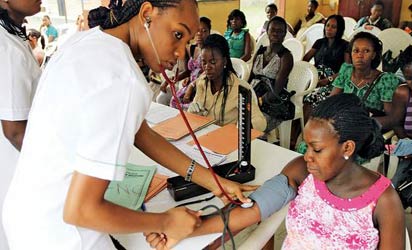
*Some expectant mothers undergoing check-up at a maternity clinic
By Sola Ogundipe
As Nigeria joins the rest of the world at the London Summit on Family Planning, being put together by the UK Government and the Bill & Melinda Gates Foundation with UNFPA and other partners, to mobilize global consensus in support of the contraceptive rights of women, Nigerians back home are still coming to terms with President Goodluck Jonathan’s assent to a family planning legislation in Nigeria.
How many children do you have? How many are you planning to have? If you haven’t thought about family planning, now is probably as a good a time as any to begin to realise there is a world of difference between the number of children you want to have, and the number you need to have.
President Goodluck Jonathan certainly stirred the hornet’s nest last month when he openly declared that Nigerians are having too many children. He pointed accusing fingers at persons he described as unable to properly cater for the needs of their children as those guilty of giving birth too many times and too often. “Uneducated people are having too many children. People should only have as many children as they can afford,” he remarked.
The President’s declaration was that it is high time Nigerians learned to limit the number of children they brought into the world. His call for new policies and legislation on family planning in the country towards controlling number of births was greeted with mixed reactions.
But even as incisive debate trails the President’s commentary on the sensitive issue of procreation, or better, childbirth, the implications of unchecked population increase and fertility rate remain paramount. There is even evidence that unchecked population growth is a major trigger of violence in the country.

*Some expectant mothers undergoing check-up at a maternity clinic
So having planned families is the rule and not the option. Currently, Nigeria is Africa’s most populous country, with an estimated population of 160 million, according to the National Population Commission. Estimates by the United Nations show that the population of Nigeria could grow from 160 million to 400 million by 2050.
For numerous reasons, there are different attitudes towards family planning and contraception or “birth control” as it is better known. Disagreements regularly spark off in different circles as to whether or not the country is appropriately populated.
Although awareness creation about family planning and service delivery began about two and a half decades ago in Nigeria, not much appears to have been achieved by the trend in total fertility rate and contraceptive prevalence rate.
For decades, the challenges of meeting the contraceptive requirements of Nigerian women of reproductive age who do not want to become pregnant but are not using contraception has been primal. For instance, Nigeria’s unmet need for contraception usage or access among women of reproductive age (15-49) is significant.
Today, millions of girls and women, in Nigeria who don’t want to get pregnant do not use any form of modern contraceptive. Women of reproductive age have little or absolutely no access to modern contraceptives, either because there is lack of adequate information, or the services are unavailable. According to experts, unmet need for contraception points to the apparent gap between reproductive intentions and contraceptive behaviour.
The excitement about this data boils down to the fact that it is a veritable tool for identifying and targeting women at high risk of unintended pregnancy. The experts say assessment of the levels and patterns of unmet contraceptive need and to some extent, the demand for contraception, remains of importance to population and health policy makers and programmers for the purpose of defining targets.
With a 20 percent unmet need for family planning services, Nigeria was recently urged to invest in country-specific family planning supplies and programmes. President of the Women Deliver Organisation, Ms. Jill Sheffield, who gave the advice stated specifically that: “Nigeria should invest in family planning supplies and programmes, which would drastically reduce the number of unintended pregnancies, maternal deaths, newborn deaths, and unsafe abortions”.
Sheffield, who spoke in a follow-up interview to the Regional Consultative conference on women’s health that took place in Kampala, Uganda, listed specific areas in which Nigeria and other African countries required more capacity building, skills empowerment, and technical support for improved maternal health. She observed that latest data released by Countdown to 2015, showed that 1 in 23 women in Nigeria will die of complications during pregnancy and childbirth.
Perhaps the most pressing issue about contraception in Nigeria is the question of choice. Choice is often the common denominator in arguments for contraceptive awareness and service provision. The global slogan now is that women should be enabled and empowered to decide, freely and for themselves, whether, when and how many children they have.
Just to give insight into the significance of the essence of choice where matters of contraception are concerned, today, the Government of the United Kingdom in collaboration with the Bill & Melinda Gates Foundation – in partnership with UNFPA, national governments, donors,
civil society and faith-based organisations, including the private sector, research community, and others – are launching a groundbreaking initiative that will bring affordable, lifesaving contraceptives, information, services, and supplies to the doorstep of an additional 120 million women and girls in the world’s poorest countries.
This time, the magic year is 2020, by what time 380 million women and girls of reproductive age in the world’s poorest countries would have voluntary access to modern methods of contraception. By that time, every government of every country on planet Earth, supported by the global community, would have committed to sustaining coverage for the estimated 260 million women currently using modern contraceptives.
Contraceptives are one of the best investments a country can make in its future. That is why, today, it is worrisome that more than 200 million women and girls in developing countries who do not want to get pregnant lack access to contraceptives, information, and services – which, for many, will cost them their lives.
Family planning saves lives, this is proven. Family planning also improves health, strengthens communities, and stimulates economic growth. The message of the London Summit is that the time is now for governments of developing countries, donors, international agencies, the private sector, and civil society to come together to help the world’s poorest women.
Primarily, the London Summit also aims to revitalise global commitments to family planning and access to contraceptives as a cost-effective and transformational development priority; improve the access and distribution of contraceptive supplies and remove and reduce barriers to family planning.
Disclaimer
Comments expressed here do not reflect the opinions of Vanguard newspapers or any employee thereof.