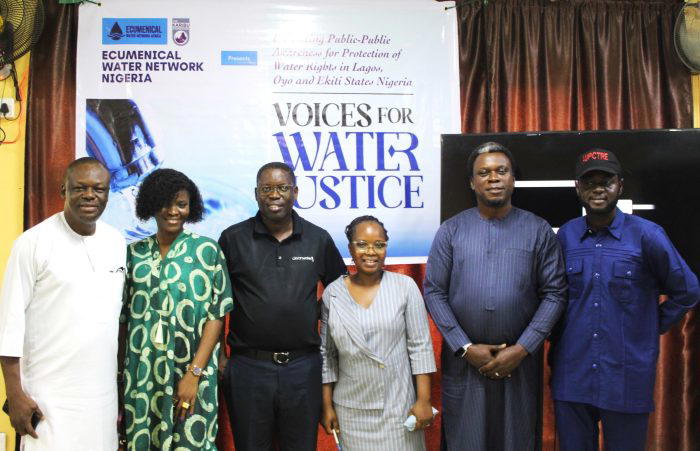
A cross section of civil society and unionists at the event.
By Agbonkhese Oboh
On Thursday, February 12, the Ecumenical Water Network convened a Stakeholders’ Awareness Camp at the premises of the Institute of Church and Society in Ibadan, Oyo State. It had participants from civil society and trade unions from Oyo, Ekiti and Lagos states, under the umbrella of Voices for Water Justice, discussing the need to advance the public-public partnership model to address Nigeria’s water crisis.
Read Also: How water privatisation can work – Hon. Femi Akindele, Ekiti lawmaker
Prompted by concerns over the dire impacts of water privatisation on workers and the general populace, participants emphasised the central role of water in human development. The engagement was aimed at addressing persistent water disparities across communities.
The meeting also focused on advancing policy responses, including the development of a legislative framework expected to undergo scrutiny in Ekiti, Oyo, and Lagos states.
In his address, the host, Very Rev. O. Kolade Fadahunsi, the Ecumenical Water Network, EWN, Coordinator, said the Network, and the partners in Nigeria, started working together in 2015, and has evolved into state level advocacy.
Fadahunsi added that EWN is affiliated to the World Council of Churches, a global body.
Discussions
At the Awareness Camp, discussions highlighted the far-reaching consequences of water unavailability and inaccessibility, particularly in underserved rural communities.
Speakers identified economic hardship, threats to food security, public health concerns, and the heightened vulnerability of women and children as key outcomes of inadequate access to safe and affordable water.
Contributions were made by representatives of labour unions, development agencies, faith-based organizations, civil society groups, and the media.
The stakeholders further advocated collaborative approaches to water governance, calling for public-public partnerships which de-emphasises profit motives and instead advanced shared expertise and resource pooling.
Participants stressed the need to prioritise public interest over profit-driven models and concluded by proposing policy measures aimed at ensuring fair, affordable, safe, and accessible water, while reaffirming a collective commitment to advancing water justice.
Speakers
Also, at the meeting, Philip Jakpor, Executive Director, Renevlyn Development Initiative, RDI, spoke on “Role of Trade Unions in Public-Public Partnership for Water Justice in Nigeria”, while Barr. Aderonke Ige of HELP Initiave for Social Justice, did “Advancing Public-Public Partnership: Water Jusce in Nigeria”.
Ige stressed that privatisation is not the solution to the water crisis. She stressed that policy priorities include increase in public financing, monitoring appropriation, human rights-based legislative reform, people-centered water governance, and community participation.
The next steps, she added, is to formalise public-public collaboration platforms – develop accountability benchmarks, and agree on coordination and follow-up structure.
What PuP means – Jakpor
Jakpor explained that public-public partnerships, PuP, means collaboration between two or more public bodies and a non-profit/labour organisation to improve, manage or deliver public services.
“The PuP prioritises sharing technical skills, shared expertise, and resources to strengthen public sector capacity, with a long-term goal of sustainability,” he noted.
Also, the Executive Director of RDI gave global examples of PuP.
One was the Yokohama Waterworks Bureau, which first started training partnerships in the 1980s to help staff in other Asian countries.
He said “Water PuPs have been growing in number more rapidly the last few years and used as an alternative tool for improvements in public water management.
“In the EU, PUPs are used to coordinate national research policies to create a pan-European research system, also called the European Research Area.”
He gave a lists of what labour unions should do:
*Research and Documentation – Success stories must be identified, compiled and told in a compelling way.
*Public enlightenment – It is a relatively new concept hence there must be enlightenment programmes tailored to understanding it.
*Expose of the ills of privatization – In public documents and public messaging.
*Recruitment of allies to champion PuP – CSOs, faith-based groups, lawmakers.
*Creative engagement of the media – Educating the media on the PUP to elicit in-depth reports.
Disclaimer
Comments expressed here do not reflect the opinions of Vanguard newspapers or any employee thereof.