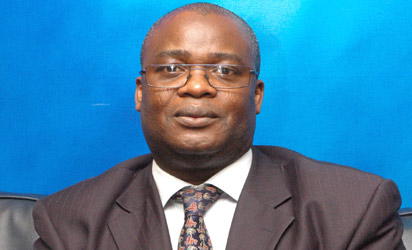
*Adedamola Aminu
By Yemisi Suleiman
Councillor Adedamola Aminu, a Labour Party member in the UK, is the Deputy Cabinet Member for Children and Young People for London Borough of Lambeth. He is also the chairman of British-Nigerian Councillors in the UK and President of Association of Nigerian Academics.
A lecturer, school governor and Trustee of a charitable organisation, he sits on Joint Meeting of the Appointments, Overview and Scrutiny Committees, School Organisation Advisory Board for the London Borough of Lambeth and other outside bodies such as London Councils – Children and Young Peoples Forum, Reserve Forces and Cadets Association for Greater London.
He holds bachelor honour degrees in Business Studies from London Southbank University, Diploma in Marketing from Chartered Institute of Marketing, Masters Degree in Marketing from Greenwich University and Post Graduate Certificate in Education (PGCE cantab).

*Adedamola Aminu
An encounter with him at the Lambeth Town Hall Brixton Hill London reveals his love for politics, love for his country and his passion for education…
So what exactly is your job as councillor?
My job as a councillor is to work with our community, to make sure we provide varied services for them, such as housing, education, fighting crime, roads and to make sure the environment is clean. We also make sure that every thing the people need like roads are provided. I am responsible for the social service and education of children and young persons.
How long have you held the position?
I have been in the position since 2006, and I have been a deputy cabinet member. This is my second year as a cabinet member.
How well would you say you have done or represented your ward, what is your achievement so far?
I think we are so lucky that our borough is one of the most improved in the whole of London and all the local authorities are actually looking up to us, in terms of how we have been able to manage things, how we have done things better, the school result which is the main area I am responsible for, for the past five to six years, education in Lampard has been improving.
In fact, it is above the national average, which means that we are doing something right in the schools. Most of the schools that we have now are adjudged either as good or outstanding by up stead, and that is the body that inspect schools to make sure they are of standard. No school is under special measure in Lambeth. So that means we have made a difference. And we have managed to reduce crime in the borough as well.
We are doing everything to make sure that those people who are vulnerable in our community are given priority.
The ward you represent, are they basically Nigerians?
I think the ward is about 70% white and 30% mixed; African-Caribbean, other nationalities, so it is mixed, but majorities of them are whites.
What are the challenges of the job, being an African, particularly a Nigerian?
The challenge is being someone from the black ethnic minority (BEM), it is always a barrier because some people still see you as a foreigner, so that will always be a challenge. But I think that we have been able to overcome that in our own borough because we are diversified and multicultural. And UK is also a multicultural country as well. So that helps as well.
I don’t think that should be a barrier for people to put themselves forward. If people think like that I won’t be there and also some of my colleagues. Because I represent the Nigerian-British council as their chairman and we have about 37 Nigerian origin councilors at the moment. So if we think like that, that it is a barrier, and none of us put ourselves out, we won’t be there because we represent everybody.
How did you get into politics and how did you become a councilor?
It started when I was actually looking for a secondary school for my son really; that was many years ago, he is now in Chile. I couldn’t find good schools within our borough so I had to send him to another borough where I knew that the school is very good.
I am a lecturer myself so I thought of what I could do to make a difference in the borough where I lived and that was one of the reasons I decided to go into politics. The other reason is that I have been a party member since about 1997 and most of the time when I did attend council or committee meetings, I found out that there are some people in that committee that probably don’t understand what it takes or have good knowledge of the area where they are responsible for and these are people that make decisions that affect everybody’s life.
I mean they set the council tags, how much rent the people pay, the school your children attend, so if we leave people who haven’t got the experience to be responsible for all those things on our behalf, then we are not d
oing ourselves any justice. If you know you have something to contribute, get involved so that you can do something about it, but if you don’t, don’t complain.
What impact would you say this has really had on Nigerians here and generally?
I think that it has helped a lot of Nigerians; personally, in my case anyway, being the chairman of Nigerian- British council, when people have issues, they don’t have to live in Lampard before I can help them. All I need to ask them is which borough do they live in. If I know we have a colleague there I will ask them to ‘go and see councilor so, so, so and tell him you are from me’ and he will attend to that person.
But if it is a borough that we don’t have somebody, I can take up the case myself and just send email to wards in that area and I can say ‘this person lives in your area, this is the problem he has, can you please assist?, and they will do it.
We are all colleagues and I have done it for people outside London. That way, we are able to reach a wider audience, but the problem is that our communities are not coming forward when they have problems at an early stage, so that we can solve them before they go to court, because when they go to court, there is nothing much we can do.
What about the general perception of Nigerians, like they are criminals, they are 419, terrorists, etc. What are you doing to help erase the negative image of Nigeria?
I am involved in many things and, as a lecturer, I reach out to a lot of young people on a daily basis, so I always tell them that, to be honest it is only a tiny minority of Nigerians that are actually involved in criminality. But the problem is that the media are not actually focusing on the good ones.
They focus on those small minority and then they make it bigger, but it is up to us to help in showcasing the good Nigerians among us. We have a lot of people who are in dignified professions, one of my regional directors is a Nigerian, he is doing well, he is an experienced man and we have a lot of doctors, engineers and some other professionals. How many of them do you hear about?
It is only when some thing happens that you hear about them. So it is just our media to actually reach out to good Nigerians who are doing good things to help Nigerians so that people can access them, rather than focusing on the entertainers but there are a lot of people who are actually doing something more useful to our commun
ity that people don’t notice.
Let us go back to your growing up days, what was growing up like for you?
I am from Oyo State, I was born in Nigeria and I grew up there. I did my primary and secondary education in Nigeria. When I was in Nigeria, I actually played for Cocoa Research Institute of Nigeria. I joined Leventis later, on but I didn’t have the opportunity to play with them before I left. I have spent over 25 years in the UK.
How do you take care of yourself when it comes to unwinding and relax?
I love sports as you can see from my background and I watch a lot of programmes on TV like politics show, talk show, and current affairs.
So you don’t go on vacation or holiday?
I do.. I do travel to Nigeria at least once a year, but, actually, in terms of traveling to other places, it depends on whether I have the time or not. As you can see, I am very busy taking time out it is just that my job gives me the opportunity, as a lecturer when there is a holiday I travel.
Is there anything you miss about home; is there anything you miss about Nigeria?
I miss my people. I still have my mother there, I still have my family there, and I have investments back home as well. I hope one day I am able to go back home and settle down.
Do you hope to do politics some day in Nigeria with all the experience you have acquired here?
I will like to get involved because, at the end of the day, it is my country and, with the experience which I have here, I am using it to make a difference here, I see no reason why I shouldn’t use it to make a difference in my country. And like I always say to people that when Nigeria calls I must obey, if they call me to come and serve in that capacity, if it is meant to be I will consider it
What qualities did you say a public office holder should possess?
Good leadership skills, and obviously time management is very important in achieving good leadership skills. To know what is important to do and not to do, they should have the desire to serve as well, they should have a vision of what is good for the people and should also work with the vision of others, you cannot do everything by yourself, so you have to get along with other people to be able to represent people and also they have to be good communicators.
Looking at how the professionals here work, we are looking at how we can transfer the experience and the resources we have here to support the educational system in Nigeria that is the most important thing. The problem we have is that when our education ministers come here, they do not actually engage with the academics.
Who do they engage with?
I don’t know, they just go to the embassy have their usual party and then go back home.
In other words, they don’t do the right thing?
I don’t know who they see here when they come, because if they don’t talk to the Nigerians in Diaspora who are in academics, who would they be talking with?. And then we will continue to try, especially in my case, the area I want to focus on which I am writing a project on is primary and secondary education in Nigeria, to see how we can make it better. I have sent a letter of interest to Oyo State government.
Briefly what do you think is actually wrong with our educational system?
Lack of infrastructure, how can you expect a child to learn in an environment where there is no window, it rains it is all raining on them, that is not good. And in terms of resources, many of them don’t have books, even the teachers don’t have the resources to teach.
How do you teach a child in that environment? Lack of proper management of resources is another thing. Because if you look at the budget of education in Nigeria, it is a lot, but where do they keep all these money, where do they go? No body knows, so things like this is about tracking the investment, and channeling the resources of education to the right places, to actually reach the people it is meant for.
Disclaimer
Comments expressed here do not reflect the opinions of Vanguard newspapers or any employee thereof.