By Oliver Enwonwu
In these photographs from the Calabar Carnival in Nigeria, taken between December 28 and 30, 2024, Mavic Chijioke Okeugo continues his mission to sustain the exploration of African performance cultures as sites where the body can serve as architecture and celebration takes form. Far from the language of reportage, these images assert carnival as a serious aesthetic field, one capable of generating artistic presence, chromatic orchestration, and symbolic density within the flux of street festivity.
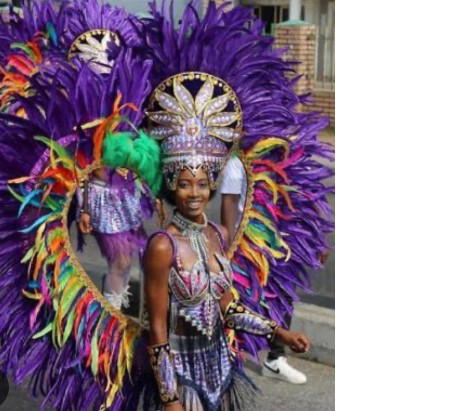
Okeugo’s approach is consistent: he does not chase crowds or the general atmosphere. Instead, he isolates figures at moments when spectacle condenses into visual coherence. The carnival body, in his hands, becomes a spectacle, an event arrested into image. The first two images are dominated by a regal purple palette. In one, a single female performer stands framed by an immense arc of violet feathers, rainbow tipped plumes unfurling around her like a haloed wing. In the other, a group of women wear towering purple and gold headdresses with bodies aligned in a gentle diagonal rhythm.

Purple here is not merely decorative; it functions symbolically as a sovereign color, a hue historically tied to royalty, ceremony, and spiritual elevation. Okeugo allows the color to saturate the frame, binding feathers, fabrics, and skin into a unified field. The effect is one of controlled opulence: excess disciplined into composition.
These images are built around curvature and symmetry. The feathered wings and headdresses form arching motifs that echo crowns and aureoles, transforming the performers into figures of coronation. The bodies are not dwarfed by costume; they are amplified by it. Each woman stands as both bearer and embodiment of ornament. Their faces, smiling, poised and confident reintroducing humanity into the grandeur. Okeugo’s lens captures not anonymity but self-possession. These are not costumes wearing bodies; they are bodies commanding costumes. The photographer resists the temptation to reduce spectacle to surface, instead framing these women as agents of their own radiance. In the group portrait, repetition becomes a formal device. The headdresses rise and fall in rhythm, creating a visual cadence across the frame. Carnival here reads as collective choreography not chaos, but intentional abundance.
The third image shifts tone dramatically. A lone performer stands in the middle of the street, clad in gold, arms outstretched as colossal orange gold wings fan outward on either side. The wings slice through space like architectural planes, transforming the street into a proscenium and the body into a vast kinetic sculpture, the works of Yinka Shonibare come to mind. Okeugo centers the figure, allowing the wings to dominate the horizontal field. Power lines and distant spectators recede into insignificance. The body becomes the image’s gravitational core. This is carnival at its most monumental, movement aspires to monument, and costume is the structure.
The color palette here, fiery oranges and molten golds suggests heat, light, and transfiguration. The performer appears almost solar, a figure radiating outward. The costume does not merely decorate; it redefines scale, making the human body the anchor of something vastly larger than itself.
What is striking is the stillness Okeugo finds within motion. Though the wings imply movement, the moment captured is one that is suspended. Carnival’s velocity is arrested into formal clarity. The image reads less as an action shot and more as a sculptural tableau. The street; a temporary studio, the carnival body, a site of sculptural invention. Okeugo’s shallow depth of field and selective framing extract performers from the noise of context, allowing each figure to stand as a self assuring visual statement while still carrying the weight of public space. This strategy situates the work firmly within fine art photography. The images are not about telling us what Calabar Carnival is; they are about what it can look like when distilled into creative visual essence.
Within the Nigerian context, where Calabar Carnival has become a major site of cultural tourism, performance, and national self imagining, these photographs read as reflections on visibility and power. The performers are not marginal figures; they are protagonists of public space. Their bodies command attention, re-script the street, and momentarily suspend everyday routines.
The dominance of purple and gold across the images evokes not just celebration, but authority and elevation. Carnival becomes a rehearsal of sovereignty; ordinary citizens step into roles of queens, deities, and radiant beings. Okeugo’s images suggest that such performances are not escapist; they are mindful acts of self representation. Importantly, his lens restores dignity within excess. Even in the most flamboyant moments, the figures are composed, centered, and respected. The photographs refuse caricature. They propose carnival bodies as serious aesthetic propositions.

In these Calabar Carnival photographs, Mavic Chijioke Okeugo demonstrates a mature ability to convert spectacle into structure, color into architecture, and performance into monument. He reveals carnival as a space where joy builds its own forms, where bodies become columns, wings become walls, and feathers become crowns. The images stand as visual arguments for carnival’s place within contemporary African fine art: not as peripheral festivity, but as a complex aesthetic system capable of generating images of power, beauty, and symbolic resonance. Ultimately, Okeugo does not merely photograph carnival. He composes with it, finding within its excess the quiet order of form, and within its noise the enduring clarity of image.
Oliver Enwonwu wrote in from Calabar
Disclaimer
Comments expressed here do not reflect the opinions of Vanguard newspapers or any employee thereof.