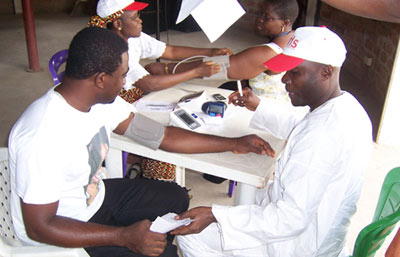
By CHIOMA OBINNA
JULIUS Agbo, a top bank executive was being welcomed home one evening by his wife and children after a hard day at the office. He was in the process of returning their warm welcome when suddenly, he collapsed.
Stella, his wife tried all she could to revive him but there was no response from Julius. Stella was sensible enough to realize her husband was only few minutes away from death.
She raised alarm and with the help of neighbours got him to a nearby hospital. Immediately, doctors started work on him. Julius had a heart attack. Further investigation showed that he had elevated high blood pressure. Even he did not know he was hypertensive. His blood pressure was 300/150. Efforts by the medical personnel to save him proved abortive as he never responded. Within 30 minutes, Julius, a 42 year old man was gone.
Julius is just one out of the eight million Nigerians living with hypertension. He also falls among the 40 per cent of Nigerians who do not know their hypertension status. Experts say if Julius had known his status and monitored his blood pressure, he would be alive today.
In recent times, many notable Nigerians have lost their lives within the twinkle of an eye like Julius. Most recent are the Vice Chancellor of the University of Lagos and former Nigerian Labour Congress President. Both of them died of heart attack last week.

To say hypertension or HPB is become a common place in Nigeria is not far from the truth. This is because the disease condition has assumed an epidemic dimension. Today, HBP affects almost people of all ages in Nigeria. In the past, it is seen as the disease of the elderly between the ages of 60 and above. Sadly, today, many young people in their early 20s are now down with hypertension, a situation experts recommend quick interventions such as regular screening and reduction of diets that predispose an individual to the disease.
Hospital statistics have shown that in Nigeria, hypertension-related admissions account for significant proportion of admissions at hospital emergency departments. Each clinic day, about 150 patients are seen with hypertension related diseases.
According to the World Heart Federation, WHF, Hypertension is the leading cause of CVD worldwide and contributes about 50 per cent of all CVD. Raised blood pressure is estimated to cause 7.5 million deaths, about 12.8 per cent of the total of all annual deaths.
In Nigeria, the prevalence is alarming; between 20 and 25 per cent of the population have hypertension. Statistics available show that high blood pressure is on the rise in Nigeria and affects more of the urban folks than it does their rural counterparts.
Although, the World Health Organization, WHO, report says hypertension affects about eight million Nigerians which is about 10 per cent of the population, other studies have shown that hypertension affects 20 to 25 per cent of Nigerians. WHO attributes hypertension among Nigerians to high consumption of salt and fat, low consumption of fruits and vegetables and lack of physical activity.
Popularly described as a silent killer, HBP is defined as a repeatedly elevated systolic pressure of 140 or higher or a diastolic pressure of 90 or higher. It is measured as two numbers, written one over the other and recorded in millimetres of mercury. Example; 120/78 mm Hg.
The top (higher) number is the systolic pressure – the pressure in the arteries as the heart is contracting and the bottom (lower) number is the diastolic pressure-the pressure in the arteries when the heart is relaxed between beats Statistics available have shown that by 2025, an estimated 1.56 billion adults will be living with hypertension and people with hypertension are more likely to develop complications of diabetes.
Unfortunately, in Nigeria, not many know their status. According to the President of the World Heart Federation, Sydney Smith, only 40 percent population are aware of their status and less than 5 percent are controlled globally.
In the views of the President of the Nigeria Heart Federation, NHF, Dr Kingsley Akinroye, high blood pressure that goes undetected or not properly controlled can lead to heart attack, heart failure, kidney failure, stroke or premature death.
“Because hypertension has few early symptoms, many people are not aware they have it and this is why it is important to get blood pressure checked regularly.”
“Treatment methods, however, have improved over the years, and some of the old fears are unfounded. Many people shy away from taking the medications that could manage their blood pressure because they are concerned about their side effects.”
However, to keep blood pressure in check, a Consultant Cardiologist, at the University Teaching Hospital Ilorin, Dr. Philip Kolo said treatment of HBP actually starts from correct diagnosis and that regular monitoring of blood pressure will prevent complications of hypertension.
“Diagnosis is very simple but if appropriate criteria’s are not followed it makes diagnosis unreliable. So in diagnosing hypertension certain precautions must be taken which include; patients must have measurement at least two times, two weeks apart. Patients must have rested between five to 10 minutes before blood pressure reading is taken.
Appropriate cuff for individual must be used to take the blood pressure and individual must avoid taking coffee, eating in the last one hour before BP is measured. And patients must not talk while measuring the BP. If BP is taken twice in two weeks apart and the result of the blood pressure is equal or greater than 140 /90mmHGg the individual has hypertension.
He said current suggestion is that a 24 hour blood pressure monitoring should be done in a newly diagnosed hypertensive patient. This is not only to determine the patient’s night blood pressure but also to diagnose white coat hypertension which does not require treatment.
Studies have shown that night time blood pressure of a person correlated more with cardiovascular complications than office blood pressure measurement.
“Hypertension actually caused a lot of deaths among Nigerians from it complications in terms of management. Making correct diagnosis to hypertension is essential to treatment. Majority of Nigerians are not aware of their hypertension status. Only very few of them that initiate anti hypertension continue with their drugs. Among those who continue, their control is inadequate. It must be emphasize that there is no cure but can be control using appropriate medications.
“Food supplements such as GNLD, Tianshi products are not substitute
for anti hypertensive drugs. In initiation of drugs for hypertension, the total patients CV risk must be take into account such as present other CV risk factors like Dyslipedmia, and target organ damage.”
Last Thursday, 17th May, this year’s World Hypertension Day, experts say increasing urbanisation, diets high in sugar, salt and cholesterol but low in fruit and vegetables, as well as increasing sedentary lifestyle, have all contributed to increasing the prevalence of systemic hypertension.
In this interview with Chioma Obinna, a Senior Lecturer and Consultant Cardiologist at the Department of Medicine, University of Ilorin/University of Ilorin Teaching Hospital, Dr. Philip Kolo traced increasing prevalence of complicated hypertension to poor hypertension awareness among Nigerians.
Excerpts:
Increase of cardiovascular related diseases Well, if you look at cardiovascular disease globally, in 2011 the
World Health Organisation, WHO, released a data which clearly show that CVD has remained a leading cause of death globally. In 2008, 36 million people actually die from non communicable diseases. Of these deaths, 48 per cent was actually due to CVD, 21 per cent due to cancer and 12 percent due to respiratory diseases while diabetes mellitus accounted for 3 per cent. Over 8 per cent of these deaths actually occur in low and middle income countries like Nigeria. And by projections, 23.6 million deaths from CVD will occur by year 2030.
In Sub Sahara Africa, CVD have reached near epidemic proportion but hypertension still remains the number one cardiovascular disease.
Currently, the three main risks factors identified for CVD mortality are hypertension, tobacco smoking, and dyslipidaemias.
However, in Africa, there are still other very important causes of mortality and these include; rheumatic valvular heart disease, usually due to disease of poverty, overcrowding.
Prevalence in Nigeria
Though, Nigeria doesn’t have a population wide study apart from the ones done in the early 90s by Akinkugbe Eto on non communicable disease which shows that High Blood Presure, HBP, prevalence was about 10 per cent, 8 to 10 per cent in rural areas and 10 to 12 per cent in urban centres.
However, we must recognise the fact that the cut-off of that study was above the current definition of hypertension which is equal or greater than 140/90mmHg of Mercury.
Since then, other reports from different population in Nigeria showing that hypertension ranging from between 20 to 35 per cent. So, hypertension still remains the main factor of CVD in Nigeria.
Why the rise?
The incidence of hypertension has actually increased over the years in Africa including Nigeria. Studies in early 70s showed that hypertension was a rare problem in black Africans but with increasing urbanisation, changing diets which is very high in sugar, salt and also very high in cholesterol but low in fruit and vegetables with increasing sedentary lifestyle have all contributed to increases in the prevalence of systemic hypertension.
Increase in complicated hypertension
The main problem that is making hypertension to be associated with complications is the fact that many people are not even aware about their hypertension status. Some studies in Nigeria have put awareness of hypertension to be less than 60 per cent and of this only few of them are treated. Unfortunately, the control of blood pressure
is less than 30 per cent. That is why in the hospital settings many of our patients when the first present to the tertiary health facilities they have already developed complications of hypertension. For example, a study showed that close to 75 per cent of newly diagnosed hypertension patients at the University of Teaching Hospital already have Left Ventricular Hypertrophy which is a major risk for cardiovascular event such as stroke, heart failure, kidney disease and myocardial infarction, (heart attack).
Factors responsible for poor control of HBP
Major factors responsible for poor control of blood pressure among Nigerians include; lack of education on the dangers of hypertension, poverty, illiteracy, fake drugs and reliance on alternative medication for treatment of HBP such as GNLD and Tianshi drugs amongst others.
In terms of man power development, I will not say that we have not enough completely but the problem is the distribution. It should be recognised that the bulk of patients with hypertension is not actually treated by the cardiologists. Most of these patients first present to general practitioners, private clinics and PHCs.
Is hypertension hereditary?
The children of individuals in systemic hypertension are known to be more at risk of developing hypertension and other CVDs event later in life compare with offspring of those who do not have hypertension.
Low birth weight has been documented to be a risk factor in the development of hypertension. Long time follow up studies have shown that children who are born low birth weight are more likely to develop hypertension later in life compare with children that have normal birth weight
A recent study by me and some of my colleagues and another study at the University Teaching Hospital Lagos among adolescents children of Nigerians showed that the heart of offsprings of hypertensive parents were heavier than heart of off spring of normotensive individuals (people without hypertension).
These echocardiographic findings in the children of hypertensive parents are known to predict future of occurrence of hypertension, therefore, children of hypertensive individuals should be consider as a special group that require early monitoring not only for hypertension but for early markers of hypertension in their hearts.
Disclaimer
Comments expressed here do not reflect the opinions of Vanguard newspapers or any employee thereof.